

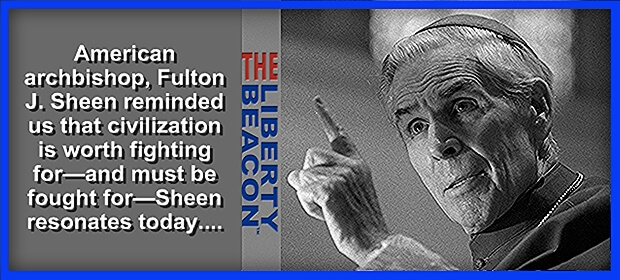
The Once and Future Fulton Sheen
Today, when we are reminded that civilization is worth fighting for—and must be fought for—Sheen resonates….
BREITBART
The British author T.H. White’s classic tales of King Arthur were collected as The Once and Future King, befitting Arthur’s legendary status as a warrior for good. We can say the same of the American archbishop, Fulton J. Sheen (1895-1979). Today, when we are reminded that civilization is worth fighting for—and must be fought for—Sheen resonates.
In the middle of the last century, Sheen was America’s most prominent Catholic cleric. On radio, in his syndicated column, on prime-time TV—he went head-to-head with Milton Berle and Frank Sinatra, garnering 30 million viewers—and in countless sermons and speeches, Sheen was everywhere; in 1956, Gallup rated him as the third-most admired American.
And yet even though Sheen has been gone for nearly half a century, his admirers still remember. As Breitbart News reports, he is about to be formally beatified by the Catholic Church. That is, recognized as blessed, one step away from being canonized, sainted. Miracles in his name will be evaluated by the Vatican’s Dicastery of the Causes of the Saints, and if the verdict is favorable, Sheen will join the company of the saints.
Yet even non-Catholics should find Sheen compelling, because he played such an important role in forming, and strengthening, American resolve during the Cold War. That is, the long twilight struggle, from the 1940s to the 1990s, between the Free World and the stormtroopers of Soviet communism—which Ronald Reagan rightfully called the “evil empire.”
The good guys won that struggle, of course, and yet as Reagan also said, “there are no final victories.”
Indeed, today it seems that we’re on the edge of “Cold War 2,” albeit not against Moscow, but against fifth columnists within. Some of these are operating under the cloak of “democratic socialism,” although nobody should be fooled. In New York City, Mayor Zohran Mamdani is poised to unleash anarchy, and from that chaos, he and his cadres plan on seizing private property, consolidating their “collectivist” power.
In his life, Sheen saw all that happen, and worse. As early as 1936, when Stalin’s agents sought to take over Spain, Sheen published a tutorial that reads in part:
Q: Who was the first one in the history of Christianity to use the tactics of the United Front? [the pro-Soviet political bloc]
A: Judas, by betraying our Lord with a kiss.
That was the essential Sheen: his Christian faith informing calls to action. He was, for sure, a full-spectrum Catholic, endorsing the centrist teachings of that apostle of gradual reform, Leo XIII.
Yet Sheen was more articulate that most; he earned his national podium thanks to his rich voice, strong message, wide vocabulary, and good looks. (He resembled the Hollywood star Tyrone Power.)
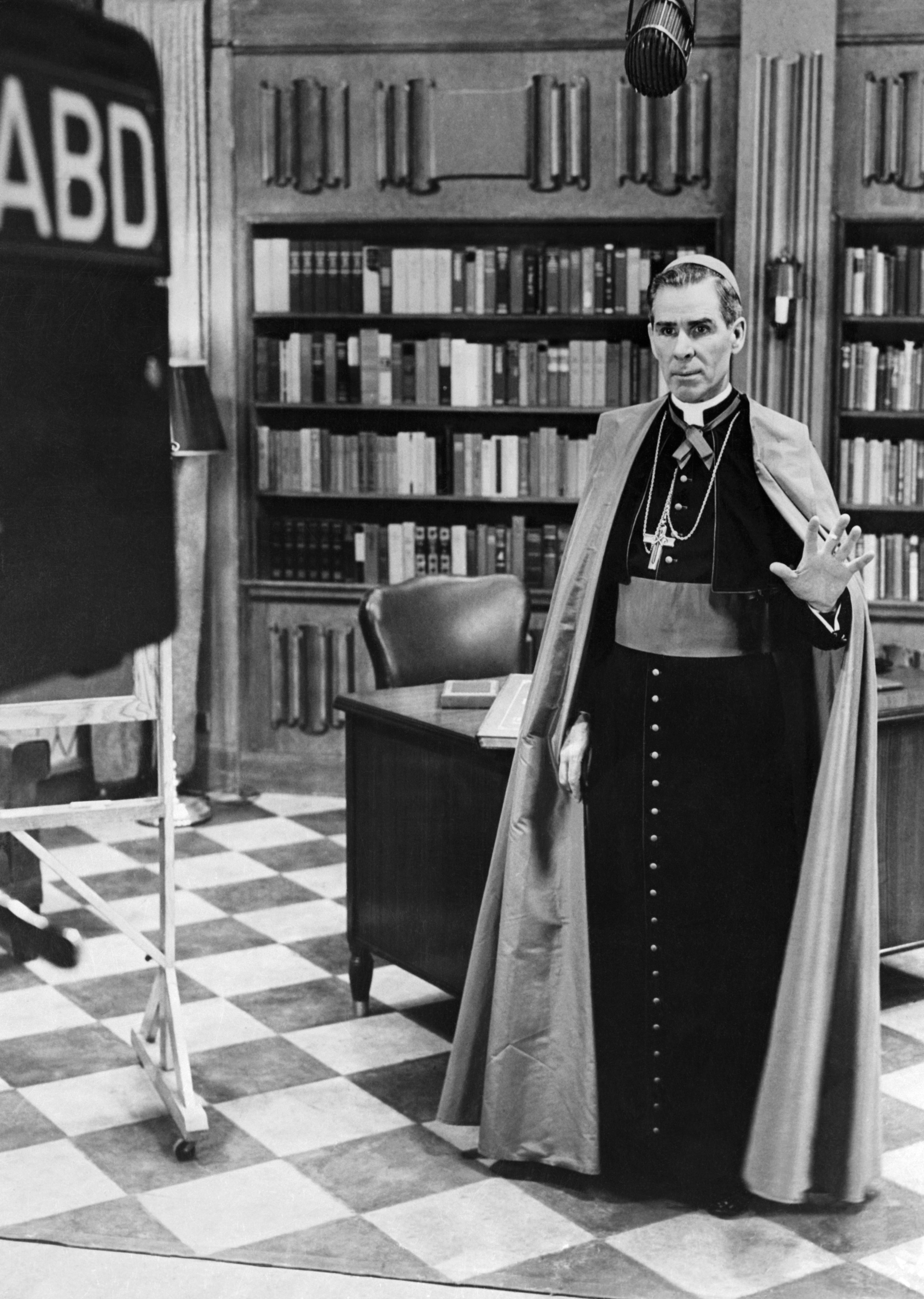
Original photo caption from 1953: Speaking in precise, never stagey tones, Bishop Sheen discusses a variety of subjects. His only prop is a blackboard on which he draws simple diagrams to help the audience grasp more easily the philosophical points he is making. A stage hand who is never seen by the TV audience erases the blackboard. Sheen refers to him as his “angel”. The Bishop is not averse to telling jokes or making a pun but he aims more for thought than laughter. The Bishop’s stage presence is most remarkable for graceful arm gestures and flashing change of facial expression. Never striving for drama, Sheen is, one of the most compellingly dramatic of TV personalities. (Getty Images)
Sheen used his gifts to make vital points. In his 2001 biography, America’s Bishop: The Life and Times of Fulton J. Sheen, Thomas C. Reeves writes:
Frequently outspoken, Sheen stirred controversy with forceful statements on such topics as communism, socialism, the Spanish Civil War, World War II diplomacy, psychiatry, secularism, education, and the Left in general.
Sheen was unafraid to state his arguments in, well, religious terms; he scorned the liberalism of the National Council of Churches. As Sheen put it, “Satan’s last assault was an effort to make religion worldly.” Today, of course, the National Council of Churches has gone from worldly to woke.
For sure, all of Sheen’s talents were needed to confront the greatest crisis of his era. According to the scholarly Black Book of Communism, in the 20th century, red totalitarians killed some 100 million people, and blighting the lives of billions more, from Russia to China, from Cambodia to Cuba.
In Eastern Europe, the Catholic Church was a bulwark against atheistic Bolshevism, and so its priests, and laity, suffered greatly. In Poland, to name just one captive nation, the communist regime executed or imprisoned thousands of believers.
So it’s fitting, even poetic, that beginning in the late 1970s, a Polish pope, John Paul II, and Gdansk dock workers, led by Lech Walesa, were at the forefront of the struggle for freedom, including, of course, freedom of worship. That struggle paid off in 1989; today, Poland prospers.
As a legionary of Christ, Sheen was a heroic soldier in this success, and yet trendy history has sought to blot him out. According to biographer Reeves, “The celebration of religious certainty that characterized Sheen…has no doubt been responsible in part for the bishop’s neglect at the hands of more recent historians and journalists.” Yes, to the secular mind, Sheen’s Catholic views—apolitical on ordinary partisan matters, and yet resolutely anti-communist—simply do not compute.
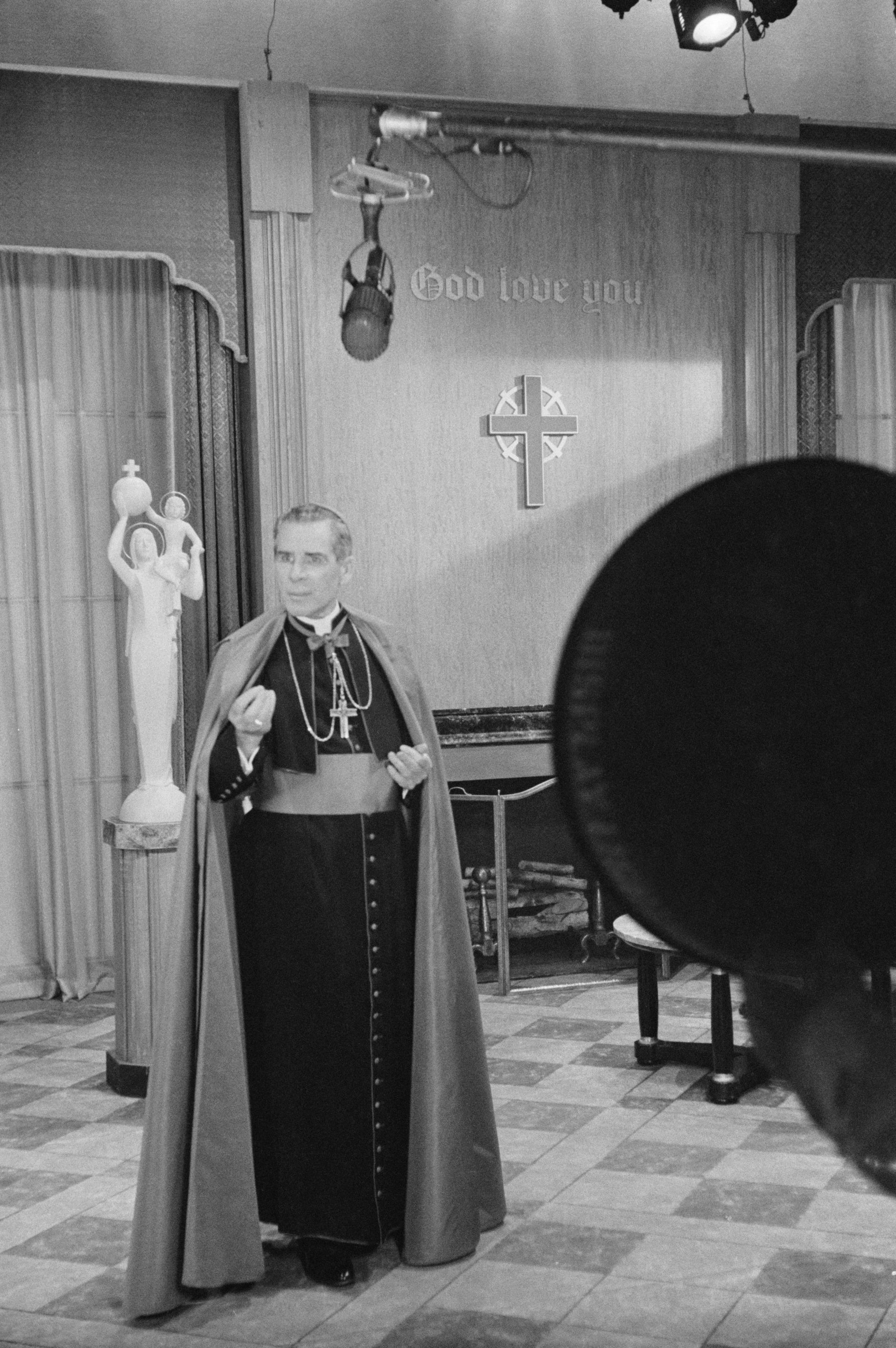
Fulton J. Sheen, Auxiliary Bishop of the Archdiocese of New York, on the set of the television series ‘Life is Worth Living’ in New York City, circa 1955. The series discusses moral issues from a religious perspective. (Photo by Michael Ochs Archives/Getty Images)
Sheen’s ways were definitely not secular. He called the Soviet Union “the most anti-Christ nation on the face of the earth,” observing that the Kremlin’s central shrine was “a rotted corpse, the body of Lenin—a perfect symbol of that to which all communism must lead us all, unto dust, unto dissolution, unto death.”
That’s all true, of course, and in the early 1950s, when the U.S. was hot-war fighting communism in Korea, Sheen was a frequent keynoter at American Legion conventions and other patriotic assemblies.
Yet Reeves nailed it when he wrote, “Sheen’s staunch anti-communism undoubtedly also contributes to his lack of appeal for many modern intellectuals.”
You see, over the last few decades, the liberal chattering class has embraced a newer idea, anti-anti-communism. That is, it wasn’t the communists who were bad—they were just liberals in a hurry. In the progressive version of events, the anti-communists were the nogoodniks.
By contrast, Sheen always told the truth: communism was a “diabolical system.” And yet Sheen’s powers of perception transcended the fury of the moment. At a 1949 rally—with the vice president of the United States, as well as the mayor and the archbishop of New York City in the audience—Sheen declared that Marxism “is not the promise of a new era. It is the dying gasp of an old age. It is made up of all the cheap agnostic, atheistic philosophies of the 18th and 19th centuries.”
We can see: Sheen anticipated the optimism of John Paul, Reagan, and Walesa—communism, Moscow-style, could be overcome.
Yet now, in the 21st century, even as the blessed memory of Sheen awaits his rendezvous with the Dicastery, the dread of communism should inspire us to pray for new Sheens, as well as other anti-communist avatars—of the cloth, in uniform, in the media, wherever they are needed.
To be sure, communism is a little bit different today….
CONTINUE READING ARTICLE…
Header featured image (edited) credit: Org. post content. Emphasis added by (TLB) editors
••••

••••
Stay tuned…

••••
The Liberty Beacon Project is now expanding at a near exponential rate, and for this we are grateful and excited! But we must also be practical. For 7 years we have not asked for any donations, and have built this project with our own funds as we grew. We are now experiencing ever increasing growing pains due to the large number of websites and projects we represent. So we have just installed donation buttons on our websites and ask that you consider this when you visit them. Nothing is too small. We thank you for all your support and your considerations … (TLB)
••••
Comment Policy: As a privately owned web site, we reserve the right to remove comments that contain spam, advertising, vulgarity, threats of violence, racism, or personal/abusive attacks on other users. This also applies to trolling, the use of more than one alias, or just intentional mischief. Enforcement of this policy is at the discretion of this websites administrators. Repeat offenders may be blocked or permanently banned without prior warning.
••••
Disclaimer: TLB websites contain copyrighted material the use of which has not always been specifically authorized by the copyright owner. We are making such material available to our readers under the provisions of “fair use” in an effort to advance a better understanding of political, health, economic and social issues. The material on this site is distributed without profit to those who have expressed a prior interest in receiving it for research and educational purposes. If you wish to use copyrighted material for purposes other than “fair use” you must request permission from the copyright owner.
••••
Disclaimer: The information and opinions shared are for informational purposes only including, but not limited to, text, graphics, images and other material are not intended as medical advice or instruction. Nothing mentioned is intended to be a substitute for professional medical advice, diagnosis or treatment.
Leave a Reply