

.
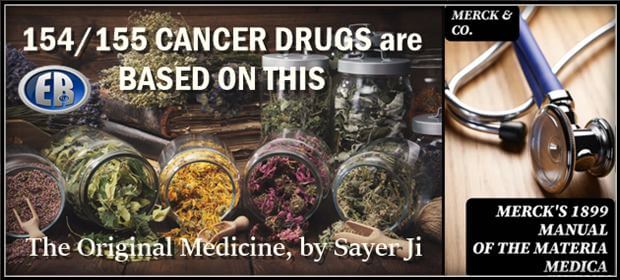
ER Editor: Nature works best, which is why 154 of 155 cancer drugs have been derived from plants. But they hid it from us. And they also hid this —
🔺THEY KNEW ABOUT FREQUENCY HEALING IN 1928. THEY BURIED IT FOR 98 YEARS.
Georges Lakhovsky was a Russian-French engineer who built a device called the Multi-Wave Oscillator in 1928. His theory was simple: every cell in the human body is a miniature oscillating circuit. When… pic.twitter.com/eiIWvjgPEp
— Diana PATRIOTS ARE UNITED❤️🇺🇸❤️🙏 (@DianaT192) April 4, 2026
Disclaimer: The Liberty Beacon and Europe Reloaded are in no way affiliated with GreenMedInfo. We have left in their advertising below because it simply might be useful for readers.
********
They Called It “Alternative.” It Was Always the Original.
SAYER JI
From the 1899 Merck Manual to a 1932 pharmacist’s map, the historical record is unambiguous: natural medicine was displaced not because it failed, but because it couldn’t be owned.

Let’s begin with a question that should unsettle anyone who has ever been told that natural medicine is “alternative”: alternative to what, exactly?
Not to the medicine of 1899. Not to the medicine of 1932. Not, in fact, to any era of medicine prior to the mid-twentieth century, when a legal and commercial infrastructure was deliberately built to ensure that the only substances recognized as “drugs” would be those that could be patented, manufactured at scale, and sold for profit.
Before that infrastructure existed, the original medicine was plant medicine (ER: In western culture, perhaps). And the documentation proving it is hiding in plain sight.

THE 1899 MERCK MANUAL: WHERE IT ALL BEGAN
The Merck Manual is the oldest continuously published English-language medical textbook and, by most measures, the best-selling medical textbook in the world. Its first edition, published in New York in 1899 by George Merck — founder of what would become a $43 billion pharmaceutical empire — was not a catalog of synthetic drugs. It was a compendium of natural ones.

The manual drew from the Materia Medica tradition: the full body of accumulated knowledge about the therapeutic properties of substances used for healing. In 1899, that tradition was still largely intact. The remedies it recommended included arnica, papain, cod liver oil, valerian, camphor, myrrh, and beef tea. It recommended dried ovaries of cow for hormonal conditions. It recommended papaya enzyme for digestion. And it recommended Cannabis Indica, extensively, for a striking range of conditions.

Cannabis Indica as listed in the 1899 Merck Manual (partial):
– Hematuria (blood in urine)
– Bright’s Disease (kidney inflammation)
– Chronic Bronchitis
– Cholera Asiatica
– Climacteric Disorders
– Coughs
– Delirium Tremens
– Nocturnal delirium in softening of the brain
– Paralysis of the bladder from spinal disease
– Corns
…and 52 additional indications
Cannabis appears 62 times in the 1899 Merck Manual. Not as a curiosity. As medicine. Prescribed by physicians, dispensed by pharmacists, accepted as standard of care.
The manual promised physicians a “complete Ready-Reference Book covering the entire eligible Materia Medica” — and that Materia Medica was overwhelmingly natural. It would not be until 1906, with the Pure Food and Drug Act, that the regulatory scaffolding for pharmaceutical medicine would begin to be erected. In 1899, the age of the patent drug had not yet arrived. And medicine looked entirely different.
Amazingly, you can access the entire manual here for free on Gutenberg press.
THE 1932 PHARMACIST’S MAP: THE LAST DOCUMENT OF A WORLD BEFORE THE TAKEOVER

Get a full resolution view of this remarkable map here.
For three more decades after the 1899 manual, natural medicine held its ground. Then, in 1932, the American pharmacy profession published something extraordinary: a large-format map of the medicinal plants in common use by pharmacists and the public. Cannabis. Lobelia. Goldenseal. Cascara. Echinacea. Dozens of botanicals, mapped geographically, distributed publicly, under the heading “The Service of Pharmacy.”
“Few people realize the extent to which plants and minerals enter into the practice of pharmacy, and how vital they are to the maintenance of the public health. It has been stated that upwards of 70 percent of all medicines employed are plant products.”
— From the 1932 Pharmacist’s Map, ‘The Service of Pharmacy’
Seventy percent. At the threshold of the synthetic drug era, the pharmacy profession was still formally and publicly affirming that the majority of medicine came from the earth. This was not a fringe position. This was the mainstream consensus, printed and distributed as a public education document.
And then, within a generation, it was gone.
WHAT ACTUALLY HAPPENED — AND WHY
The displacement of natural medicine from the center of healthcare was not the result of scientific failure. It was the result of a structural transformation in how medicine was regulated, funded, and rewarded.
The logic is simple, and its consequences have been enormous: a patent gives its holder the exclusive right to profit from an invention for twenty years. A natural substance — a plant, a mineral, a food compound — cannot, by definition, be patented in its natural form. Therefore, no pharmaceutical company can recoup the billion-dollar investment required to run clinical trials on something any farmer could grow. Therefore, those trials are never funded. Therefore, the evidence base that regulators require for official recognition never accumulates — not because the substance doesn’t work, but because the system was built to ensure it would never be proven to work within the terms the system accepts.
This is regulatory capture operating at civilizational scale. And the 1899 Merck Manual and the 1932 pharmacist’s map are the receipts.
Key data:
- 63% of all drugs approved since 1981 were derived from or inspired by natural products
- Cannabis Indica listed as medicine 62 times in the 1899 Merck Manual
- 154 of 155 anti-cancer drugs developed since the 1940s have natural product origins
Consider that last number carefully: of the 155 anti-cancer drugs developed since the 1940s, only one had absolutely no relationship to a natural chemical compound. The pharmaceutical industry did not abandon nature. It learned to extract nature’s intelligence, modify it enough to patent, and then systematically delegitimize the original.
CANNABIS: THE MOST VIVID CASE STUDY

No single plant illustrates the trajectory more starkly than cannabis. Listed without controversy in the 1899 Merck Manual across 62 indications. Mapped without controversy as a standard pharmacist’s remedy in 1932. Then, within five years of that map’s publication, the Marihuana Tax Act of 1937 began its criminalization. Hundreds of thousands of Americans would eventually be incarcerated simply for possessing a plant that was, within the lifetime of their grandparents, on the pharmacist’s shelf.
The science did not change. The plant did not change. The politics and economics changed — and the law followed.
In fact, there has been an extraordinary accumulation of peer-reviewed research on cannabis and the therapeutic role of cannabinoids in human health, as evidenced by the 1,229 studies on our database alone. Dive deeper into that evidentiary body here.

THE EVIDENCE NEVER STOPPED ACCUMULATING
Here is what the “natural medicine is alternative” narrative most needs you to forget: the research base supporting natural healing is vast, active, and growing. It was not abandoned. It was not disproven. It was simply defunded at the clinical trial level while accumulating quietly in the peer-reviewed literature for decades.
The GreenMedInfo database now indexes over 1,700 natural substances with documented therapeutic properties, across more than 3,000 health conditions — all drawn from the published, peer-reviewed scientific literature. The problem is not a lack of evidence. The problem is a system designed to ensure that evidence cannot be converted into official recognition without a patent attached to it.
As early as the turn of the twentieth century, Merck himself understood that natural medicine was the foundation. What his successors built on top of that foundation — and what they spent a century trying to bury beneath it — is the story of modern medicine.
Natural medicine is not alternative. It is original. The 1899 Merck Manual knew it. The 1932 pharmacist’s map knew it. The peer-reviewed literature knows it. The only entity that has ever insisted otherwise is the one with a financial interest in you not knowing.
The Research Doesn’t Stop Here
What you’ve read in this piece represents a single thread pulled from a tapestry twenty years in the making.
GreenMedInfo.com was built on a simple conviction: that the peer-reviewed literature contains answers that the mainstream medical system has no financial incentive to amplify. Over two decades, we have indexed thousands of studies on hundreds of natural compounds — building what is now the world’s largest open-access natural health database, used by physicians, researchers, and sovereign individuals in every corner of the world.
View all that membership makes possible.

When you join the GreenMedInfo community, you gain full access to the database — searchable by disease, substance, pharmacological action, and study type. You gain the ability to pull the actual research, not a summary of a summary filtered through an institution with a financial stake in the outcome. You gain something rarer than any supplement on the market: the unmediated truth of what the science actually says.
We built this for you. Not for pharmaceutical advertisers. Not for institutional approval. For the person who suspects that nature got here first — and wants the evidence to prove it.
Published to The Liberty Beacon from EuropeReloaded.com


••••
The Liberty Beacon Project is now expanding at a near exponential rate, and for this we are grateful and excited! But we must also be practical. For 7 years we have not asked for any donations, and have built this project with our own funds as we grew. We are now experiencing ever increasing growing pains due to the large number of websites and projects we represent. So we have just installed donation buttons on our websites and ask that you consider this when you visit them. Nothing is too small. We thank you for all your support and your considerations … (TLB)
••••
Comment Policy: As a privately owned web site, we reserve the right to remove comments that contain spam, advertising, vulgarity, threats of violence, racism, or personal/abusive attacks on other users. This also applies to trolling, the use of more than one alias, or just intentional mischief. Enforcement of this policy is at the discretion of this websites administrators. Repeat offenders may be blocked or permanently banned without prior warning.
••••
Disclaimer: TLB websites contain copyrighted material the use of which has not always been specifically authorized by the copyright owner. We are making such material available to our readers under the provisions of “fair use” in an effort to advance a better understanding of political, health, economic and social issues. The material on this site is distributed without profit to those who have expressed a prior interest in receiving it for research and educational purposes. If you wish to use copyrighted material for purposes other than “fair use” you must request permission from the copyright owner.
••••
Disclaimer: The information and opinions shared are for informational purposes only including, but not limited to, text, graphics, images and other material are not intended as medical advice or instruction. Nothing mentioned is intended to be a substitute for professional medical advice, diagnosis or treatment.

Leave a Reply