

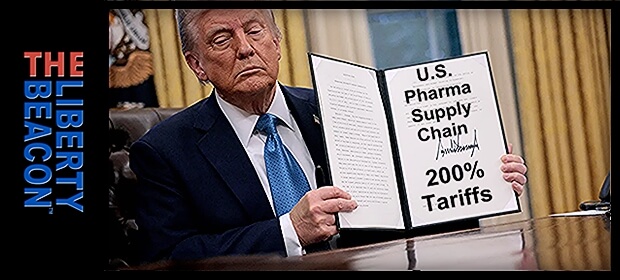
Charting The U.S. Pharma Supply Chain As Trump Threatens 200% Tariffs
The U.S. pharmaceutical supply chain could undergo a massive shift
(Tyler Durden Reports) – President Trump’s proposed 200% tariff on the pharmaceutical industry would not take effect immediately, instead allowing for a 1 to 1.5-year grace period. Over time, the U.S. pharmaceutical supply chain could undergo a massive shift, becoming less reliant on foreign-made drugs and medical supplies. The Trump administration currently views this dependency as a national security threat.
One week ago, the president warned that long-awaited industry-wide tariffs would be announced “very soon” after a 232 investigation was launched in April. Even with a grace period, the delay will force a complete reconfiguration of overseas supply chains for domestic ones, which could have a significant impact on profit margins for ‘Big Pharma’ and even affect drug prices.
“A 200% tariff would inflate production costs, compress profit margins, and risk supply chain disruptions, leading to drug shortages and higher prices for U.S. consumers,” Barclays analysts wrote last week.
UBS analysts warned that the Trump administration’s 12- to 18-month tariff grace period is “insufficient,” arguing that reshoring efforts would require a lot more time.
“We would usually think of 4 to 5 years as the timeline to move commercial-scale manufacturing to a new site,” the analysts wrote.
According to the industry trade group Pharmaceutical Research and Manufacturers of America, even a 25% tariff on pharmaceutical imports could drive up U.S. drug prices by $51 billion annually, raising prices by as much as 12.9% if costs are passed on. The group slammed Trump’s proposal as “counterproductive” to health outcomes. Yet, as we’ve come to understand, these tariffs are merely economic tools to secure better trade deals or, in this case, to force corporations to reshore production.
To visualize the U.S.’ heavily dependent medical supply chain on overseas trading partners, research firm BryceTech released an in-depth graphic on Tuesday, highlighting the industry’s deep overseas dependencies. The graphic suggests that significant domestic investment will be required—echoing UBS’s view that a 12- to 18-month grace period is insufficient to reshore production at scale.

The illustration reinforces UBS’s warning that a 12- to 18-month grace period is far too short to reshore production at scale, signaling the need for increased time. A larger takeaway is that these supply chains need to be reshored as the world fractures into a bipolar state, and definitely before the 2030s.
_________
MORE MEDICAL
Cambridge Researchers Find Gut Bacteria Could Help Remove ‘Forever Chemicals’ From Body
Cancer Patients Recover By Taking Repurposed Anti-Parasitic Drugs
__________
Header featured image (edited) credit: Getty Images. Emphasis added by (TLB)
••••

••••
Stay tuned…

••••
The Liberty Beacon Project is now expanding at a near exponential rate, and for this we are grateful and excited! But we must also be practical. For 7 years we have not asked for any donations, and have built this project with our own funds as we grew. We are now experiencing ever increasing growing pains due to the large number of websites and projects we represent. So we have just installed donation buttons on our websites and ask that you consider this when you visit them. Nothing is too small. We thank you for all your support and your considerations … (TLB)
••••
Comment Policy: As a privately owned web site, we reserve the right to remove comments that contain spam, advertising, vulgarity, threats of violence, racism, or personal/abusive attacks on other users. This also applies to trolling, the use of more than one alias, or just intentional mischief. Enforcement of this policy is at the discretion of this websites administrators. Repeat offenders may be blocked or permanently banned without prior warning.
••••
Disclaimer: TLB websites contain copyrighted material the use of which has not always been specifically authorized by the copyright owner. We are making such material available to our readers under the provisions of “fair use” in an effort to advance a better understanding of political, health, economic and social issues. The material on this site is distributed without profit to those who have expressed a prior interest in receiving it for research and educational purposes. If you wish to use copyrighted material for purposes other than “fair use” you must request permission from the copyright owner.
••••
Disclaimer: The information and opinions shared are for informational purposes only including, but not limited to, text, graphics, images and other material are not intended as medical advice or instruction. Nothing mentioned is intended to be a substitute for professional medical advice, diagnosis or treatment.


Leave a Reply