

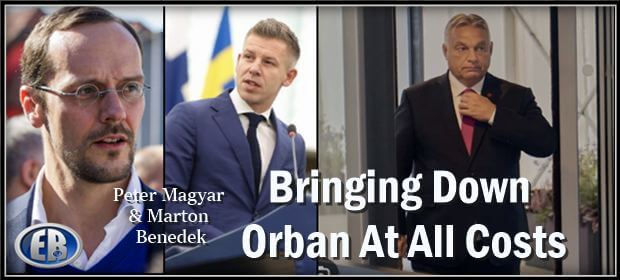
ER Editor: A reminder that Orban faces re-election in April of this year.
********
EU official plotted to ‘organise resistance’ against Hungary’s Orban, files show
By Kit Klarenberg for The Grayzone
A senior EU official has been secretly seeking to remove Hungarian President Viktor Orban since at least 2019, according to leaked documents reviewed by The Grayzone.
The files show in January 2019, the International Coordinator for the Directorate-General for Migration and Home Affairs, Marton Benedek, authored a “project proposal” aimed at “developing a permanent coordination forum to organise resistance against the Orban regime.” In addition to his role at the European border control agency, Benedek currently heads Brussels’ “cooperation” with Libya.
Read Benedek’s anti-Orban project proposal here.
The impetus for Benedek’s plot was “an unprecedented set of anti-regime demonstrations in Hungary and among expat Hungarians” over controversial proposed legislation allowing businesses to compel employees to work overtime, and delay payment of their wages for an extended period. Thousands took to the streets before and after its implementation.
According to Benedek, outrage over what he referred to as “the slave law” had “compelled a small group of some 30 political, trade union and civic leaders to coordinate their activities, agree on a set of minimum objectives and funding principles, and jointly plan future action.” This had given birth to “an ad hoc coordination forum… which could develop, over time, into an incipient political coordinating body that could credibly challenge” Orban’s rule.

Benedek’s proposal to harness resistance to the so-called “slave law” and bring its opponents into a single political movement was likely a reaction to the pro-sovereignty positions pursued by Orban and his Fidesz party, which has consistently sought to maintain national veto power for member states and to prevent the bloc from enlarging further, to the great chagrin of Brussels.
Participating in the “ad hoc coordination forum” were a variety of NGOs, many of which have been acccused of receiving funds from George Soros’ Open Society Foundations. OSF relocated its Hungarian office to Berlin in April 2018, due to Orban’s government undertaking numerous measures to curb the activities and influence of foreign-financed NGOs locally. OSF activities in Budapest have been a closely-guarded secret ever since. Nonetheless, the most recent available figures indicate Soros’ personal regime change operation pumped $8.9 million into Hungary in 2021 alone.
The source who obtained the files told The Grayzone that the proposal was submitted to Open Society Foundations, although they were unable to furnish proof that the Soros-led organization received the documents or signed off on them.
In the document, Benedek wrote that he hoped “to develop a few ideas to transform this forum into a potent entity capable of planning and executing collective action” ahead of elections that would be held in Hungary in 2019 and 2022. Benedek stressed the need for expansive financing to “deliver results” not least as organizing a single “large demonstration in Budapest” costing roughly $11,000. The then-ongoing demonstrations relied on crowdfunding, and Hungarian political parties – which receive state funding – to cover “gaps” in “project management.”
Among Benedek’s “proposed lines of action” was the creation of “a non-profit entity, registered in Hungary (for operational activities) and a financial vehicle potentially registered in Austria.” A board comprising political party representatives, trade unions and NGOs “could provide the political steer for future action.”
Benedek sought to maintain as broad of an anti-Orban coalition as possible, warning against “rapidly proceeding to controversial projects,” for instance uniting opposition parties to contest European elections. As these votes are “contested in a fully proportional system,” it was “quite rational” for parties “to run individual party lists.”
Instead, Benedek looked ahead to “organising collective action” and “sustained opposition to the Orban regime” over contentious domestic political issues ahead of Hungary’s 2019 local and 2022 national elections. The operation would involve “primary campaigns, information campaigns, mobilisation campaigns, electoral debates and joint fundraising activities,” he wrote.
The senior EU functionary concluded by suggesting his proposed organization would ultimately morph into a shadow government that could seize power from the Hungarian president. “In the longer run, the proposed non-profit entity could also… develop the policy foundations (and shadow cabinet) of a united political front against the Orban regime.”
A failed test-run for toppling Orban?
By this point, Benedek had been intimately involved in anti-Orban activism in Hungary for many years, while also working in a variety of senior EU posts related to bloc enlargement and relations between aspiring member states. An official profile reveals he “led the European Commission’s visa liberalisation dialogue” with the breakaway statelet of Kosovo, “oversaw rule of law reforms in the Western Balkans,” and coordinated “the EU’s internal security policies during Hungary’s EU Council Presidency” in 2011.
Benedek’s determined plotting against Orban clearly constitutes a clear conflict of interest.
In October 2012 – the year that Orban’s disputes with Brussels significantly intensified – Benedek co-founded a party called Együtt, or Together. A progressive liberal party, it sought to forge an extremely broad political coalition in Hungary. Együtt’s explicit objective was to seize power and undo all reforms enacted by Fidesz since taking office two years prior. Its leaders urged parties of every ideological extraction to join their cause.
Despite much initial media hype framing Együtt as Hungary’s premier opposition entity, and therefore a threat to Orban’s grip on power, the party failed miserably. Having been flatly rejected by the country’s right-wing, it formed a coalition with a quartet of green, liberal and social democratic parties. This was sufficient to elect three MPs to Budapest’s 199-seat parliament in 2014, although four years later that figure fell to just one. The lone lawmaker promptly defected to another party, and Együtt folded.
Despite the cataclysmic results, and Együtt’s chiefs being forced to pay back close to half a million dollars in state funding they received for campaigning activities due to abysmal electoral performance, Benedek was undeterred. In a 2017 interview, he branded allegations that his family had improperly profited from his mother’s senior position within the EU as a “Fidesz lie.” The fact that he was reaping a sizable salary from Brussels for sensitive, high-level work, while simultaneously playing opposition politician at home, was left mentioned by his interviewers.
This matter should have been a source of significant critical interest and inquiry, however. Under formal rules, EU civil servants are supposed to be impartial and politically neutral. Officials must declare any personal or political interests that could compromise their independence, and obtain permission from superiors before engaging in external activity. One might think Benedek engaging in nakedly partisan political campaigning, both covert and overt, would be prohibited – unless of course it was signed off upon at the bloc’s highest levels.
In the leaked 2019 “project proposal,” Benedek boasted that “an online community that yours truly set up” was part of the anti-Orban “coordination forum.” That group, “Hazajöttünk túlórázni” (“We came home for overtime”), had attracted the interest of thousands of Hungarian emigres, which were drawn together when it “organised demonstrations against the Orban regime in 35 cities in Europe, North America, Asia and Australia.” How these actions were funded, and whether the EU played any role in bankrolling them, remains unclear.
While Együtt’s crusade to dislodge Orban crashed and burned, the experience offered clear lessons for future contenders. The first of these was that Hungarians are overwhelmingly right-wing, dooming virtually any explicitly progressive, liberal movement to failure. Second, and equally important, as Benedek noted in his “project proposal,” was that European parliament votes are conducted under proportional representation, making it much easier for smaller parties to break through in Brussels than in national elections. Recent political developments suggest Együtt’s contemporaries learned from their efforts, and adapted accordingly.
EU ‘resistance’ ambitions fulfilled by Tisza?
In March 2024, a little-known figure named Peter Magyar exploded onto Budapest’s political scene when he released secret recordings of his ex-wife, former Justice Minister Judit Varga, revealing that senior government figures attempted to sabotage the prosecution of a state official for corruption. Varga had resigned the previous month along with Hungarian President Katalin Novak, for signing off on the pardon of the deputy director of an orphanage who was implicated in covering up pedophilia.
Ever since, Varga has repeatedly claimed Magyar was physically abusive, and that she made the incriminating statements under duress. She has variously alleged Magyar locked her in a room without her consent, violently shoved her into a door while she was pregnant, and menacingly stormed around their shared residence brandishing a knife. In April 2024, a police report was released exposing how Magyar attempted to forcibly seize custody of the pair’s children, while making a variety of threats to Varga. He denies the report’s authenticity.
These revelations have fallen almost entirely on deaf ears, however, while Magyar’s star grew inexorably. Magyar became chief of the Tisza (Respect and Freedom) party almost overnight, and was immediately bestowed the title of “opposition leader” by mainstream media. While founded in 2020, Tisza had not previously competed in any elections or ever publicly campaigned. However, in the June 2024 European parliament election, Tisza garnered almost 30% of the vote, and seven seats. Today, the party enjoys a significant lead over Orban’s Fidesz in many national opinion polls.
From the very inception of Magyar’s stratospheric ascent, his political activities have been of intense interest to Western news outlets, with protests he routinely leads generating saturation coverage. At no point have obvious questions been asked as to whether Magyar’s abrupt emergence as Hungary’s leader-in-waiting was an organic phenomenon, or how his activities have been funded. Despite repeated promises, Magyar has yet to provide the public with any detailed financial statements. Instead, he claims Tisza relies on “micro-donations” from average citizens, and the largesse of popular local anti-government actor Ervin Nagy.
Immediately after Magyar assumed leadership over Tisza, he barnstormed through towns and villages across the country. The spectacular campaign often saw him addressing crowds from large stages featuring concert-ready audio equipment, along with videographers and professional security. Magyar has also been supported by highly sophisticated PR and social media efforts, as well as a liberal-leaning local mainstream media ecosystem which seems increasingly desperate to market him to right-wing voters.
In 2024, Hungarian academic Zsolt Enyedi published a typical profile of Magyar’s party, marvelling at Tisza’s “meteoric” and “unprecedented” rise, while acknowledging that its “ideological profile” is “amorphous” – which is quite an understatement.
Though he claims to be conservative, Magyar’s positions on many issues are unclear. For example, he has visited Ukraine and branded Moscow the proxy war’s “aggressor,” while Tisza has voted for European Parliament resolutions calling for more weapons for Kiev. The party’s representatives performatively donned Ukrainian flag t-shirts as they cheered Volodymyr Zelensky’s November 2024 address to the chamber.
Magyar has also promised to adopt the EU’s ban on Russian energy imports, a position opposed by the overwhelming majority of Hungarians. Adding to the confusion, Tisza supports the government’s refusal to send weapons to Kiev, as well as Ukraine’s EU accession. Magyar has admitted he avoids taking concrete positions on Ukraine, as the topic is “divisive” among domestic constituents. Pointed questions about his penchant for flip-flopping have prompted Tisza’s leader to storm out of live TV interviews.
Hungary on the verge of EU subjugation?
Nonetheless, one policy area in which Magyar is consistent, unequivocal, and in stark opposition to Fidesz, is the EU. Defining himself as avidly pro-European, he supports adoption of the Euro, as well as greater EU integration and federalism. If he comes to power, Budapest will no longer be an irritant to Brussels’ designs. It is likely to back the Ukrainian proxy war “for as long as it takes,” as EU chief Ursula von der Leyen has repeatedly pledged, and to eliminate the remaining vestiges of sovereignty from the bloc’s members.
Since late 2022, the EU has withheld billions of euros from Hungary due to “rule of law concerns.” Accessing these vast sums would require Fidesz to undertake major reforms in eight separate policy areas. However, Magyar has claimed once he takes office and Budapest is “a fully-fledged member of the EU,” the funds will instantly be unfrozen – a key Tisza pledge, which has propelled the party’s surging popularity ahead of Hungary’s national elections in April.
If current polling trends hold, Marton Benedek’s clandestine scheme to “organise resistance” and “credibly challenge” Orban may finally be fulfilled.
Source
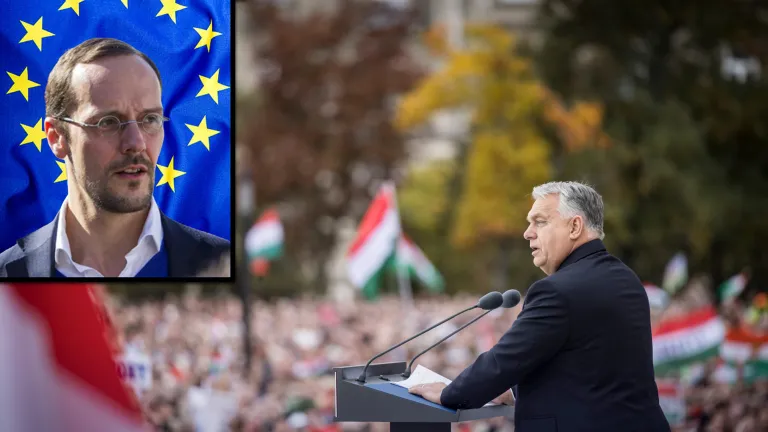
Featured image, Benedek: https://courrierdeuropecentrale.fr/tilos-radio-rencontre-avec-marton-benedek-membre-fondateur-du-parti-egyutt/
Featured image, Magyar: https://euractiv.pl/section/demokracja/news/wegry-peter-magyar-pozwie-doradce-orbana-chodzi-o-deepfake/
Featured image, Orban: https://www.la-croix.com/international/les-europeens-ont-ils-les-moyens-de-faire-sauter-le-verrou-viktor-orban-20251016
************
Published to The Liberty Beacon from EuropeReloaded.com


••••
The Liberty Beacon Project is now expanding at a near exponential rate, and for this we are grateful and excited! But we must also be practical. For 7 years we have not asked for any donations, and have built this project with our own funds as we grew. We are now experiencing ever increasing growing pains due to the large number of websites and projects we represent. So we have just installed donation buttons on our websites and ask that you consider this when you visit them. Nothing is too small. We thank you for all your support and your considerations … (TLB)
••••
Comment Policy: As a privately owned web site, we reserve the right to remove comments that contain spam, advertising, vulgarity, threats of violence, racism, or personal/abusive attacks on other users. This also applies to trolling, the use of more than one alias, or just intentional mischief. Enforcement of this policy is at the discretion of this websites administrators. Repeat offenders may be blocked or permanently banned without prior warning.
••••
Disclaimer: TLB websites contain copyrighted material the use of which has not always been specifically authorized by the copyright owner. We are making such material available to our readers under the provisions of “fair use” in an effort to advance a better understanding of political, health, economic and social issues. The material on this site is distributed without profit to those who have expressed a prior interest in receiving it for research and educational purposes. If you wish to use copyrighted material for purposes other than “fair use” you must request permission from the copyright owner.
••••
Disclaimer: The information and opinions shared are for informational purposes only including, but not limited to, text, graphics, images and other material are not intended as medical advice or instruction. Nothing mentioned is intended to be a substitute for professional medical advice, diagnosis or treatment.



Leave a Reply