
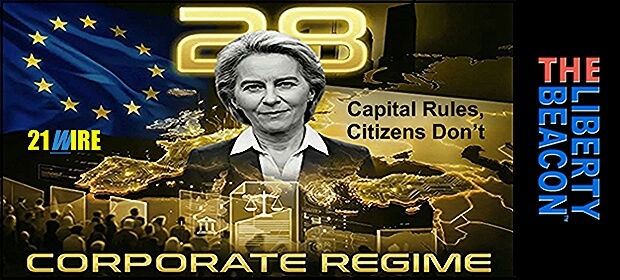
Europe’s 28th State: A Legal Lab Where Capital Rules, Citizens Don’t
Freddie Ponton
21st Century Wire
In October 2025, Europe was faltering. Inflation was eroding savings, war raged on its borders, and trust in governments was crumbling. Amid this turbulence, Brussels quietly moved forward with a project that sounded, at first, almost routine—a technical reform, harmless on paper. Its name, the “28th regime,” suggested little more than bureaucratic housekeeping. But appearances are deceiving.
Beneath the neutral jargon of “legal harmonisation” and “startup facilitation” lies a radical experiment: a borderless, supranational corporate super-state. A virtual realm where companies operate free from national laws, beyond democratic oversight, and without the constraints of social protections. No flag, no citizens, no elections, just corporations, empowered to bend the rules to their advantage.
A State Without Territory
This is not science fiction. Momentum for the 28th regime is rising fast, backed by tech moguls, venture capital firms, lobby groups, and high-profile EU officials. If adopted, any European company could opt out of its home country’s laws entirely, stepping into a legal playground that no nation, not even the United States, has ever offered. Imagine a Europe where business rules, not citizens, hold the ultimate authority. Where labour protections, tax laws, and social safeguards are optional, and the boardroom wields more power than parliaments.
In Brussels, this is being sold as “modernisation” and “competitiveness.” But for critics, it is something far darker: the creation of a federal business law for capital, a virtual haven under the European flag, quietly undermining the very principles of democracy and social progress that Europe claims to protect. The 28th regime isn’t just a reform. It’s a power shift, and it’s happening now, almost unnoticed.
Many sceptics go even further, and see, in what many have called “The 28th State“, something else entirely: a virtual free‑trade zone for capital, eerily reminiscent of real‑world experiments such as Próspera, the semi‑autonomous corporate enclave in Honduras, or the “Freedom Cities” movement backed by libertarian network‑state enthusiasts in the US.
These similarities are not accidental. Whether territorial or digital, these projects are variations of the same idea: legal exceptionalism for capital, justified by the language of innovation, competitiveness, and survival in a globalised economy. The EU’s 28th regime is not an anomaly; it is Europe’s entry into a global movement to carve out spaces where capital governs itself.
To understand the official framing of this initiative, it is useful to see the announcement in EC President Ursula von der Leyen’s own words. In her speech at the World Economic Forum 2026 in Davos, she outlined the upcoming 28th Regime / EU‑Inc as a new European corporate legal framework, designed to allow companies to register and operate seamlessly across the EU single market.
VIDEO: Ursula von der Leyen’s 3 Focal Points at WEF 2026 – Regulation, Investment, and Energy (Source: APT)
For those who are familiar with the One Health concept, which we have covered extensively here, just note that EU-INC is marketed as One Europe. One Standard. Déja Vu?
Who Is Pushing the 28th Regime? Origins and Mechanics
The 28th Regime did not spring from bureaucratic necessity; it was conceived in the boardrooms and think tanks of Europe’s startup elite. Its intellectual nucleus revolves around Andreas Klinger (Prototype Capital, former CTO of Product Hunt, turned lobbyst), supported by Philipp Herkelmann, Simon Schaefer, and Vojtech Horna, each of whom has played a leading role in designing EU‑Inc, the coalition advocating for a pan‑European corporate legal entity. From early drafts circulated in Brussels to closed-door workshops with EU policymakers, this group has framed the 28th Regime as a technical innovation, rather than a political restructuring of corporate sovereignty.
Behind them stand major venture capital firms, including Index Ventures, Atomico, Creandum, Seedcamp, and Sequoia, alongside prominent startup advocacy networks such as France Digitale, Allied for Startups, and the European Startup Network. Legal architecture is guided by firms like Cooley, Orrick, and Osborne Clarke, ensuring that the initiative is not merely a proposal but a technically viable framework for cross-border corporate operations.
Publicly, the 28th Regime is presented as a grassroots response to regulatory fragmentation, a lifeline for startups struggling with bureaucratic hurdles. Yet surveys of European entrepreneurs reveal a different picture: regulation ranks low among real obstacles, while funding shortages, energy costs, labour scarcity, and political uncertainty dominate their concerns.
Operationally, EU‑Inc translates these ambitions into mechanisms which propose a pan-European corporate form, a digital registry, management dashboards, and new investment instruments such as EU‑FAST, alongside an EU-wide employee share option scheme (EU‑ESOP). Founders from firms like Revolut, Bolt, Personio, and DeepL have publicly endorsed the initiative, signalling a convergence of tech capital and policy influence aimed at bypassing national legal and social constraints. In other words, EU-Inc is designed to operate similarly to the “Delaware C-Corp” model found in the US. We are not quite sure if companies will need a registered agent in Europe. Time will tell…
In essence, the 28th Regime reflects both a strategic lobbying campaign and a legislative experiment: it is an effort to embed the interests of venture capital, corporate founders, and tech lawyers into the DNA of European law, turning an ideological vision of deregulated, borderless corporate governance into a tangible policy reality.
The Myth That Justifies Everything
The ideological foundation of the 28th regime rests on a claim repeated so often it has hardened into dogma: Europe is fragmented; the United States is unified. According to this narrative, European businesses suffocate under 27 legal systems while American firms flourish under a single, seamless framework. The conclusion follows naturally: Europe must imitate the US by creating a unified corporate law above national systems.
This premise is flatly false. Studies and policy analyses recognise that the US internal market itself is a patchwork of state and federal laws, making cross‑state operations legally complex even there, and that the European internal market has achieved a high degree of regulatory integration despite the diversity of national systems.
Nevertheless, this myth persists because it serves a political function. By portraying Europe as uniquely dysfunctional, EU leaders manufacture a sense of urgency that legitimises extraordinary legal measures. The 28th regime thus becomes less a response to objective market failure and more a strategic narrative for policy change.
Political Champions Within EU Institutions
The initiative has powerful allies in the European Commission and Parliament. Ursula von der Leyen has repeatedly endorsed the 28th regime as part of the Commission’s broader competitiveness and startup strategy, alongside Commissioners Henna Virkkunen, Stéphane Séjourné, Michael McGrath, and Ekaterina Zaharieva, a fact documented in reporting on the proposal’s trajectory through EU institutional agendas.
This coalition of tech ecosystem actors, investors, legal professionals, and senior EU policymakers demonstrates that the 28th regime is not simply a spontaneous grassroots movement but a concerted policy project with deep institutional support.
EU‑Inc Policy Proposal
To understand what EU‑Inc and its backers are actually proposing in practical terms, the EU‑Inc Policy Proposal lays out a detailed blueprint for the upcoming 28th regime:
-
A standardised corporate structure for a new digital holding company
-
A digital registry and management dashboard for EU companies
-
A new investment instrument called EU‑FAST
-
An EU‑wide employee share option scheme (EU‑ESOP)
-
Proposals on taxation and employment for companies under EU‑Inc
This document provides concrete insight into how EU‑Inc envisions not only streamlined corporate governance but also new financial instruments designed to attract capital across borders while minimising regulatory frictions.
DOCUMENT: EU‑Inc Policy Proposal [Cliick Here to View] (Source: Welcome Europe)
From Honduras to Brussels: Prospera, Startup Nation Logic, and the Rise of Test‑Bed Governance
To understand where this logic leads, one must look beyond Europe.
On the island of Roatán in Honduras, the Próspera ZEDE was created as a semi‑autonomous zone governed by a separate legal code, private arbitration, and investor‑friendly policies, effectively a charter city designed to attract international capital and offer alternative governance structures. Próspera’s CEO, Erick Brimen, has described the project as an experiment in economic liberty and governance innovation aimed at unlocking prosperity through regulatory freedom.
In mainstream reporting on tech elite‑driven experiments, outlets like the Financial Times have compared Próspera to broader trends in for‑profit cities and network states, highlighting its low‑regulation, venture capital‑friendly environment and the controversies it has sparked.
“Próspera isn’t just another development project; it’s an experiment in how governance itself can be delivered as a service, offering a legal and regulatory environment financed and tailored by billionaire capitalists and Big Tech innovators.”
In his 2018 essay “Lessons Learned from Israel, the Start-Up Nation,” Erick Brimen, CEO of Prospera, explicitly cites Israel as a model for innovation-driven jurisdictions. He argues that Israel’s global tech success stems from targeted deregulation, fiscal and legal discipline, and state-backed venture capital, creating fertile ground for high-potential industries like technology and R&D. Prospera’s semi-autonomous enclave, with its investor-friendly legal code, applies the same logic: streamlined or minimal regulation to enable entrepreneurial experimentation. Brimen’s analysis confirms that Prospera’s architecture is not mere libertarian rhetoric, but a deliberate adaptation of Israel’s Start-Up Nation principles, which seem to have largely influenced the EU-Inc 28th Regime Initiative in Europe.
This callout highlights the ideological lineage linking Próspera to the EU‑Inc/28th Regime. While Próspera is territorial and the 28th regime is juridical, both adopt a similar deregulation‑first worldview: lowering barriers for investors, prioritising capital mobility, and treating social protections as costs. Próspera was a proof‑of‑concept; Brussels now seeks to scale the experiment across an entire union.
European Parliament 28th Regime Resolution
To see how this vision has translated into formal EU policy, the European Parliament resolution of 20 January 2026 lays out recommendations to the Commission for a new legal framework supporting companies across the EU, colloquially known as the “28th regime”.
This document represents the first tangible legislative step toward institutionalising a legal “28th regime,” turning abstract deregulation and harmonisation proposals into a concrete policy blueprint.
- DOCUMENT: The 28th regime: a new legal framework for innovative businesses – Adopted texts [Click Here to view] (Source: European Parliament)
Technocracy in Practice: Governing Without Citizens
Across continents, elites are converging on a single solution to the crisis: remove capital from politics, rather than politics from capital.
This vision echoes the long‑standing ideology of technocracy, a governance by experts and systems optimised for profit under the guise of “efficiency”, instead of democratic deliberation. In this worldview, society is a machine, and those who understand its levers, namely economists, engineers, and corporate executives, are best positioned to run it. The push for uniform EU company law is often portrayed through the lens of a technical necessity, and not a democratic choice.
The 28th regime fits this pattern with disturbing precision.
It is not debated as a social contract but, as we just said, presented as a technical necessity. Its governance would be shaped by legal experts, investors, and EU bureaucracies, largely insulated from national parliaments or public contestation. Labour laws, taxation, and social standards become variables to optimise, and are no longer democratic choices.
In effect, the 28th regime lays the legal foundation for a world governed like a boardroom. Companies become quasi‑sovereign actors. Governments remain, but increasingly as administrators rather than decision‑makers. Politics becomes a façade, a forum for managing consequences rather than setting direction.
Supporters insist this is simply pragmatism. Critics see something darker: a slow hollowing‑out of republican and democratic forms of governments and authority, as well as an attack on the rule of law—replaced by regimes of corporate orders packaged as ‘rules’, and complex legal frameworks designed to serve a corporate elite and an overfed oligarchy, primarily for capital mobility and so-called ‘investor confidence’.
Europe is told this is the price of survival. But survival for whom? Overall, in attempting to emulate a mythical deregulated America, Europe risks dismantling the very features that have made its economy resilient: social stability, legal clarity, and democratic legitimacy. Yes, administrative processes can be improved. Digitisation, transparency, and efficiency are legitimate goals. But legal exceptionalism for capital is not reform—it is plain surrender of your sovereignty to a transnational corporate takeover.
The 28th state may never fly a flag. It may never hold elections. But if it succeeds, it will quietly rule over Europe’s economic future, not in the name of its citizens, or “Freedom”, but in the language of markets, metrics, and managerial necessity, reacting to a declining economy, and the technocrats’ desire for more authority to achieve complete control.
___________
(TLB) PUBLISHED THIS ARTICLE FROM 21WIRE
SUPPORT INDEPENDENT MEDIA – BECOME A MEMBER @21WIRE.TV & VISIT THEIR TELEGRAM CHANNEL
Header featured image (edited) credit: Org post content. Emphasis added by (TLB)
••••

••••
Stay tuned…

••••
The Liberty Beacon Project is now expanding at a near exponential rate, and for this we are grateful and excited! But we must also be practical. For 7 years we have not asked for any donations, and have built this project with our own funds as we grew. We are now experiencing ever increasing growing pains due to the large number of websites and projects we represent. So we have just installed donation buttons on our websites and ask that you consider this when you visit them. Nothing is too small. We thank you for all your support and your considerations … (TLB)
••••
Comment Policy: As a privately owned web site, we reserve the right to remove comments that contain spam, advertising, vulgarity, threats of violence, racism, or personal/abusive attacks on other users. This also applies to trolling, the use of more than one alias, or just intentional mischief. Enforcement of this policy is at the discretion of this websites administrators. Repeat offenders may be blocked or permanently banned without prior warning.
••••
Disclaimer: TLB websites contain copyrighted material the use of which has not always been specifically authorized by the copyright owner. We are making such material available to our readers under the provisions of “fair use” in an effort to advance a better understanding of political, health, economic and social issues. The material on this site is distributed without profit to those who have expressed a prior interest in receiving it for research and educational purposes. If you wish to use copyrighted material for purposes other than “fair use” you must request permission from the copyright owner.
••••
Disclaimer: The information and opinions shared are for informational purposes only including, but not limited to, text, graphics, images and other material are not intended as medical advice or instruction. Nothing mentioned is intended to be a substitute for professional medical advice, diagnosis or treatment.



Leave a Reply