

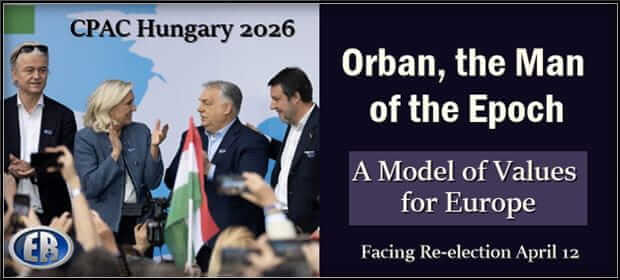
ER Editor: Yes, Hungary is now a key country, a symbol as much as anything else. And they have elections on April 12, with much media hinting that Orban will lose. We predict major drama following this, with more ways to wake up a sleeping public, not just in Hungary.
Here’s The Guardian article on this CPAC Hungary event on March 23. Apologies to readers for not having picked this up sooner. The analysis below is from yesterday —
Viktor Orbán celebrated by Europe’s far right before Hungary election
Our sense of drama and timing tempts us to believe that the harder someone is celebrated, the harder they are going to fall.
********
Europe’s Patriots Uniting
The European Right is joining forces in rejecting the abolition of unanimous decision-making in the EU and opposing the use of the rule of law as a political tool, while standing up for energy sovereignty and taking a firm position against mass migration.
GABOR SZUCS
After CPAC Hungary on March 21 and the Patriots’ rally in Budapest on March 23, Budapest is no longer just the capital of a small Central European country. In the space of a few days, the Hungarian capital became a political meeting point where the sovereigntist, nationalist Right simultaneously showed its strength, its international embeddedness, and the fact that it has its own European ‘language.’
More than 3,000 participants, more than 600 international guests, 51 countries, and more than 40 speakers gathered in Budapest for CPAC. The Patriots’ Grand Assembly, held just a few days after CPAC, was the first such gathering of the Patriots group, now the third largest force in the European Parliament.
This European Right is not a fringe phenomenon anymore, but an organized and growing political bloc.
It was also confirmed at these two events that the international Right no longer simply sympathizes with the Hungarian model, but sees it as a point of reference. Javier Milei, Alice Weidel, Irakli Kobakhidze, Santiago Abascal, and Mateusz Morawiecki endorsed the Hungarian prime minister at CPAC Hungary, while, at the Patriot rally, such prominent European leaders as Marine Le Pen, Geert Wilders, Matteo Salvini, Tom Van Grieken and Ainārs Šlesers stood by Viktor Orbán. This list in itself indicates that Budapest is no longer a follower, but a major organizing centre of the sovereigntist Right.
Moreover, the support was not a polite gesture, but an open political statement. Marine Le Pen called Orbán an “exceptional leader,” while Geert Wilders described him as “a lion on a continent led by sheep.” Matteo Salvini spoke about the Hungarian voters having to decide on self-determination, Christian identity, families, and security, and then the crowd chanted Orbán’s name together. All this clearly shows that it was not just allies meeting in Budapest: an entire political camp confirmed that the Hungarian government plays a key role in representing the values of the community.
At CPAC Hungary, Orbán emphasized that a Hungarian patriotic victory would not only mean successful self-defence for Hungary but could also bring a breakthrough against the progressive mainstream in Brussels.
It is no coincidence that the Patriots’ Budapest manifesto was built precisely on this fault line. The Budapest proclamation contrasts the Europe of free nations with the plan of the European superstate: it rejects the abolition of unanimous decision-making, criticises the degradation of the rule of law as a political tool, stands up for energy sovereignty, and takes a firm stand against mass migration. In other words, the right-wing leaders who arrived in Budapest brought with them not only a voice of general dissatisfaction, but also a clear, coherent political programme, of which Hungary is today the most important, workable model. The liberal adversaries of the patriotic Right also understand this precisely. The April 12th elections will not only decide the domestic political direction of a country but also about the European balance of power.
That is why the Hungarian election is now much more than a domestic political test: it has become a political test of European significance.
The example of Hungary has proven since 2010 that it is possible to govern sustainably and effectively within a democratic framework, with repeated electoral mandates, and by consistently representing the national interest. This gives hope to the Right across Europe: that drifting is not their fate, that alignment with the Brussels mainstream is not a compulsion, and that politics based on national sovereignty is not a mere temporary protest, but can be a viable model of government in the long term. The Budapest actions were in fact driven by this realization: Viktor Orbán is no longer just the prime minister of Hungary, but living proof that patriotic politics based on democratic legitimacy can work in the long term.
Even Reuters reported that Brussels understands exactly what is at stake in the Hungarian election. Many in EU circles are confident that the possible defeat of Viktor Orbán could end Hungarian vetoes (ER: Couldn’t Slovakia under Robert Fico fill these shoes?), especially on matters related to Ukraine. In the event of an opposition victory, Brussels expects a kind of a ‘new era,’ even if the Hungarian opposition’s position on several issues is far from unified. This in itself says a lot. The Hungarian elections are not so much of a concern to the EU elite because they are worried about the state of Hungarian democracy, but because the Hungarian government is still capable of curbing centralizing efforts and, if necessary, saying no to the will of Brussels.
For the same reason, Kyiv’s attention is also focused on the Hungarian elections. The war in Ukraine, energy policy conflicts, the issue of EU enlargement, and the sanctions debate have indeed raised the stakes of who represents Hungary’s position in the European Council. That is why any interpretation that treats this election as a purely domestic political party struggle is simplistic: in reality, a decision is also being made on whether the room for manoeuvre of the nation-state can be preserved in an increasingly centralised Europe.
If a patriotic, sovereigntist government is again given power in Hungary, it will signal to the right-wing forces of the continent that there is still a significant social demand for the politics of normality; that family, border protection, energy sovereignty, a pro-peace foreign policy, and national self-determination are not relics of the past, but political expressions of majority expectations that are still real today. Budapest has become a symbol because all this is not presented as mere theory here, but is supported by the experience and results of a government that has been in power for a decade and a half.
And the incumbent government is likely to remain. (ER: Will it? We have our doubts.) Although polls and analyses that suggest there is a tight race or a breakthrough by the opposition appear from time to time in the international press, these often reflect political expectations rather than reality. The most recent survey found that Viktor Orbán is still the strongest and most popular political figure: according to the Nézőpont Institute’s poll conducted on March 28, he leads with an approval rate of 42%, and the pro-government camp’s willingness to take part in the vote is also strengthening. Moreover, the Nézőpont analysis two days earlier measured Fidesz (ER: Orban’s party) leading with 46% ahead of the Tisza Party at 40% regarding party lists. In the final phase of the campaign, it is therefore not the weakening of the governing parties that is visible, but rather Fidesz continuing to approach the election with a stable advantage, mobilization reserves and a realistic chance of victory.
The European Right is watching the Hungarian elections with hope, while Brussels and Ukraine are following the same elections with nervous anticipation. The outcome may be uncertain for now but what is certain is that the forces promoting a Europe of nations are no longer on the defensive. They are uniting and are ever stronger.
Source
Gábor Szűcs is currently an analyst at the 21st Century Institute and a political commentator for Megafon.
Featured image source: https://www.theguardian.com/world/2026/mar/23/viktor-orban-celebrated-europe-far-right-hungary-election
************
Published to The Liberty Beacon from EuropeReloaded.com


••••
The Liberty Beacon Project is now expanding at a near exponential rate, and for this we are grateful and excited! But we must also be practical. For 7 years we have not asked for any donations, and have built this project with our own funds as we grew. We are now experiencing ever increasing growing pains due to the large number of websites and projects we represent. So we have just installed donation buttons on our websites and ask that you consider this when you visit them. Nothing is too small. We thank you for all your support and your considerations … (TLB)
••••
Comment Policy: As a privately owned web site, we reserve the right to remove comments that contain spam, advertising, vulgarity, threats of violence, racism, or personal/abusive attacks on other users. This also applies to trolling, the use of more than one alias, or just intentional mischief. Enforcement of this policy is at the discretion of this websites administrators. Repeat offenders may be blocked or permanently banned without prior warning.
••••
Disclaimer: TLB websites contain copyrighted material the use of which has not always been specifically authorized by the copyright owner. We are making such material available to our readers under the provisions of “fair use” in an effort to advance a better understanding of political, health, economic and social issues. The material on this site is distributed without profit to those who have expressed a prior interest in receiving it for research and educational purposes. If you wish to use copyrighted material for purposes other than “fair use” you must request permission from the copyright owner.
••••
Disclaimer: The information and opinions shared are for informational purposes only including, but not limited to, text, graphics, images and other material are not intended as medical advice or instruction. Nothing mentioned is intended to be a substitute for professional medical advice, diagnosis or treatment.

Leave a Reply