

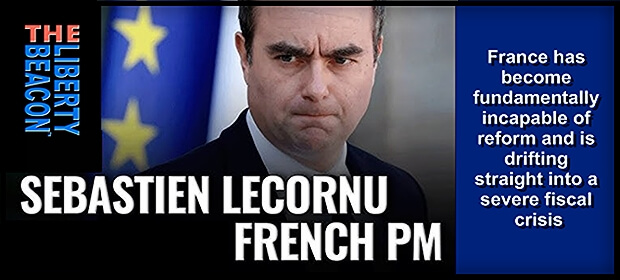
France’s Fiscal Death Spiral: A Nation Incapable Of Reform
It is surreal: political gridlock has driven France into a place where the far-left and the right vote together – and collectively push the government toward collapse…
By Thomas Kolbe
What is now unfolding in France may soon drag the entire Eurozone into deep turmoil. The country is staggering through a fiscal crisis while locked in a political stalemate that seems impossible to break. In the bond market, the clock is ticking loudly as France’s public debt spirals out of control.

This week, Prime Minister Sébastien Lecornu celebrated a textbook Pyrrhic victory. On Tuesday, the National Assembly narrowly approved his draft for next year’s social budget. But the win came at a steep price: sweeping concessions that will only worsen an already explosive fiscal situation.
Strange coalitions
With 247 votes in favor, 234 against, and 93 abstentions, the Assembly passed a plan projecting a €20 billion deficit in the social budget – significantly worse than the originally planned €17 billion. Marine Le Pen’s party and the far-left bloc around Jean-Luc Mélenchon both rejected the proposal.
It is surreal: political gridlock has driven France into a place where the far-left and the right vote together – and collectively push the government toward collapse. For President Emmanuel Macron, this could soon mean assembling yet another fragile government, as there is no indication France can lift itself out of its catastrophic stalemate.
The bill now moves to the Senate, where the governing coalition holds a majority. It will likely pass without major obstruction. On December 23rd, the Senate begins negotiations for the 2026 budget. It may provide drama, but no one seriously expects the political blockade to change.
Pension reform on ice – permanent reform paralysis
Lecornu was forced to freeze the planned pension reform, which would have raised the retirement age from 62 to 64. Instead, France will raise it only to 62 years and nine months. The country maintains the largest social budget in the EU while keeping one of the lowest retirement ages. Once again, France sidesteps its growing pension crisis, following Germany down the same dangerous path of a collapsing pay-as-you-go system. Paris also refuses to address the fiscal consequences of illegal migration – a social time bomb whose fuse is already burning.
This decision exposes the deep political denial embedded in France’s leadership: they continue living at the expense of future generations, consuming economic substance that no longer exists. France has become fundamentally incapable of reform and is drifting straight into a severe fiscal crisis.
This year’s budget deficit is roughly 5.6% of GDP. The government’s wildly optimistic projection for next year is 5%. With huge gaps in the social accounts, no one can explain how this number could be reached. It is pure fantasy. A far more realistic expectation is a deficit between 6% and 7%.
France’s political crisis mirrors its economic paralysis. Economic productivity has been shrinking for years. With a state share of 57% of GDP, the government blocks the free allocation of capital and absorbs the very resources required to revive the economy. France has never been comfortable with market economics and now, like a Siamese twin of Berlin’s disastrous policies, pushes central planning deeper into the economy.
Economic ossification
With 68,000 corporate insolvencies over the past twelve months and an industrial sector stuck in contraction, the country is heading directly into a severe social crisis – already reflected in an inescapable fiscal trap.
France is experiencing a bankruptcy wave of biblical proportions, likely costing 400,000 jobs this year. The economy is on its knees, and the French retreat into the illusion that endless debt can somehow restore their welfare system.
We have seen what this means for Eurozone stability: fifteen years ago, tiny Greece lost access to markets and triggered a debt crisis that spread like wildfire across Europe.
Back then, the credibility of Eurozone monetary policy was sacrificed to keep the highly interconnected credit markets liquid through massive ECB intervention and years of bailouts.
If the Eurozone’s second-largest economy experiences an “air pocket” on its bond market – a sudden collapse in demand for its swelling debt issuance – the traditional toolkit of the European Central Bank will not be enough to contain the fallout.
A secular shift in global bonds
In an acute crisis, the ECB would be ready to intervene. Its main tool would be sovereign bond purchases under the PSPP (Public Sector Purchase Programme). Additional liquidity could be injected through targeted long-term refinancing operations or via support for banks holding large volumes of French sovereign debt.
The Outright Monetary Transactions (OMT) program could also be activated, allowing direct purchases of crisis-country bonds – though only under strict fiscal-conditionality rules. But in the next crisis, those conditions will almost certainly be ignored to prevent the Eurozone from disintegrating. The ECB already provided the playbook when Mario Draghi uttered his famous “whatever it takes.”
Yet the ECB’s actual influence has limits: the long end of the bond market – maturities beyond ten years – is the deepest and most liquid segment. No single central bank can truly control it.
For months, long-term yields have been rising – first in Japan, now increasingly across parts of the Eurozone. The market is signaling a fundamental loss of confidence in the debt sustainability of fiscally undisciplined states.
A secular turning point in global bond markets has already occurred. At its climax, it will mark the final full stop on every pending fiscal crisis. Think Argentina. The age of the chainsaw is approaching.
***
Thomas Kolbe, born in 1978 in Neuss/ Germany, is a graduate economist. For over 25 years, he has worked as a journalist and media producer for clients from various industries and business associations. As a publicist, he focuses on economic processes and observes geopolitical events from the perspective of the capital markets. His publications follow a philosophy that focuses on the individual and their right to self-determination.
___________
SOURCE: Thomas Kolbe
Header featured image (edited) credit: YouTube article tease open card. Emphasis added by (TLB) editors
••••

••••
Stay tuned…

••••
The Liberty Beacon Project is now expanding at a near exponential rate, and for this we are grateful and excited! But we must also be practical. For 7 years we have not asked for any donations, and have built this project with our own funds as we grew. We are now experiencing ever increasing growing pains due to the large number of websites and projects we represent. So we have just installed donation buttons on our websites and ask that you consider this when you visit them. Nothing is too small. We thank you for all your support and your considerations … (TLB)
••••
Comment Policy: As a privately owned web site, we reserve the right to remove comments that contain spam, advertising, vulgarity, threats of violence, racism, or personal/abusive attacks on other users. This also applies to trolling, the use of more than one alias, or just intentional mischief. Enforcement of this policy is at the discretion of this websites administrators. Repeat offenders may be blocked or permanently banned without prior warning.
••••
Disclaimer: TLB websites contain copyrighted material the use of which has not always been specifically authorized by the copyright owner. We are making such material available to our readers under the provisions of “fair use” in an effort to advance a better understanding of political, health, economic and social issues. The material on this site is distributed without profit to those who have expressed a prior interest in receiving it for research and educational purposes. If you wish to use copyrighted material for purposes other than “fair use” you must request permission from the copyright owner.
••••
Disclaimer: The information and opinions shared are for informational purposes only including, but not limited to, text, graphics, images and other material are not intended as medical advice or instruction. Nothing mentioned is intended to be a substitute for professional medical advice, diagnosis or treatment.

Leave a Reply