

French Crime Breaks New Records

French Crime Breaks New Records

France is plunging into a spiral of violence that is unique in Europe

HELENE  de LAUZUN for EUROPEAN CONSERVATIVE

Following the release of immigration figures for 2025, the French Interior Ministry has published crime statistics for the past year.

These figures dramatically coincide with the French people’s perception that they are living in an increasingly dangerous and violent country. Furthermore, cross-referencing this data with immigration figures confirms another intuitive observation: foreigners are over-represented in crimes of all kinds.

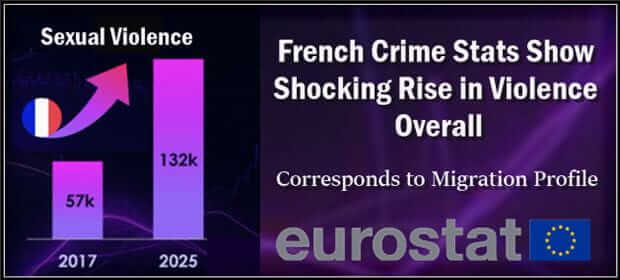
Apart from burglaries, absolutely all crime indicators rose between 2024 and 2025: 5% on average for physical violence and homicides, and up to 8% for sexual violence. This increase is not new: it is a significant trend, as analyst Marc Vanguard points out. As far as assaults are concerned, there has been a 25% increase since 2017, when Emmanuel Macron came to power. For sexual violence (ER: represented by ‘v.s’. in the tweet below), the increase is as high as 132%.

Cross-referencing this data with Eurostat figures reveals a situation that is specific to France.

One might imagine that the deterioration in public safety is a European phenomenon and that France’s neighbours are also experiencing increasing violence, particularly due to the intensity of the waves of migration that are weakening social structures. However, this is not the case: there is a distinctly French aspect to this rise in crime. France, along with Belgium, with which it shares this sad record for similar reasons, is the country with the highest homicide rate in Western Europe. The European Union, the cause of many ills, is not solely to blame here.

With all due respect to the Left, the connection between these more than worrying data and immigration figures makes the picture even worse. The task is made difficult for commentators in the absence of reliable ethnic statistics: these have been banned in France since the 1970s. But there is no need for detailed figures on the origins of criminals to sense the trends. National statistics do exist. Non-European foreigners represent 5.7% of the French population, and they are over-represented in almost all crimes and offences: 14% of homicides and up to 30% of vehicle thefts. And these figures obviously do not include recent immigrants who have obtained French nationality or their descendants.

This is a common-sense observation: the populations that provide the largest contingents of immigrants in France (the Maghreb and sub-Saharan Africa) are initially populations with higher crime rates than native French people. Importing them inevitably increases the crime rate in France.

Essayist Laurent Obertone is also alarmed by these overall figures. Since the publication of his shocking essay in 2013, La France Orange Mécanique (A Clockwork Orange France), the figures have continued to break sad new records year after year—even though the number of complaints filed remains constant and well below the actual number of crimes and offences, with many victims simply giving up on filing complaints due to the inefficiency and slowness of the justice system (ER: Except when pre-Covid Yellow Vest protestors found themselves before the justice pronto). There are now more recorded homicides than in the year when France was hit by the Charlie Hebdo and Bataclan attacks—attributed to terrorism, which means that violence has become deeply structural in society, rather than the result of external circumstances.

His very pessimistic conclusion echoes our own. What will the state do? Nothing, except prepare for the next election by taking care to increase taxes, again and again. The work of counter-information is therefore more essential than ever.

Hélène de Lauzun is the Paris correspondent for The European Conservative. She studied at the École Normale Supérieure de Paris. She taught French literature and civilization at Harvard and received a Ph.D. in History from the Sorbonne. She is the author of Histoire de l’Autriche (Perrin, 2021).
.
************

Published to The Liberty Beacon from EuropeReloaded.com

••••

The Liberty Beacon Project is now expanding at a near exponential rate, and for this we are grateful and excited! But we must also be practical. For 7 years we have not asked for any donations, and have built this project with our own funds as we grew. We are now experiencing ever increasing growing pains due to the large number of websites and projects we represent. So we have just installed donation buttons on our websites and ask that you consider this when you visit them. Nothing is too small. We thank you for all your support and your considerations … (TLB)

••••

Comment Policy: As a privately owned web site, we reserve the right to remove comments that contain spam, advertising, vulgarity, threats of violence, racism, or personal/abusive attacks on other users. This also applies to trolling, the use of more than one alias, or just intentional mischief. Enforcement of this policy is at the discretion of this websites administrators. Repeat offenders may be blocked or permanently banned without prior warning.

••••

Disclaimer: TLB websites contain copyrighted material the use of which has not always been specifically authorized by the copyright owner. We are making such material available to our readers under the provisions of “fair use” in an effort to advance a better understanding of political, health, economic and social issues. The material on this site is distributed without profit to those who have expressed a prior interest in receiving it for research and educational purposes. If you wish to use copyrighted material for purposes other than “fair use” you must request permission from the copyright owner.

••••

Disclaimer: The information and opinions shared are for informational purposes only including, but not limited to, text, graphics, images and other material are not intended as medical advice or instruction. Nothing mentioned is intended to be a substitute for professional medical advice, diagnosis or treatment.


Be the first to comment

Leave a Reply

Your email address will not be published.


*