
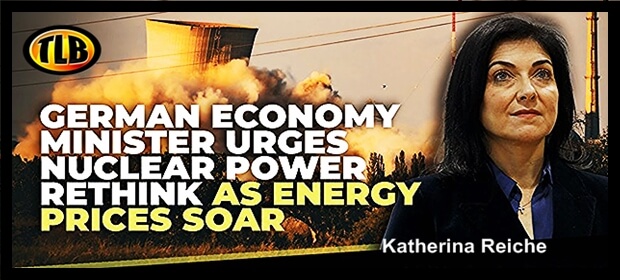
Germany’s Economy Minister: Nuke Rethink, Prices Surge, Growth Slides
“Politically speaking, I have no alternative” ~Germany’s Economy Minister Katherina Reiche
(Tyler Durden Reports) – Germany’s Economy Minister Katherina Reiche has openly called for a fundamental reassessment of the country’s long-standing rejection of nuclear power, warning that heavy dependence on gas has left Europe’s largest economy dangerously exposed to repeated energy shocks.
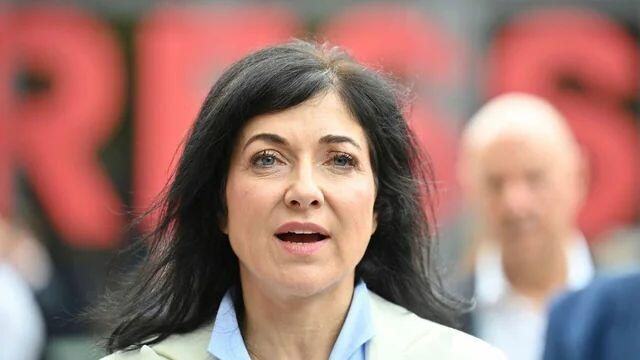
Speaking at the launch of a new international investor conference aimed at drawing foreign capital into Germany, Reiche told the Financial Times that the decision by previous governments to phase out nuclear generation has eliminated any realistic alternative for reliable baseload electricity. “We need gas to secure our supply – that is the only baseload supply I have left,” she said. “Politically speaking, I have no alternative.”
Reiche, a senior figure in Chancellor Friedrich Merz’s Christian Democratic Union, made the remarks as fresh data highlighted the mounting costs of the nuclear exit, originally decided under Angela Merkel in 2011 and completed under Olaf Scholz. While the policy was accompanied by a massive push for renewables, it has left Germany more reliant on gas-fired power stations to keep the lights on when the wind doesn’t blow and the sun doesn’t shine.
Related:
-
German Chancellor Merz Admits Shutting Down Nuclear Energy Production Was A “Severe Strategic Mistake”
-
Germany Blows Up Last Nuclear Plant Towers While Economy Collapses
-
The US Shows A Way Out Of Germany’s Energy Trap
European gas prices have risen more than 60 per cent since the outbreak of conflict in the Middle East, delivering the continent’s second major energy price crisis in under five years. Futures contracts for German electricity in May are trading at four times the level seen in France, Europe’s biggest nuclear producer, according to the energy exchange EEX.
Reiche urged Germany to stop sitting on the sidelines of Europe’s nuclear revival. France, Sweden and Poland are all either building new reactors or extending the life of existing ones, attracted by the technology’s ability to deliver large volumes of low-carbon, dispatchable power. “We can decide that we are not interested. Then we stick to gas and become more dependent on one energy source,” she said. “Or we can say that we are interested in technology again.”
With Germany’s renowned engineering expertise, Reiche argued the country should at minimum engage constructively in European nuclear projects and international forums. “Anyone standing on the sidelines simply commenting loses influence. You must be on the pitch if you want to play.”
The vulnerability of Germany’s gas strategy was brutally exposed after Russia’s 2022 invasion of Ukraine cut off pipeline supplies. Berlin was forced to pivot rapidly to liquefied natural gas, much of it from the United States, which now accounts for around 10 per cent of the country’s gas supply. Energy costs have remained stubbornly high ever since. In the second half of 2025, gas prices for private households were 79 per cent above 2021 levels, while electricity prices rose 23 per cent, official statistics show.
The latest price spike is already hammering industry and derailing growth forecasts. A consortium of leading German economic institutes warned on Wednesday that the energy shock would erase more than half the GDP growth previously expected for 2026. The new projection is just 0.6 per cent, down from 1.3 per cent in September, with 2027 growth seen at 0.9 per cent.
Reiche acknowledged the strain on energy-intensive sectors but insisted Germany faced no immediate supply shortages. She noted that Chancellor Merz, who heads a year-old coalition between the CDU and Social Democrats, has long described the nuclear phase-out as a “huge mistake.” While the government has ruled out restarting closed conventional reactors, it is now supporting research into small modular reactors and nuclear fusion. Merz has also pledged to end Germany’s previous opposition to nuclear power at EU level.
The renewed energy debate comes as Berlin battles to revive an economy weighed down by high costs, Chinese competition and structural weaknesses. Despite a €1 trillion decade-long infrastructure and defence spending package – the largest since reunification – growth remains elusive.
To counter the gloom, the government is hosting the first “Invest in Germany” summit in Berlin on 19-20 October. Reiche hopes the event, modelled on France’s “Choose France” initiative, will secure concrete investment pledges and reposition Germany as a stable, diversified alternative for global capital. “I don’t see a flight from the dollar … but we see a lot of inquiries from America,” she said.
Investors she speaks to recognise the country’s underlying strengths, she added: a powerful industrial base, well-capitalised small and medium-sized companies (Mittelstand) and strategic importance. “Germany is currently in a weak phase,” they tell her, “but … you are of great strategic interest to us.”
Whether a more pragmatic stance on nuclear power can help restore that interest – and ease the pressure on German households and factories – will be one of the defining tests for Merz’s government in the months ahead.
Whoops.
..
In Germany, two cooling towers at the former Gundremmingen nuclear power plant were demolished, almost four years after the last reactor was shut down. Thousands came to watch the spectacle, according to the police. pic.twitter.com/Lqh2vaQNqa
— DW News (@dwnews) October 26, 2025
__________
Header feature image (edited) credit: Open public X account.. Emph. added by (TLB)
••••

••••
Stay tuned…

••••
The Liberty Beacon Project is now expanding at a near exponential rate, and for this we are grateful and excited! But we must also be practical. For 7 years we have not asked for any donations, and have built this project with our own funds as we grew. We are now experiencing ever increasing growing pains due to the large number of websites and projects we represent. So we have just installed donation buttons on our websites and ask that you consider this when you visit them. Nothing is too small. We thank you for all your support and your considerations … (TLB)
••••
Comment Policy: As a privately owned web site, we reserve the right to remove comments that contain spam, advertising, vulgarity, threats of violence, racism, or personal/abusive attacks on other users. This also applies to trolling, the use of more than one alias, or just intentional mischief. Enforcement of this policy is at the discretion of this websites administrators. Repeat offenders may be blocked or permanently banned without prior warning.
••••
Disclaimer: TLB websites contain copyrighted material the use of which has not always been specifically authorized by the copyright owner. We are making such material available to our readers under the provisions of “fair use” in an effort to advance a better understanding of political, health, economic and social issues. The material on this site is distributed without profit to those who have expressed a prior interest in receiving it for research and educational purposes. If you wish to use copyrighted material for purposes other than “fair use” you must request permission from the copyright owner.
••••
Disclaimer: The information and opinions shared are for informational purposes only including, but not limited to, text, graphics, images and other material are not intended as medical advice or instruction. Nothing mentioned is intended to be a substitute for professional medical advice, diagnosis or treatment.


Leave a Reply