

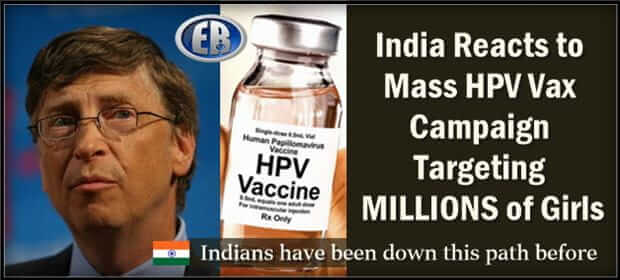
ER Editor: The HPV vaccine is a known problem for its side effects, recognized as such by Japan back in 2013. Mass vaccination by the likes of Gates and his globalist pals has long had bad press in India. A reminder that he and Melinda, the real ones, were reportedly lynched and killed there back in 2013. This story comes from 2021 —
World’s First Vaccine Murder case against Bill Gates filed in India
From 2021, this Diplomat article paints a comprehensive picture of why Indians were through with Gates’ ‘health’ (depopulation) meddling —
Why Are Indians So Angry at Bill Gates?
This massive HPV vaccine campaign (2026) got serious backlash upon its announcement in India according to the report below. Therefore we wonder if the Indian white-hat equivalents are not putting this ‘campaign’ out to prod the bear even more among the citizenry.
Notice in the article below what poor, 14 year old Indian girls REALLY have to contend with – malnutrition and anemia. The article is a good overview of the corruption Indians have had to face from their own ‘esteemed’ medical and government institutions, there evidently to serve cabal medical interests. The usual story.
********
Health Official Calls for Review of India’s Massive HPV Vaccine Campaign
Donthi Narasimha Reddy, Ph.D., visiting senior fellow at the Impact and Policy Research Institute in India, called for an independent scientific review of the country’s 90-day campaign to give free HPV vaccines to an estimated 150 million teenage girls.
Citing past issues with the vaccine, including seven deaths in a previous HPV vaccine trial, Reddy said screening for cervical cancer is safer and more effective than the vaccines.
BRENDA BALETTI, Ph.D.

India launched a national HPV vaccination campaign for teenage girls last week, sparking outcry on social media and a critical response from public health experts, including one who called for an independent review of the campaign.
Prime Minister Narendra Modi kicked off the campaign, which will target 150 million girls, on Feb. 28 in Ajmer, Rajasthan. For 90 days, government facilities across the country will offer a single dose of Merck’s Gardasil 4 vaccine, free of charge to 14-year-old girls.
After that, the facilities will provide the shots on routine vaccination days.
The Indian government is partnering with the Gates Foundation-backed Gavi, the Vaccine Alliance, which since 2023, has given the government hundreds of millions of dollars to add the HPV vaccine and the typhoid conjugate vaccine to India’s national immunization schedule.
The campaign launch comes 13 years after another Bill Gates-backed organization, the Program for Appropriate Technology in Health (PATH), violated Indian laws to covertly test Gardasil and GSK’s Cervarix vaccine on 24,000 Indian girls ages 10 to 14. (ER: 13 years ago was when the Gates were allegedly killed. Hmm.)
The government suspended the project in 2010 following protests over the deaths of seven girls who took the vaccine. The Parliamentary Standing Committee on Health held an inquiry into the issue.
Donthi Narasimha Reddy, Ph.D., visiting senior fellow at the Impact and Policy Research Institute, called for an independent scientific review of the latest HPV vaccination campaign before it moves forward.
In a March 1 letter addressed to Union Health Minister J.P. Nadda — who was a member of the committee that investigated the PATH debacle, but also launched the new HPV vaccination campaign alongside Modi — Reddy raised critical scientific, operational and health concerns about the campaign.
Reddy told The Defender he felt compelled to intervene in this new national vaccination campaign after India’s disastrous COVID-19 vaccination campaign.
“The fiasco that we witnessed with COVID vaccination, wherein Indian citizens were forced to take vaccination, and the laxity in following procedures of approval and vaccine administration, led me to put things straight and upfront,” he said.
Reddy alleged there are serious and long-standing concerns in India with the HPV vaccine. “It has been pushed by a multinational NGO, the Bill & Melinda Gates Foundation, whose boss said India is a good experimental ground.”
He said the new attempt to roll out the HPV vaccine is riddled with problems.
“There is no transparency. No response to calls for accountability. In the aftermath of COVID vaccination, the government says this is also voluntary. But the prime minister himself leads the vaccination, which invariably turns out to be a government-imposed vaccination — in a country where government has a larger-than-life role, especially in rural areas and among indigenous populations.”
The announcement also triggered a wave of protest on social media. Reddy said a large sector of civil society is concerned about the rollout.
HPV vaccine should not be included in the National Immunisation programme.
Vaccinating vulnerable girls is a crime against humanity pic.twitter.com/RMWzy9pJt0— Awaken India Movement (@awakenindiamvmt) February 28, 2026
Wrong vaccine, wrong target, no oversight?
The government’s press release said that India accounts for 25% of global cervical cancer deaths, with over 120,000 new cases and nearly 80,000 deaths annually. Health officials said the vaccine will be 93%-100% effective in preventing the disease.
However, Reddy said in his letter that not a single Indian state has published baseline data on cervical cancer incidence or HPV prevalence. Without baselines, he said, outcomes cannot be measured, and the program’s effectiveness can’t be evaluated.
That doesn’t make sense for an annual program set to cost 13,000,000,000 rupees, or about $141.6 million per year, he added.
Gardasil 4 is designed to stop four strains of HPV, but there have been 26 distinct types identified among healthy women in one Indian state, Uttar Pradesh. Thirty percent of cervical cancers are related to HPV strains not covered by the vaccine.
According to Reddy, there is no systematic HPV genotype surveillance among the target population. That means the type of HPV vaccine the campaign decided to use “is based on disease-case data, not circulating field-level strain data.”
He also said there is no clear mechanism for adverse event reporting. There are no district-level measures cited for adverse event reporting, no paper-based reporting methods for offline areas, and no mandatory public disclosure of aggregated adverse event data. “Absence of reporting is not safety,” he wrote in his letter to the health minister.
The campaign also ignores India’s nutritional context, he said. India’s 14-year-old girl population tends to have high rates of anemia and malnutrition, which could impact vaccine efficacy and adverse events, yet the campaign doesn’t require any nutritional or immunological screening before vaccination.
The women who die from cervical cancer in India are typically between 30 and 49 years old, he said. Yet screening rates among this age group are only 1.9%-2.2%. “Universal screening using low-cost, available technology would save more lives, sooner, at lower cost,” he wrote.
He told The Defender that corporate and commercial interests drive the government’s investment in vaccination over screening.
“Priorities of government on public health are redefined to suit the program of one single multinational foundation, which finds India is an ideal ground for experimenting its global agenda of profiting from vaccination.”
7 deaths: India’s troubled HPV vaccine clinical trial history
In his letter, Reddy also raised concerns about informed consent. The HPV vaccine program’s informed consent materials are available only in Hindi and English, but India has 22 officially recognized regional languages.
That variation “requires local-language materials developed with community participation — not centrally designed PDFs adapted by overstretched state machinery.”
Informed consent has long been at the center of concerns over HPV vaccination in India.
In 2013, the Parliamentary Standing Committee on Health published a damning report on the Gates-backed HPV “demonstration project” that PATH began implementing in 2006.
In early 2010, media reports surfaced about the deaths of female children in the Khammam district of Andhra Pradesh after they got the HPV vaccine as part of the PATH trials.
PATH described its work as an “observational study.” But the parliamentary committee and independent experts concluded it was effectively a clinical trial — since it involved invasive pharmaceutical interventions on human subjects — and thus should have followed all clinical trial regulations.
The committee concluded PATH used this misleading label to avoid regulatory scrutiny, with the commercial goal of getting the HPV vaccine included in India’s Universal Immunization Programme.
The committee noted egregious violations of informed consent. In Andhra Pradesh, hostel wardens, who manage residential educational facilities, signed 2,763 consent forms on behalf of girls’ parents, and witness signatures were missing from 69 of 100 sampled forms.
In some cases, the date of vaccination preceded the date of consent — suggesting forms were filled retroactively.
In 2007, India’s top medical research body, the Indian Council of Medical Research, signed a memorandum of understanding with PATH to help introduce the HPV vaccine into India’s government immunization program — even though the vaccine wasn’t approved in India until 2008.
Seven people died during the trial. The committee that first investigated the scandal dismissed all of them as unrelated to the vaccine, citing causes like suicide, accidental drowning and viral infections. But the parliamentary committee found these dismissals to be cursory and inadequately investigated.
The committee also found that the Drugs Controller General of India — a position similar to the commissioner of the U.S. Food and Drug Administration — initially recognized the project as a clinical trial requiring regulation — yet he became a “silent spectator” as his agency’s own rules were violated.
The committee found the drugs controller’s approvals of the clinical trials and import licenses to be irregular.
PATH used the logo and infrastructure of the National Rural Health Mission — a government program — to lend false official credibility to what was a privately run trial, according to the report. It used government funds and personnel without authorization.
PATH had operated in India since 1999 without obtaining the mandatory approvals from the Ministry of External Affairs or the Ministry of Home Affairs, obtaining only backdated and partial clearances years later, the committee found.
Source
Featured image source, Gates: https://thediplomat.com/2021/06/why-are-indians-so-angry-at-bill-gates/
************
Published to The Liberty Beacon from EuropeReloaded.com


••••
The Liberty Beacon Project is now expanding at a near exponential rate, and for this we are grateful and excited! But we must also be practical. For 7 years we have not asked for any donations, and have built this project with our own funds as we grew. We are now experiencing ever increasing growing pains due to the large number of websites and projects we represent. So we have just installed donation buttons on our websites and ask that you consider this when you visit them. Nothing is too small. We thank you for all your support and your considerations … (TLB)
••••
Comment Policy: As a privately owned web site, we reserve the right to remove comments that contain spam, advertising, vulgarity, threats of violence, racism, or personal/abusive attacks on other users. This also applies to trolling, the use of more than one alias, or just intentional mischief. Enforcement of this policy is at the discretion of this websites administrators. Repeat offenders may be blocked or permanently banned without prior warning.
••••
Disclaimer: TLB websites contain copyrighted material the use of which has not always been specifically authorized by the copyright owner. We are making such material available to our readers under the provisions of “fair use” in an effort to advance a better understanding of political, health, economic and social issues. The material on this site is distributed without profit to those who have expressed a prior interest in receiving it for research and educational purposes. If you wish to use copyrighted material for purposes other than “fair use” you must request permission from the copyright owner.
••••
Disclaimer: The information and opinions shared are for informational purposes only including, but not limited to, text, graphics, images and other material are not intended as medical advice or instruction. Nothing mentioned is intended to be a substitute for professional medical advice, diagnosis or treatment.



Leave a Reply