
How NATO’s Power and Money Shape Romania’s Politics
Democracy Under the Alliance
21WIRE –
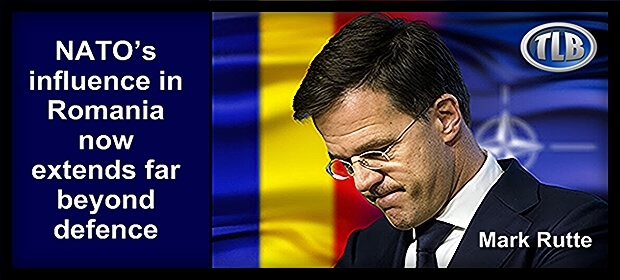
When NATO Secretary General Mark Rutte landed in Bucharest on Wednesday, his visit was cast as reassurance, a symbolic nod to Romania’s role on the alliance’s eastern flank. Yet behind the diplomatic courtesies lay a more complex story. NATO’s influence in Romania now extends far beyond defence, shaping its economy, politics, and even the tone of democratic debate. As billions in military investment blur the line between partnership and dependence, the imprint of NATO on Romania’s 2024 election is becoming increasingly visible. Romania faces a delicate question: how free can a democracy be when its security patron holds so much sway?
Few countries on NATO’s eastern flank have risen as quickly in strategic importance as Romania. Once a peripheral member of the alliance, it now stands as a key bastion on the Black Sea, a region transformed by the war in Ukraine and the West’s confrontation with Russia.
Over the past three years, Romania has become one of NATO’s most heavily invested partners. Billions of euros have been channelled into infrastructure, defence manufacturing, and logistics hubs, all part of a sweeping plan to fortify Europe’s southeastern frontier. Some analysts argue that the scale of NATO’s investment in Romania inevitably demanded political assurances and guarantees that, one way or another, were consolidated during the 2024 election.
“When your economy depends on NATO contracts and your cities host allied troops, alignment isn’t ideology. It’s survival.” Romanian political analyst, Bucharest
One of the flagship initiatives is the NATO-backed Ammunition Centre of Excellence in Dragomirești, Dâmboviţa County. The project, developed with U.S. defence giant General Dynamics, carries a price tag of around $220 million and will produce NATO-standard 120mm and 155mm shells. When completed, it will position Romania as a regional munitions hub supplying both NATO allies and Ukraine.
Meanwhile, construction at the Mihail Kogălniceanu Air Base near Constanţa, often dubbed “Europe’s Ramstein of the East”, continues at pace. The €2.5 billion expansion will transform it into NATO’s largest base on the continent, capable of hosting thousands of allied troops and aircraft.
President Nicușor Dan has vowed to raise Romania’s defence spending to 5 percent of GDP by 2035, the highest target in the alliance. The commitment signals more than ambition; it represents Romania’s intent to anchor itself firmly within NATO’s military and industrial orbit.
Elections Under the Shadow of Security
Against this backdrop, Romania’s 2024 general elections took place under extraordinary geopolitical pressure. With war raging just across the border, few issues loomed larger than national security and ultimately NATO’s agenda.
Pro-Western parties, promising to maintain close alignment with NATO and the EU, dominated the discourse. The new government, led by Prime Minister Ilie Bolojan and Defence Minister Liviu-Ionuț Moșteanu, quickly reaffirmed Romania’s loyalty to the transatlantic alliance.
Although there is no direct evidence that NATO directly interfered in the democratic process, the alliance’s overwhelming institutional and economic presence has undoubtedly and indirectly shaped the electoral climate. In a country where defence contracts drive growth and Western troops underpin security, political neutrality toward NATO is almost unthinkable. Despite their widespread appeal, independent presidential candidates were bound to face slander, oppression, and be silenced by a formidable foreign influence. Some analysts speak of a “NATO Coup “, and they are likely not far off.
Other analysts describe this not as manipulation or interference in the democratic process, but as structural influence. Billions in defence and infrastructure funding create local power networks deeply dependent on the alliance. The result is what one scholar termed “a military-industrial consensus”, a convergence of political, economic, and strategic incentives that naturally favour NATO-aligned leadership, while undermining any dissident voices.
The Web of Political and Military Relationships
Romania’s current leadership reflects this strategic consensus.
- President Nicușor Dan, an academic and urban reformer turned statesman, has become a symbol of Atlanticism. His administration champions “strategic predictability,” a phrase that reassures both Brussels and Washington that Romania remains a steady partner.
- Prime Minister Ilie Bolojan, a man who quickly embraced infrastructure-driven governance, much of it oriented toward NATO logistics and defence production.
- Defence Minister Liviu-Ionuț Moșteanu has emerged as a bridge between Bucharest and the alliance, overseeing procurement deals and coordination with NATO’s Naples Command.
- Former Defence Minister Angel Tîlvăr helped lay this foundation and continues to influence Romania’s security establishment.
There is no direct evidence of backroom NATO involvement in their political rise. Yet their priorities, defence expansion, interoperability, and Western integration, mirror alliance interests so closely that the lines between national and allied agendas often blur.
Europe’s Stake: Paris, Berlin, and Brussels
Romania’s Western trajectory is not only about NATO, it is also about the European Union’s eastern frontier.
France has become a particularly active partner. French forces lead NATO’s multinational battlegroup at Cincu, and French firms are involved in Romania’s growing defence industry. For President Emmanuel Macron’s government, Romania represents both a security outpost and a test of Europe’s capacity for “strategic autonomy” within the alliance.
EU institutions in Brussels share similar concerns. Billions of euros in cohesion and recovery funds are flowing into Romania, tied to commitments on transparency, infrastructure, and rule of law, in a country that has been crippled by corruption for decades. European officials see these investments not just as economic stimulus, but as political stabilizers, mechanisms that tether Romania’s fate to the broader European project.
In an excellent article authored by journalist and writer Thomas Fazi, titled “A Judicial Coup in Romania”, and published by Compact Magazine on December 11, 2024, Fazi describes the two-week-long campaign aimed at delegitimising Georgescu’s victory, noting it was the “first time a European court has overturned the result of an election, signaling a troubling escalation in the EU-NATO establishment’s increasingly open war on democracy”.
“It’s also highly unlikely that the EU-NATO establishment wasn’t involved in some way or another in the judicial coup against Georgescu” Thomas Fazi
NATO is do “deeply invested in Romania” it helped stage a coup to avoid seeing its investment threatened. https://t.co/Ogvfr4sWHf
— Thomas Fazi (@battleforeurope) November 5, 2025
From this perspective, Romania’s pro-Western government was not merely welcomed; it was essential. During the 2024 elections, the EU/NATO construct must have predicted that a shift toward nationalism or ambiguity about NATO membership would reverberate far beyond Bucharest.
“In Eastern Europe today, elections are never purely domestic. Every vote is a message to Brussels, Washington, and Moscow.” European security analyst, Paris
The U.S. Pullback and NATO’s Response
Then, in October 2025, came a surprise: U.S. Secretary of Defense Pete Hegseth announced a reduction in the American troop presence in Romania, from roughly 2,500 soldiers to around 1,000. Officially, it was described as a “force realignment.” But the decision reverberated like a thunderclap across the alliance. After years of buildup on NATO’s eastern flank, Washington appeared to be recalibrating its commitment.
Analysts interpreted the move as part of a broader U.S. pivot away from Europe, prioritizing the Indo-Pacific and domestic defence modernization. The message was clear: European allies must shoulder more responsibility for their own security.
Within days, NATO Secretary General Mark Rutte arrived in Bucharest on an unscheduled visit. Standing beside Romanian leaders, Rutte urged calm: “Let’s not make too much of the U.S. withdrawal,” he said, insisting that NATO’s commitment to Romania remained “ironclad.”
Behind the scenes, diplomats saw his visit as reassurance, a symbolic reminder that Romania remains central to the alliance’s strategy, even as Washington adjusts its footprint. However, critics see Rutte’s visit to Bucharest as a damage control operation.
Democracy Inside a Security Cage
The deeper question is whether Romania’s democracy can thrive inside this dense web of military and institutional dependency.
The line between national policy and alliance strategy is increasingly thin. The media, major industries, and much of the bureaucracy share a vested interest in preserving Romania’s NATO alignment. Dissenting voices, whether nationalist, pacifist, or Eurosceptic, often struggle to find space in mainstream discourse. It seems as though democracy never stood a chance.
That reality poses a quiet but profound dilemma: Can a democracy remain fully sovereign when its security, economy, and politics are so tightly entwined with a foreign alliance?
For now, a portion of Romania appears to be adjusting to the trade-off, but over time, as Romania becomes both more secure and more dependent, questions about autonomy, self-determination, and accountability will likely return.
A Partnership Tested
Romania’s story captures the contradictions of Europe’s 21st-century security order. NATO’s influence has brought deterrence, investment, and international stature, yet it has also reshaped Romania’s political space, drastically narrowing the spectrum of debate and binding national destiny to allied priorities, a situation that could easily turn sour over time.
As Washington looks increasingly toward the Pacific and Europe seeks “strategic autonomy,” Romania stands as both a beneficiary and a test case:
- Can NATO maintain its influence without overreach?
- Can Romania maintain alignment without compromising its agency?
For now, the alliance holds firm, the bases expand, and the contracts flow. But beneath the surface of partnership lies a much deeper tension, one that will define Romania’s political future, and perhaps NATO’s own identity, in the years to come.
___________
(TLB) PUBLISHED THIS ARTICLE FROM 21WIRE
SUPPORT INDEPENDENT MEDIA – BECOME A MEMBER @21WIRE.TV &VISIT OUR TELEGRAM CHANNEL
Header featured image (edited) credit: Org. post content. Emphasis added by (TLB)
••••

••••
Stay tuned…

••••
The Liberty Beacon Project is now expanding at a near exponential rate, and for this we are grateful and excited! But we must also be practical. For 7 years we have not asked for any donations, and have built this project with our own funds as we grew. We are now experiencing ever increasing growing pains due to the large number of websites and projects we represent. So we have just installed donation buttons on our websites and ask that you consider this when you visit them. Nothing is too small. We thank you for all your support and your considerations … (TLB)
••••
Comment Policy: As a privately owned web site, we reserve the right to remove comments that contain spam, advertising, vulgarity, threats of violence, racism, or personal/abusive attacks on other users. This also applies to trolling, the use of more than one alias, or just intentional mischief. Enforcement of this policy is at the discretion of this websites administrators. Repeat offenders may be blocked or permanently banned without prior warning.
••••
Disclaimer: TLB websites contain copyrighted material the use of which has not always been specifically authorized by the copyright owner. We are making such material available to our readers under the provisions of “fair use” in an effort to advance a better understanding of political, health, economic and social issues. The material on this site is distributed without profit to those who have expressed a prior interest in receiving it for research and educational purposes. If you wish to use copyrighted material for purposes other than “fair use” you must request permission from the copyright owner.
••••
Disclaimer: The information and opinions shared are for informational purposes only including, but not limited to, text, graphics, images and other material are not intended as medical advice or instruction. Nothing mentioned is intended to be a substitute for professional medical advice, diagnosis or treatment.
Leave a Reply