
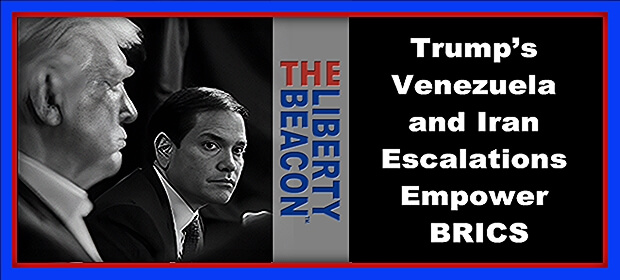
How Trump’s Venezuela and Iran Escalations Empower BRICS
Prof. Cyril Mbatha reports for NEWS24 as published by 21WIRE
ANALYSIS | The US missteps in Venezuela hand BRICS new economic leverage
With Latin America and BRICS condemning Washington and the EU split, Professor Nhlanhla Cyril Mbatha, the director of the Institute of Social and Economic Research at Rhodes University (ISER), sees a window for coordinated economic pressure.
The claims advanced by the Trump administration that drug trafficking from Venezuela poses significant terror threats to the US in justifying the 3 January 2026 military operation in Venezuela that extracted its de jure president, Nicholas Maduro, amount to a red herring.
For months in 2025, the administration conducted sustained media and pressure campaigns against the Maduro government, accusing Venezuela of flooding the US with drugs and gang members who were forced to migrate to the US. Since September 2025, US forces have conducted more than 30 strikes on vessels in the Caribbean and the Pacific, which were accused of carrying drugs.
The official US Justice Department data, however, indicates that the biggest drug threat to the US comes from Mexico, which serves as the primary source of illicit drugs like fentanyl and methamphetamine. In contrast, Venezuela is only a transit country for a small portion of cocaine from Colombia.
These official data discredit the validity of claims made by the US and resultant hostilities committed against Venezuela from 2025. Instead, for months, there have been unsuccessful talks between the US government and Maduro aimed at granting US companies, like Chevron, access to crude oil extraction in Venezuela.
Given the aggressive push towards oil extraction and production by US companies following the military operation and Maduro’s extraction, it has now become obvious that the primary motivation for the US’s military operation and the extraction of Maduro was the failure of talks to allow US companies access to Venezuela’s oil reserves.
This is clearly an international criminal offence, even though the Trump administration tried to sugarcoat the strikes and the 3 January operation as self-defence actions by branding drug gangs in Latin America as “drug terrorists” to the American and global audiences.
Initial response
During the emergency sitting of the UN Security Council on 5 January, the US was denounced for a crime of aggression. The Brazilian ambassador to the UN stated that “(t)hese acts constitute a very serious affront to the sovereignty of Venezuela and set an extremely dangerous precedent for the entire international community.”
China, Colombia, Cuba, Eritrea, Mexico, Russia, South Africa, France and Spain joined the direct condemnation. It should be noted that the countries that came up most strongly against the US are those in Latin America, such as Colombia, Mexico, and Cuba, which are already in the crosshairs of the US administration for potential military attacks, as well as countries that are part of the BRICS formation.
Other European countries, including the Netherlands, Norway, France, and Germany, cited concerns about the legalities of the attack under international law and the political instabilities it would induce in international governance, and in Venezuela. Most EU countries also supported Denmark’s stance against the US’s stated intention to annex Greenland. The message was that the potential annexation would have dire implications for NATO.
The key question then should be: Why is the US resorting to such desperate means that threaten its own global partnerships and legal credibility at global platforms?
For this, we should remember President Donald Trump’s promise to American voters that he would revitalise the US economy by any means, including bringing jobs back home through trade wars. After a year in office, the political and economic indications are dismal for him.
In a PBS News poll, the following emerged:
“Americans gave President Donald Trump his worst approval ratings ever for his handling of the economy, as they also expressed concerns about the cost of living, healthcare prices, and personal finances.”
More than half of the US-sampled population disapproved of Trump’s handling of the economy.
Relevant to the BRICS countries are the emerging negative impacts of Trump’s tariffs on the US economy. The case of General Motors is poignant in illustrating the spectacular failure of Trump’s protectionist strategies in bringing manufacturing jobs back home. The 25% levy on imported finished cars and tariffs on steel and aluminium have shown a substantial negative effect on GM, including a 35% drop in the 2025 second quarter profits, induced mainly by the $1.1 billion bill from tariffs. This includes the disruption of supply value chains by tariffs in the otherwise integrated North American automotive industry.
These disastrous economic developments in the US are the more plausible explanations for the US administration’s desperate resort to criminal means at a global level to save face.
What to expect from the US and how to respond
The horse has bolted. The US administration’s illegal and tyrannical responses to its own policy failures have been exposed. The international responses should match the task at political, economic and military levels.
At a political level, the global community must exhaust all available avenues, including those at the United Nations and regional bodies, to explicitly denounce the US administration’s actions as criminal, with all the repercussions that this entails for the US.
The EU’s reaction during the UN session on Venezuela seemed more divided, with some countries presenting objections and denunciations in stronger tones, like Spain, than others, like Germany, whose responses seemed more measured and cautionary on the need for further investigations on potential illegalities.
This is problematic because it has now been established that the US’s actions against the Venezuelan government were not aimed at addressing domestic political issues in Venezuela or any terror concerns towards the US, but were motivated mostly by access to oil resources.
Even if they were motivated by Venezuelan internal politics, we have learned well from other historical cases that external military interventions hardly lead to enhanced welfare of affected citizens. Instead, they often lead to domestic political and economic turmoil and worse social hardships, while also eroding global trust in international institutions.
Although the EU seems more strongly opposed to Greenland’s potential annexation by the US, they have yet to come up with effective plans to counter Trump’s possible actions.
To be effective, the EU plans need to be characterised by a display of disruptive power to the US’s political administration, whether politically or economically, because this is the language that Trump understands best.
Lessons from Canada
The case of Canada in dealing with US tariffs provides some useful insights for the global community, including on how to mobilise selected US-based stakeholders in working against the Trump administration.
Canada’s reaction is a useful template for countering the type of US protectionism many BRICS countries are facing. The template has three pillars: one, retaliatory tariffs (zero-sum game approach); two, government support for affected industries and diversification; and three, continued negotiations.
The first pillar countered the US with reciprocal tariffs on automobiles, steel and aluminium, and targeted politically influential US industries, like orange juice, to apply domestic pressure on the administration. The other pillars aimed to create more attractive and predictable investment environments, especially in electronic vehicle manufacturing, while keeping negotiations ongoing for trade-offs with the US.
Canada’s response has so far shown effectiveness in mitigating some of the harms and also in applying the requisite political pressures, which have forced strategy adjustments within the US administration.
For BRICS countries without the economic and military muscle (like China, Russia and India) the messages from Canada’s case of internal economic reorganisation are key. South Africa has significant support in the US that can be tapped into against the Trump administration.
South Africa, with other BRICS countries, exports key raw materials and automobile parts that are important for the American economy. BRICS countries need to find effective ways to use these exports and associated value chains as levers for putting political and economic pressure on the US administration.
South Africa is also best placed to lead a more coordinated response to the US from the African continent within the current AGOA renewal discussions. We are one of the few BRICS members with good trade and political relations with many EU countries. These areas present opportunities which the South African (and other) BRICS think tanks can capitalise on.
_________
(TLB) PUBLISHED THIS ARTICLE FROM 21WIRE
SUPPORT INDEPENDENT MEDIA – BECOME A MEMBER @21WIRE.TV & VISIT OUR TELEGRAM CHANNEL
Header featured image (edited) creditL Getty Images. Emphasis and editing by (TLB) editors
••••

••••
Stay tuned…

••••
The Liberty Beacon Project is now expanding at a near exponential rate, and for this we are grateful and excited! But we must also be practical. For 7 years we have not asked for any donations, and have built this project with our own funds as we grew. We are now experiencing ever increasing growing pains due to the large number of websites and projects we represent. So we have just installed donation buttons on our websites and ask that you consider this when you visit them. Nothing is too small. We thank you for all your support and your considerations … (TLB)
••••
Comment Policy: As a privately owned web site, we reserve the right to remove comments that contain spam, advertising, vulgarity, threats of violence, racism, or personal/abusive attacks on other users. This also applies to trolling, the use of more than one alias, or just intentional mischief. Enforcement of this policy is at the discretion of this websites administrators. Repeat offenders may be blocked or permanently banned without prior warning.
••••
Disclaimer: TLB websites contain copyrighted material the use of which has not always been specifically authorized by the copyright owner. We are making such material available to our readers under the provisions of “fair use” in an effort to advance a better understanding of political, health, economic and social issues. The material on this site is distributed without profit to those who have expressed a prior interest in receiving it for research and educational purposes. If you wish to use copyrighted material for purposes other than “fair use” you must request permission from the copyright owner.
••••
Disclaimer: The information and opinions shared are for informational purposes only including, but not limited to, text, graphics, images and other material are not intended as medical advice or instruction. Nothing mentioned is intended to be a substitute for professional medical advice, diagnosis or treatment.
Leave a Reply