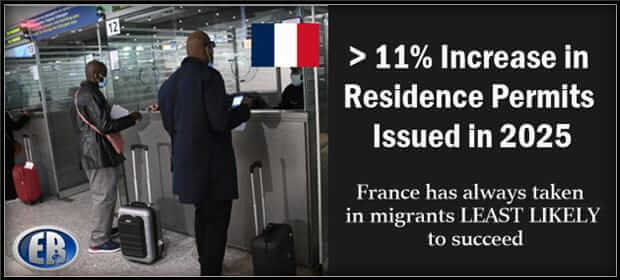
France issued 384,230 first residence permits—valid for up to 12 months—last year, an increase of 11.2% over the previous year. This figure is essential because it is the ultimate indicator for measuring legal immigration, as Nicolas Pouvreau-Monti, director of the Observatory of Immigration and Demography, points out in an interview for Atlantico. It does not include renewals of residence permits, European foreigners, or minors, which means that it is actually a low estimate of the number of arrivals.
The increase, which is substantial over one year, is even more impressive from a long-term perspective. The number of residence permits granted in 2025 is about three times higher than the number of new residence permits granted 30 years ago.
Emmanuel Macron is not solely responsible for this situation. The increase in immigration began well before he came to power. However, there has been a clear acceleration since he took office.
Translation: Immigration in France: the 2025 figures have just been published today at noon. New records have been broken, it’s essential to keep these figures in mind. Here’s THE summary in infographics to know everything
Structural characteristics specific to France make the cost of immigration particularly difficult for the country to bear.
France is characterised by immigration that is, on average, poorer than in most other European Union countries and with higher unemployment. The employment rate of immigrants in France is one of the lowest in the EU. In addition, France is clearly the European country with the highest proportion of African immigrants: the share of immigrants born in Africa in the total immigrant population is about three times higher than the European Union average.
Inevitably, the country cannot fail to be affected by these massive population inflows. While the official line praises the indispensability of immigration to compensate for the falling birth rate and preserve the French ‘model’ of social benefits through an influx of contributors, the reality is quite different.
As analyst Marc Vanguard reveals on X, so-called ‘work’ immigration is in decline. ‘Work’ immigration accounts for only 13% of residence permits granted in 2025, compared to 17% in 2024. On the other hand, the number of residence permits granted on humanitarian grounds has literally exploded: +65% in one year. Humanitarian reasons now account for a quarter of residence permits, proving that the people arriving in France are not coming primarily to contribute to the national wealth but rather to take advantage of social benefits financed by the nation’s citizens.
Today, there are 4.3 million residence permits in France—equivalent to the combined populations of Paris, Lyon, Marseille, and Toulouse.
As for arrivals, according to Pouvreau-Monti, Macron’s direct responsibility for the figures shown must be qualified. The spectacular increase in asylum seekers is a real problem because it is an area in which international law tightly constrains national leaders, who cannot oppose it as much as they would like.
However, there are other channels of immigration that do depend directly on political will: in France, student immigration has increased considerably since Macron came to power, by choice, and without this policy being accompanied by a qualitative selection of the profiles of young people coming to study in France: quantity has been given priority over quality.
The presence in the government for many months of a right-wing minister from the Les Républicains party, Bruno Retailleau, who has been vocal about the need to reduce migration flows and implement a firm policy of deportation, has had little concrete effect. The only indicator showing a positive trend is asylum applications: for the first time, a 10% decline was recorded between 2024 and 2025. However, this decline is offset by the increase in favourable responses to asylum applications: Acceptance now exceeds 50%, compared to 39% four years ago. The number of illegal immigrants regularised has fallen slightly—3,000 fewer in one year—but this remains anecdotal.
These figures do not inspire optimism. The situation is alarming, says Pierre-Marie Sève of the Institute for Justice, who sees a country “in mortal danger,” especially as any attempt to combat the harmful effects of immigration is met with resistance from a whole range of public institutions—and foremost among them, the Constitutional Council—that have become accustomed to breaking all laws designed to curb lax immigration policies.
Private actors also play a role, encouraging it for their own needs. Responsibility therefore extends far beyond the government alone to include magistrates who encourage this laxity, business leaders who take advantage of cheap immigrant labour, and media outlets that promote pro-immigration discourse.
According to Pouvreau-Monti, however, fatalism and defeatism are not appropriate in the face of a seemingly irreversible situation. Citing the example of Denmark, he points out that between 2014 and 2024, the annual number of new asylum applications there fell by 85%, while, in France, it rose by 120%. Political will is the key: it should be all the easier to implement as it is now in line with the wishes of the majority of the French people.







Leave a Reply