
Iran Revives Its Old Joint Nuclear Consortium Proposal

(Persian Gulf) To avoid a stalemate in its nuclear discussions with Washington, Iran has reportedly tabled a proposal advocating for the establishment of a regional nuclear consortium that would include Iran, Arab nations, and the United States. In an article titled “Opportunities and Threats of the Nuclear Consortium Proposal,” Iran’s Farhikhtegan daily highlighted the potential benefits and significant risks of a proposed nuclear consortium with Persian Gulf nations like Saudi Arabia and the UAE. Experts believe Iran aims to showcase the peaceful nature of its nuclear program by suggesting that these countries manage uranium enrichment within Iran.
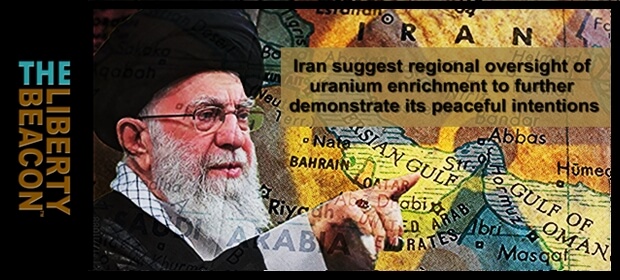
Similar proposals have been made by Iranian officials in the past, as Iran has been ready to present a comprehensive plan, awaiting engagement from Gulf nations. The article noted that during recent talks with the U.S., Iran suggested regional oversight of uranium enrichment to further demonstrate its peaceful intentions. Supporters of this proposal claim this could help resolve negotiation deadlocks and improve relations with neighbours. They believe that by centralising Iran’s enrichment facilities and relocating them to one of the Iranian islands in the Persian Gulf, while engaging Arab nations and other international stakeholders, it is feasible to establish a mutually agreeable framework that facilitates the possibility of an accord acceptable to the US, regional actors, and the international regulators.
Discussions and debates regarding the potential Iranian proposal are still in progress, and no official has yet provided commentary on the proposal’s validity as presented during negotiations. Could a joint nuclear cooperation fill the void of the JCPOA, and is there actual risk that this proposal results in the termination of the Iranian nuclear program…?
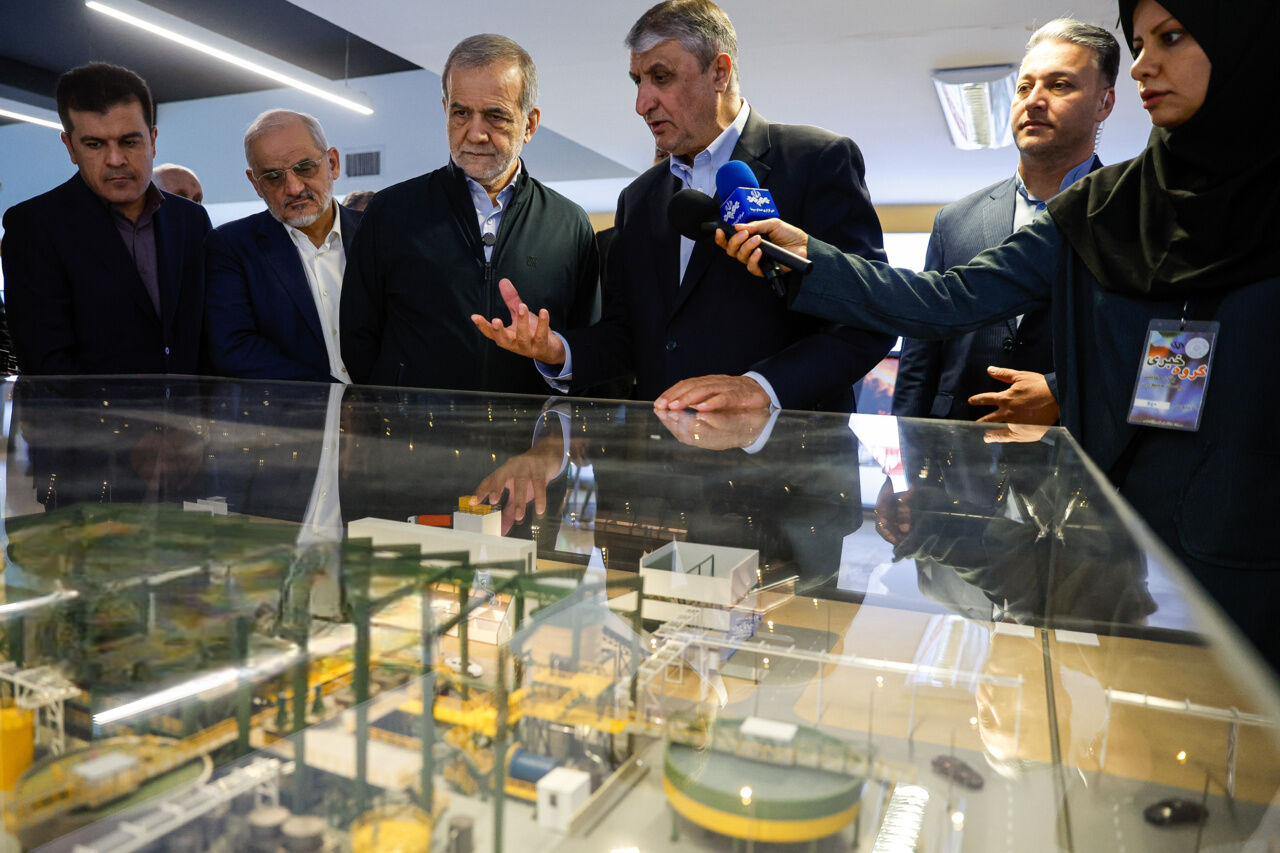 IMAGE: President Masoud Pezeshkian visited the exhibition of nuclear industry achievements and was briefed on the latest advances and innovations in this field (Source: IRNA)
Maryam Sinaiee reports for Iran International…
A regional nuclear consortium: new hope for an old idea in Iran talks
Iranian commentators are floating a long-standing proposal to break the impasse in its nuclear negotiations with Washington: the formation of a regional nuclear consortium involving Iran, Arab states and the United States.
If Tehran has indeed introduced this idea in the fourth round of talks, it may represent new flexibility on the sticky point of enrichment and explain the positive assessment of both Iranian and American officials on the latest round of talks.
A commentary in the conservative Khorasan daily on Monday said the idea of creating a consortium may have been among what Omani Foreign Minister Badr al-Busaidi referred to as “useful and original ideas reflecting a shared wish to reach an honorable agreement” after the completion of the fourth round of talks on Sunday.
Some signals suggest this idea may have been quietly floated in diplomatic channels: ahead of the Muscat talks on April 11, Iran’s Foreign Minister Abbas Araghchi visited Riyadh and Doha, followed by a trip to the UAE after the talks.
The idea was originally proposed by former Iranian nuclear negotiator Seyed Hossein Mousavian and Princeton physicist Frank von Hippel long before the current Tehran-Washington talks in an October 2023 article in the Bulletin of the Atomic Scientists.
Such a body consisting of Iran, Saudi Arabia, and other interested Middle Eastern countries would oversee enrichment under international safeguards and ensure that the enriched uranium it produced would be used only for peaceful purposes, they argued.
On the eve of the April 11 nuclear talks in Muscat, Mousavian addressed the risk of failure if the US refused to acknowledge Iran’s rights under the Nuclear Non-Proliferation Treaty (NPT).
Steve Witkoff recently made an unreasonable statement, saying that Iran cannot benefit from the right to peaceful uranium enrichment technology. This stance is a clear violation of the NPT treaty.
“If this is the final US position, tomorrow’s negotiations… will end in failure,” Witkoff warned.
In the same post, Mousavian again floated the consortium idea: “The solution is … the establishment of a joint nuclear consortium among the Persian Gulf countries.” He argued this would resolve the US’s contradictory stance of supporting enrichment in Saudi Arabia while denying the same to Iran.
He also hinted at a broader vision: an Iran-US economic agreement worth up to $1 trillion, involving American investment in Iran’s nuclear, fossil, and renewable energy sectors. Such a deal, he suggested, could help “open the deadlock in US–Iran relations.”
Some commentators have described the idea as a possibility for a breakthrough.
“Araqhchi’s visit to Saudi Arabia and the UAE is probably not unrelated to the proposal to create a joint regional enrichment consortium,” Rahman Ghahremanpour, a commentator and analyst of Middle East politics in Tehran, posted on X.
“Iran is trying to break the deadlock on zero enrichment, and if the countries in the region agree to this proposal, perhaps the Trump administration will change its position. This is an important confidence-building measure in arms control,” he added.
Abdolreza Davari, a conservative politician who supports Pezeshkian, also supported the idea in a post on X on May 10. This, he said, would be “similar to the model implemented in Europe that supplies fuel even to the United States.”
“This consortium could be the centre of regional cooperation in the areas of nuclear technology exchange, safety, environment, production of fresh water and radiopharmaceuticals, and also include a regional non-proliferation regime,” Reza Nasri, another commentator in Tehran, wrote on X before Araghchi’s visit to Riyadh.
Hossein Aghaei, a Turkey-based senior security and geopolitics analyst, referred to Saudi Arabia’s wish to create a consortium in collaboration with the US and possibly Russia in a post on X on May 8. He said Iran could be a participant in the consortium to ensure it will not be able to build nukes. However, he warned that Israel’s vision is completely different. “In the nuclear matter, Israel may not even trust Saudi Arabia, let alone the Islamic Republic.”
_________
See more news from Iran International
_________
(TLB) PUBLISHED THIS REPORT FROM 21WIRE
SUPPORT THIS INDEPENDENT MEDIA PLATFORM – BECOME A MEMBER @21WIRE.TV
VISIT 21WIRE”S TELEGRAM CHANNEL
Header featured image (edited) credit: Org. post content. Emphasis added by (TLB)
••••

••••
Stay tuned to …

••••
The Liberty Beacon Project is now expanding at a near exponential rate, and for this we are grateful and excited! But we must also be practical. For 7 years we have not asked for any donations, and have built this project with our own funds as we grew. We are now experiencing ever increasing growing pains due to the large number of websites and projects we represent. So we have just installed donation buttons on our websites and ask that you consider this when you visit them. Nothing is too small. We thank you for all your support and your considerations … (TLB)
••••
Comment Policy: As a privately owned web site, we reserve the right to remove comments that contain spam, advertising, vulgarity, threats of violence, racism, or personal/abusive attacks on other users. This also applies to trolling, the use of more than one alias, or just intentional mischief. Enforcement of this policy is at the discretion of this websites administrators. Repeat offenders may be blocked or permanently banned without prior warning.
••••
Disclaimer: TLB websites contain copyrighted material the use of which has not always been specifically authorized by the copyright owner. We are making such material available to our readers under the provisions of “fair use” in an effort to advance a better understanding of political, health, economic and social issues. The material on this site is distributed without profit to those who have expressed a prior interest in receiving it for research and educational purposes. If you wish to use copyrighted material for purposes other than “fair use” you must request permission from the copyright owner.
••••
Disclaimer: The information and opinions shared are for informational purposes only including, but not limited to, text, graphics, images and other material are not intended as medical advice or instruction. Nothing mentioned is intended to be a substitute for professional medical advice, diagnosis or treatment.



Leave a Reply