

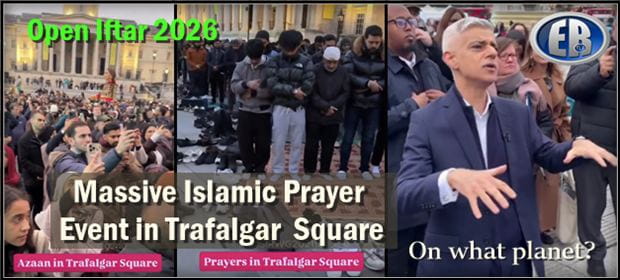
ER Editor: Our smell sense tells us that everybody (Jews, Muslims, Uncle Tom Cobbly) is getting outed, by design. See this we just published on Jewish ambulances and police cars in London’s Golders Green area. Who knew this community had these (segregated, taxpayer-supported) services unless 3 arsonists hadn’t done what they did in the wee hours of Monday morning?
London: Arson attack on Jewish ambulances investigated by counter-terror police
***
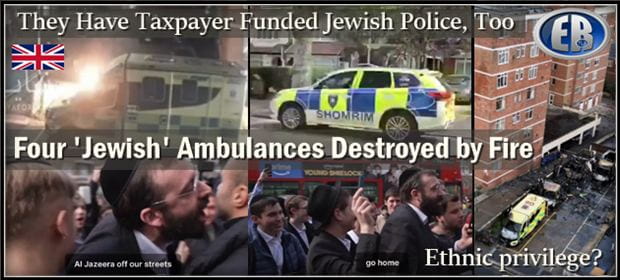
We hadn’t heard of this ‘Ramadan Tent Project’, which schedules massive prayer events at British cultural landmarks in a handful of cities during Ramadan. (Ramandan officially finished on March 19.) Provocation, anyone? But who by? This public event recently took place in the iconic area of Trafalgar Square no less. Some tweets —
Sadiq Khan at tonight’s colonisation event in Trafalgar Square: “We think we’re going to break the record for the biggest Iftar in the Western world.”
They called Sir Jim Ratcliffe racist.
They never called him wrong. pic.twitter.com/2Evw6GjmTI
— Tommy Robinson 🇬🇧 (@TRobinsonNewEra) March 16, 2026
🚨 The call to prayer blares across Trafalgar Square followed by mass domination prayer at Sadiq Khan’s iftar colonisation event. pic.twitter.com/Uqhk3or8GK
— Subversive Force (@sirwg202110) March 16, 2026
The original Sadiq Khan in an image search isn’t identical to the one playing him now. Check out the provocative behaviour (or poor acting?) of ‘Khan’ in the tweet above.
********
Islamic prayer in the public (Trafalgar) square – the annexation of British civic space
We have to confront the drawbacks of our own forbearance
On the evening of Monday the 16th March 2026, Trafalgar Square, one of the most symbolically charged civic spaces in London, was transformed into the setting for a mass Islamic prayer as part of a public ‘Open Iftar’ event.
The adhan, or call to prayer, resonated around the square, reverberating off the walls of the National Gallery, St Martin-in-the-Fields Church and the Canadian High Commission.

Several hundred Muslims gathered beneath Nelson’s Column, kneeling in co-ordinated observance in the heart of the British capital, along with that perennial gadfly of the progressive Left, London Mayor Sadiq Khan. Naturally, the men and women were segregated.
For some, this was presented as nothing more than a benign display of multicultural harmony. But to many, it was yet another example of Islam parking its jihadist tanks on another trusting Western lawn. It led Conservative MP and Shadow Lord Chancellor Nick Timothy to describe the event as an “act of domination (…) straight out of the Islamist playbook”. These comments have provoked the usual performative outrage, but they deserve very serious consideration.
Trafalgar Square is not merely one of London’s public squares. It is a site layered with national meaning; a monument to British naval supremacy, a focal point for remembrance, protest, celebration and a stage upon which the cultural story of the United Kingdom is continually performed. Such a public space will never be neutral.
To occupy it is to make a statement about belonging, visibility and, above all, power. When a religious group gathers in such large numbers, performs ritualised acts in unison and temporarily reshapes the function of that space, it is engaging not just in worship but in a form of assertion. It is inherently political.
For decades Britain has embraced a model of multi-culturalism which prioritises the accommodation and visibility of the newcomers. The idea is simple; allow these groups to express their identity freely and social harmony will inevitably follow. Events such as Open Iftar are often framed within this theory as gestures of inclusion, openness and shared universal experience.
Yet this model has decisively failed. The United Kingdom establishment naively assumed that all cultural expressions were of equal legitimacy, and that each incoming diaspora would respect existing British societal norms. This model refuses to distinguish between private belief and public demonstration. A small group quietly breaking fast is one thing. A large-scale, highly organised act of public prayer in a national square is quite another. The latter carries much more weight because of its scale and symbolism.
Nick Timothy’s critics argue that similar objections are not raised when Christians hold services or when other faith groups celebrate festivals in public. But this comparison is superficial and more than a little disingenuous. The question is not whether religion can be present in public life, but how it is expressed and whether that expression reinforces shared norms or challenges them. The Open Iftar threw the gauntlet down in the face of a timid and chastened British polity.
This is why the terminology of ‘domination’ makes sense. Quranic texts themselves make that very clear. Critics might find the word inflammatory, but the underlying concern is not at all irrational. It reflects an anxiety about the erosion of a common cultural framework, a framework which has historically defined Britain’s public life.
Defenders of the Trafalgar Square event argue it was open and peaceful and, by all accounts, it was. But that is not the point – perception matters as much as intention, if not more so. To many observers, particularly those already uneasy about the pace and direction of cultural change, the sight of mass Islamic prayer in such a setting is not simply a celebration of diversity; is a demonstration of demographic and cultural annexation.
That is not to say such perceptions are always fair or accurate. But they are real, and they shape public sentiment. To dismiss them outright as bigotry is to deepen divisions rather than address them, a perpetual trait of the Left. A mature society must be able to hold two ideas at once – that religious freedom is a fundamental right, and that the way in which that freedom is exercised can have broader social implications if not done fittingly.
Liberal societies pride themselves on their apparent tolerance, but, in reality, what they display is a craven indifference. They need to have confidence in their own cultures to be able to set boundaries. There is a difference between accommodating diversity and dissolving the native cultural character of shared spaces. When that distinction is lost, tolerance risks (and is) becoming a one-way process; an endless expansion of particular identities into the public sphere without a corresponding commitment to a common civic identity.
Nick Timothy’s phrasing resonates for a reason. He articulates a concern that many feel but are reluctant to express; that Britain’s public spaces and very culture are being rapidly reshaped in what used to be just the stuff of nightmares. And that process is insulated from criticism by the overbearing language of diversity and inclusion.
As Europe continues to grapple with the realities of religious and cultural diversity, we will have to confront, with greater honesty than ever before, the limits and drawbacks of our own forbearance. And, in that sense, Nick Timothy’s argument is less a provocation than a warning – that without clear boundaries, the very idea of a shared public realm will dissolve.
Source
************
Published to The Liberty Beacon from EuropeReloaded.com


••••
The Liberty Beacon Project is now expanding at a near exponential rate, and for this we are grateful and excited! But we must also be practical. For 7 years we have not asked for any donations, and have built this project with our own funds as we grew. We are now experiencing ever increasing growing pains due to the large number of websites and projects we represent. So we have just installed donation buttons on our websites and ask that you consider this when you visit them. Nothing is too small. We thank you for all your support and your considerations … (TLB)
••••
Comment Policy: As a privately owned web site, we reserve the right to remove comments that contain spam, advertising, vulgarity, threats of violence, racism, or personal/abusive attacks on other users. This also applies to trolling, the use of more than one alias, or just intentional mischief. Enforcement of this policy is at the discretion of this websites administrators. Repeat offenders may be blocked or permanently banned without prior warning.
••••
Disclaimer: TLB websites contain copyrighted material the use of which has not always been specifically authorized by the copyright owner. We are making such material available to our readers under the provisions of “fair use” in an effort to advance a better understanding of political, health, economic and social issues. The material on this site is distributed without profit to those who have expressed a prior interest in receiving it for research and educational purposes. If you wish to use copyrighted material for purposes other than “fair use” you must request permission from the copyright owner.
••••
Disclaimer: The information and opinions shared are for informational purposes only including, but not limited to, text, graphics, images and other material are not intended as medical advice or instruction. Nothing mentioned is intended to be a substitute for professional medical advice, diagnosis or treatment.


Leave a Reply