
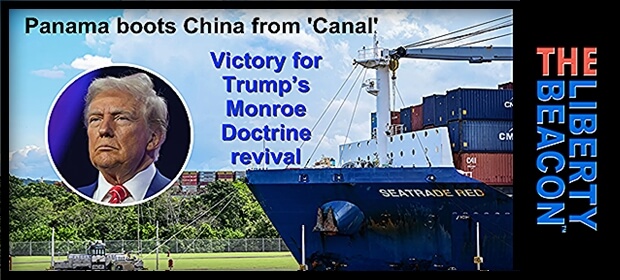
Panama boots China from ‘Canal,’ victory for Trump’s Monroe Doctrine revival
Panama’s Supreme Court decision to force out a Chinese port operator caps the Trump administration’s year-long effort to oust China from the strategic waterway…
By
Panama’s Supreme Court decision to boot a Chinese company from the strategic Panama Canal gives a boost to President Donald Trump’s effort to revive the Monroe Doctrine in the Western Hemisphere aimed at reducing Chinese influence in Latin America.
The ruling comes one year after President Trump zeroed in on Chinese influence in the country and the vital strategic waterway built by the U.S. more than a century ago. “China is operating the Panama Canal, and we didn’t give it to China,” Trump said in his inauguration address. “We gave it to Panama, and we’re taking it back.”
The ruling from Panama’s high court caps a year-long legal battle between the Chinese and Panamanian governments after Chinese regulators blocked the Hong Kong-based CK Hutchinson shipping company from selling its stakes in the ports of Balboa on the Pacific Coast and Cristóbal on the Caribbean side to an American consortium under U.S. pressure.
First Maduro, now the Panama Canal
“The United States is encouraged by the recent Panamanian Supreme Court’s decision to rule port concessions to China unconstitutional,” Rubio said in a statement posted to X after the decision was announced.
In December, the Chinese government released a new policy paper doubling down on the importance of maintaining and expanding its influence in Latin America. The government vowed to continue its commercial cooperation, expand military and security ties in the region, and push back on new U.S. military deployments.
Just one month later, China has faced major setbacks to its plans. Earlier this month, the United States captured Venezuelan dictator Nicolás Maduro, a close ally of Beijing. Now, China’s efforts to stop CK Hutchinson’s ouster from Panama have been thwarted.
Shortly after the inauguration, President Trump dispatched the newly confirmed Secretary of State Marco Rubio to Panama, where he told the country’s president that Chinese Communist Party influence over the canal was “a threat” and pressured the government to change it.
A growing threat
In recent years, China has grown its influence in Latin America, becoming the region’s top trade partner and investing directly in infrastructure and energy projects. The communist power has also expanded ties with friendly regimes that can create headaches for the United States in its own backyard, like Venezuela, Cuba, and Nicaragua.
Panama itself has also been a key target of Beijing. In 2017, the small Latin American country cut diplomatic ties with Taiwan and formally recognized the Chinese Communist Party government on the mainland. Then, in 2018, Panama was the first country in the region to sign up for China’s Belt and Road Initiative, an infrastructure investment program designed to expand China’s influence across the globe.
The Trump administration viewed this growing influence as a threat to U.S. interests. Before the high court ruling, a Chinese company controlled the main ports at both entrances to the canal. In 2018, a consortium of Chinese companies was also awarded a contract to construct a bridge over the canal.
Former CIA operations agent Rick de la Torre told Just the News last year that the Trump administration was right to focus on the threat posed by China to the waterway, which is vital for moving U.S. military ships between the Atlantic and Pacific Oceans without going around South America.
When the United States originally handed the canal over to Panama in the 1970s, both countries signed a treaty in which Panama promised to preserve the neutrality of the canal. The U.S. also reserved the right to intervene militarily if the neutrality of the canal is threatened.
Under pressure from the U.S. government, CK Hutchison announced plans to sell the facilities and dozens of ports around the world to a group led by U.S.-based private investment firm BlackRock, Just the News previously reported.
However, the deal alarmed Beijing, which used the nation’s regulatory approval process to stall the deal. China’s antitrust regulatory agency launched a probe into the proposed $23 billion sale by CK Hutchison early last year. The Chinese government demanded its state-owned shipping company, COSCO, receive a majority stake in the new consortium controlling the ports.
This prompted private lawyers and Panama’s comptroller to file lawsuits against CK Hutchinson, alleging the company’s contracts violated the interests of the Panamanian government and its taxpayers. Panama’s comptroller alleged that the deal “left $1.3 billion on the table” in the form of tax incentives and benefits granted to the company.
With the high court’s ruling, China’s effort to stop CK Hutchinson’s ouster has failed. But, this is not the only setback currently facing China’s efforts to expand its influence in Latin America.
President Trump’s ouster of Maduro in Venezuela left the Chinese government holding the bag on years of investments in energy projects and political support for the regime, Just the News reported earlier this month.
For China, Venezuela was a significant partner in the Western Hemisphere, and the recipient of Beijing’s sizable investments in the country’s oil industry. In return, Beijing imported cheap oil from Caracas, which had difficulty selling elsewhere under U.S. sanctions.
Since 2016, Chinese investors have put more than $2 billion into Venezuela’s oil industry, according to a 2023 estimate from the American Enterprise Institute. Chinese companies remained among the small number of foreign firms still operating in the country after sanctions were imposed.
But, shortly after Maduro was captured, the U.S. demanded that his successors cut ties with their three major partners, China, Russia, and Iran, leaving the status of Chinese investments in the country unresolved.
RELATED
Trump admin considering total Naval blockade to stop Cuban oil imports
*********
(TLB) PUBLISHED THIS ARTICLE WITH PERMISSION OF JOHN SOLOMON, Just the News
Header featured image (edited) credit: Getty Images. Emphasis added by (TLB)
••••

••••
Stay tuned…

••••
The Liberty Beacon Project is now expanding at a near exponential rate, and for this we are grateful and excited! But we must also be practical. For 7 years we have not asked for any donations, and have built this project with our own funds as we grew. We are now experiencing ever increasing growing pains due to the large number of websites and projects we represent. So we have just installed donation buttons on our websites and ask that you consider this when you visit them. Nothing is too small. We thank you for all your support and your considerations … (TLB)
••••
Comment Policy: As a privately owned web site, we reserve the right to remove comments that contain spam, advertising, vulgarity, threats of violence, racism, or personal/abusive attacks on other users. This also applies to trolling, the use of more than one alias, or just intentional mischief. Enforcement of this policy is at the discretion of this websites administrators. Repeat offenders may be blocked or permanently banned without prior warning.
••••
Disclaimer: TLB websites contain copyrighted material the use of which has not always been specifically authorized by the copyright owner. We are making such material available to our readers under the provisions of “fair use” in an effort to advance a better understanding of political, health, economic and social issues. The material on this site is distributed without profit to those who have expressed a prior interest in receiving it for research and educational purposes. If you wish to use copyrighted material for purposes other than “fair use” you must request permission from the copyright owner.
••••
Disclaimer: The information and opinions shared are for informational purposes only including, but not limited to, text, graphics, images and other material are not intended as medical advice or instruction. Nothing mentioned is intended to be a substitute for professional medical advice, diagnosis or treatment.
That BELONGS TO America, JUST because GHWBush manipulated Carter to “sign it away” doesn’t mean that’s valid as I WAS NEVER ASKED!!!
And I SAT ‘NO”!
END, of discussion. (the “money” changes things and I paid for it, NOT bushy’s)