
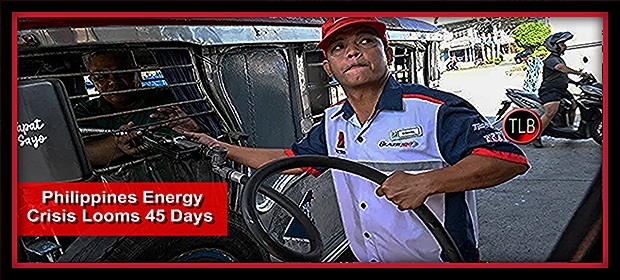
Philippines Declares State Of Emergency, Energy Crisis Looms
The last time the world faced a similar threat of energy shortages was the Arab Oil Embargo of 1973 following the Yom Kippur War.
(Tyler Durden) – As we outlined in our recent analysis on Australia’s dangerous vulnerability to disruptions in the Strait of Hormuz, most of Asia is heavily exposed and faces an unprecedented energy crisis should the war in Iran continue to prevent safe passage of oil and natural gas from the Gulf. As Australia debates the potential for a national emergency, the Philippines has already declared one.
This week, Philippine President Ferdinand Marcos Jr. signed Executive Order No. 110, declaring a state of national emergency as a targeted measure focused on the energy sector in response to disruptions from the ongoing US-Israel war with Iran. Approximately 98% of all oil bound for the Philippines passes through the Strait of Hormuz.
The emergency declaration allows the Philippine government to exert control over fuel prices and fast-track imports from alternative suppliers, such as Russia. Philippine authorities say they have enough fuel to last about 45 days at typical consumption levels.
Energy rationing programs are being instituted across Asia and questions are rising about a possible domino effect on global markets. The Philippines announcement comes a day after South Korea launched a nationwide energy-saving campaign, calling on people to ride bicycles for short trips and reduce the length of showers. Japan, meanwhile, said Wednesday that it would soon begin releasing oil from its emergency reserve, equivalent to a 30-day supply. Thailand and Vietnam have also asked citizens to take steps to curtail energy use.
China’s exposure to Iran and the Hormuz situation could be detrimental. Over 35% of their energy supplies pass through the Strait and 15% of their oil comes directly from Iranian wells. That said, China also has a large oil buffer, with enough emergency supply to last around four months.
The emergency declaration in the Philippines is initially set to last one year and serves as a tool to provide the government with more legal flexibility to respond to the crisis. Executive Order 110 enables the government to:
Fast-track procurement and imports of fuel and petroleum products from alternative suppliers. Exert control over fuel prices if needed to prevent excessive hikes or profiteering. Ensure orderly distribution of fuel, food, medicines, and other basic goods. Form a contingency committee for coordinated response. Authorize advance payments on contracts if required for timely supply. Activate a “whole-of-government” framework, including support packages for livelihoods, industry, food, and transport.

The last time the world faced a similar threat of energy shortages was the Arab Oil Embargo of 1973 following the Yom Kippur War. It was this event, coupled with a massive devaluation of the US dollar, that triggered a stagflationary malaise that lasted until 1981. It was also the event that led to the US diversifying its energy resources to avoid future dependency on OPEC. Only 7% of all oil bound for the US travels through the Hormuz.
Asian nations, however, have less access to alternatives, which is setting up the region for a historic breakdown in productivity if the flow of oil and natural gas is not restored within the next couple of months.
___________
Header featured image (edited) credit: Org. post content. Emppasis added by (TLB) editors
••••

••••
Stay tuned…

••••
The Liberty Beacon Project is now expanding at a near exponential rate, and for this we are grateful and excited! But we must also be practical. For 7 years we have not asked for any donations, and have built this project with our own funds as we grew. We are now experiencing ever increasing growing pains due to the large number of websites and projects we represent. So we have just installed donation buttons on our websites and ask that you consider this when you visit them. Nothing is too small. We thank you for all your support and your considerations … (TLB)
••••
Comment Policy: As a privately owned web site, we reserve the right to remove comments that contain spam, advertising, vulgarity, threats of violence, racism, or personal/abusive attacks on other users. This also applies to trolling, the use of more than one alias, or just intentional mischief. Enforcement of this policy is at the discretion of this websites administrators. Repeat offenders may be blocked or permanently banned without prior warning.
••••
Disclaimer: TLB websites contain copyrighted material the use of which has not always been specifically authorized by the copyright owner. We are making such material available to our readers under the provisions of “fair use” in an effort to advance a better understanding of political, health, economic and social issues. The material on this site is distributed without profit to those who have expressed a prior interest in receiving it for research and educational purposes. If you wish to use copyrighted material for purposes other than “fair use” you must request permission from the copyright owner.
••••
Disclaimer: The information and opinions shared are for informational purposes only including, but not limited to, text, graphics, images and other material are not intended as medical advice or instruction. Nothing mentioned is intended to be a substitute for professional medical advice, diagnosis or treatment.


Leave a Reply