

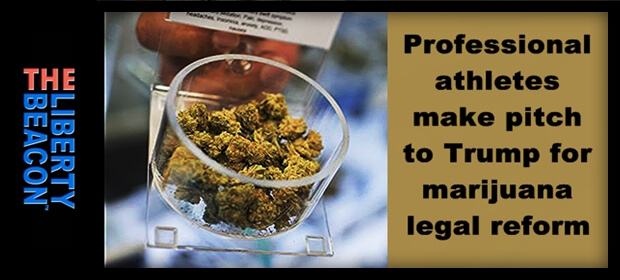
Professional athletes make a pitch for marijuana legal reform in letter to Trump
If successful, the proposed reforms would bring about sweeping changes to how cannabis is viewed in the eyes of the law and would provide access to financing for marijuana businesses.
By
Kevin Durant, Mike Tyson, Allen Iverson and other world-class athletes penned a letter to President Donald Trump urging sweeping cannabis reform. They are pressing for clemency for inmates imprisoned on nonviolent weed charges and slamming Biden for “failing to deliver on his pledge to address marijuana-related injustices.”
They are also seeking to downgrade marijuana from a Schedule I drug (like heroin and ecstasy) to a Schedule III substance on par with some pharmaceuticals like codeine cough syrup. They argue that the reforms could help cannabis-related businesses feed the economy, but only once they are able to legally acquire bank accounts and be listed on the stock exchange, so that foreign marijuana producers can no longer cash in and contaminate product.
The First Step Act
Although Trump famously avoids drugs and alcohol, those hoping for his openness might find him to be surprisingly sympathetic. Trump, who has famously never had a drink of alcohol, smoked cigarettes, or participated in illicit drug use, used his first term to develop and sign into law the First Step Act and further those reforms through the Second Step Act.
The First Step Act, signed into law by President Donald Trump in December 2018, marked a bipartisan effort to reform the federal criminal justice system. The legislation reduced mandatory minimum sentences for certain drug offenses, retroactively applied the Fair Sentencing Act to address disparities in usage of crack cocaine, and expanded judicial discretion through a “safety valve.” It also introduced a risk assessment system to assign inmates to rehabilitation programs, increased good time credits, and facilitated compassionate releases, leading to over 45,000 early releases and 4,800 compassionate releases by March 2025, though critics noted implementation issues, including concerns over the fairness of the risk assessment tool.
The Second Step Act, proposed in 2019, aimed to build on these reforms by focusing on employment opportunities for formerly incarcerated individuals to reduce recidivism but was never enacted. Introduced by Sen. Cory Booker, D-N.J., and supported by Trump’s $88 million reentry program budget request, it stalled amid political shifts and rising crime concerns. While the First Step Act reauthorized the 2007 Second Chance Act to fund reentry programs, the Second Step Act’s failure to pass highlighted challenges in sustaining reform momentum, with some states pursuing similar measures independently.
Recalibrating marijuana prosecutions, banking matters
The landscape and treatment of marijuana as a crime has shifted significantly over the last 12 years following former President Barack Obama’s Deputy Attorney General, James Cole, issuing his so-called Cole Memorandum. The memorandum, issued in August 2013, instructed federal prosecutors to prioritize enforcing marijuana laws only in cases involving significant threats, like sales to minors or cartel funding, effectively allowing state-legal cannabis programs to operate with minimal federal interference.
On the issue of discriminatory banking practices, cannabis businesses can open bank accounts, but it’s complicated due to marijuana’s federal illegality under the Controlled Substances Act. Most large banks avoid the industry due to risks of federal prosecution for money laundering under the Bank Secrecy Act and Anti-Money Laundering laws, forcing many cannabis-related businesses to operate in cash.
Nonetheless, about 815 financial institutions, mostly smaller community banks and credit unions, served cannabis-related businesses as of March 2024, per FinCEN data. These institutions face strict compliance requirements, like filing Suspicious Activity Reports, which increase costs and lead to high fees ($1,000–$2,500/month) or account closures.
*********
(TLB) published this article with permission of John Solomon at Just the News. Click Here to read about the staff at Just the News
Header featured image (edited) credit: Org. post content. Emphasis added by (TLB)
••••

••••
Stay tuned…

••••
The Liberty Beacon Project is now expanding at a near exponential rate, and for this we are grateful and excited! But we must also be practical. For 7 years we have not asked for any donations, and have built this project with our own funds as we grew. We are now experiencing ever increasing growing pains due to the large number of websites and projects we represent. So we have just installed donation buttons on our websites and ask that you consider this when you visit them. Nothing is too small. We thank you for all your support and your considerations … (TLB)
••••
Comment Policy: As a privately owned web site, we reserve the right to remove comments that contain spam, advertising, vulgarity, threats of violence, racism, or personal/abusive attacks on other users. This also applies to trolling, the use of more than one alias, or just intentional mischief. Enforcement of this policy is at the discretion of this websites administrators. Repeat offenders may be blocked or permanently banned without prior warning.
••••
Disclaimer: TLB websites contain copyrighted material the use of which has not always been specifically authorized by the copyright owner. We are making such material available to our readers under the provisions of “fair use” in an effort to advance a better understanding of political, health, economic and social issues. The material on this site is distributed without profit to those who have expressed a prior interest in receiving it for research and educational purposes. If you wish to use copyrighted material for purposes other than “fair use” you must request permission from the copyright owner.
••••
Disclaimer: The information and opinions shared are for informational purposes only including, but not limited to, text, graphics, images and other material are not intended as medical advice or instruction. Nothing mentioned is intended to be a substitute for professional medical advice, diagnosis or treatment.


Leave a Reply