
Rare Earth Wars – U.S. National Security, and the Burning of Penco Chile
INVESTIGATION
Freddie Ponton
21st Century Wire
This investigative report uncovers the convergence of corporate ambition, U.S. geopolitical strategy, and environmental catastrophe in Chile. It examines the coincidence of massive wildfires raging across the Biobío and Ñuble regions and the heavy rare earth mineral deposits coveted by the United States for national security and advanced technology applications. The report presents a critical narrative of power, profit, and ecological disruption, revealing how crises intersect with strategic resource acquisition. This comes on the heels of the recent fires started in Argentina, sparking concerns about a potentially broader geopolitical strategy involving significant global players such as the U.S and its close ally, Israel.
Flames Across Chile: Environmental Devastation and Human Cost

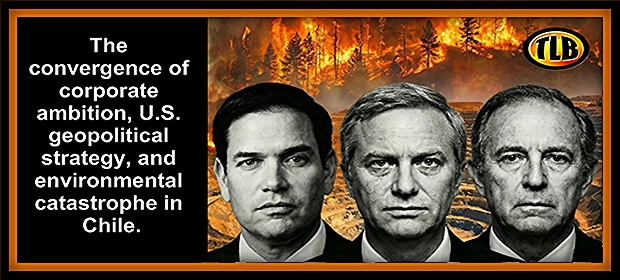
IMAGE: US State Secretary, Marco Rubio, President-elect of Chile, José Antonio Kast, and Chairman of the Board of rare earth mineral mining company Aclara Resources, Eduardo Hochschild, all (allegedly) linked to US rare earth mineral plundering of the burning Biobío mineral belt in Chile in the name of US national security policy for strategic minerals.
The summer of 2025-2026 left Chile’s central and southern regions scorched and traumatised. According to the National Forestry Corporation (CONAF), the wildfire season recorded 2,863 fires, consuming nearly 50,000 hectares and claiming 19 lives, while displacing over 1,500 families (CONAF, 2026). The Trinitarias fire in Concepción alone consumed more than 14,000 hectares, while the Rancho Chico and Perales Biobío fires in the Ñuble Region left communities overwhelmed and emergency services stretched to the limit.
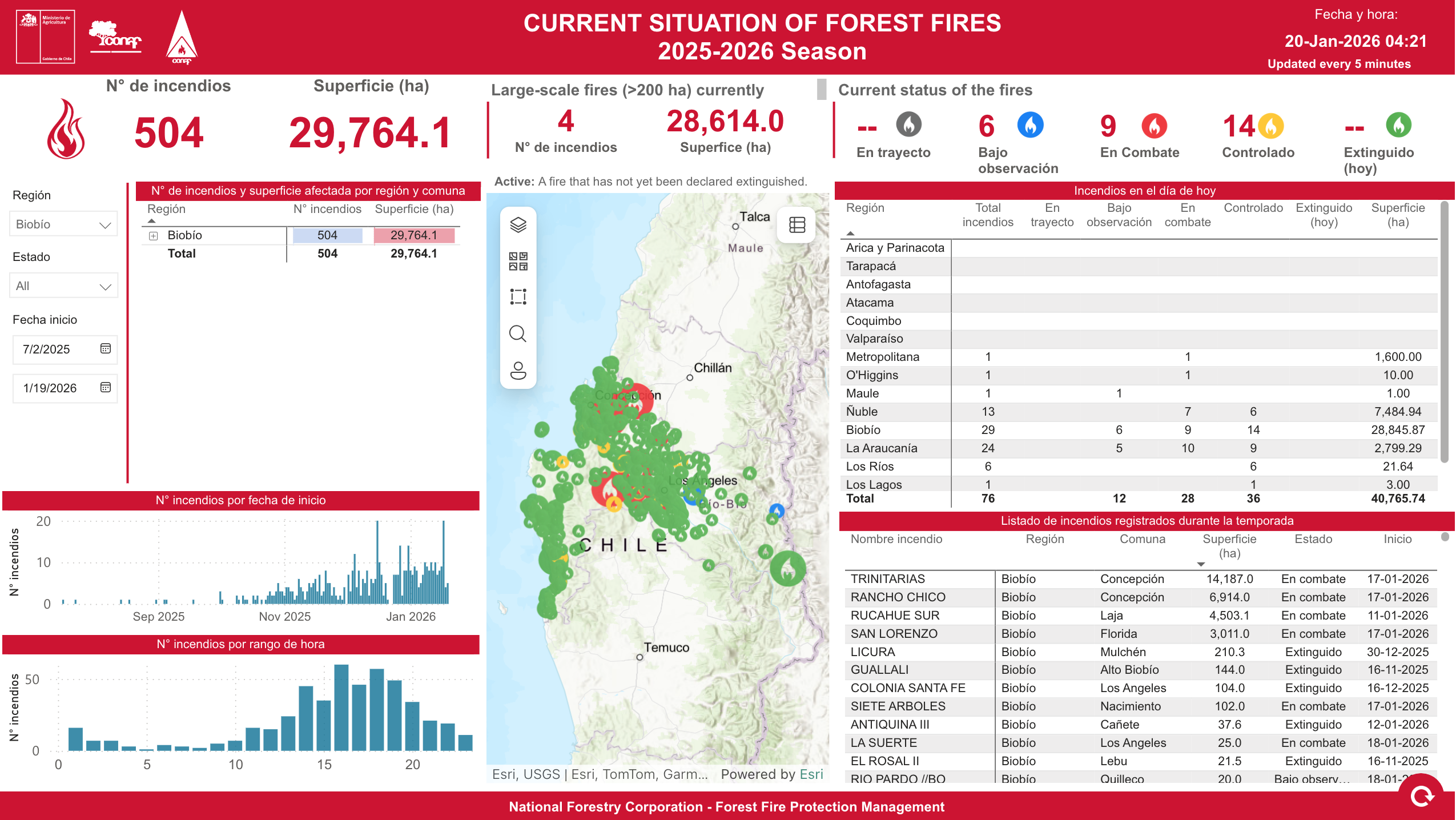
IMAGE: Current situation of forest fire in Chile (Source: Chile National Forestry Corporation | CONAF)
These fires were not random acts of nature. They engulfed territories historically protected by local communities as natural monuments, recreational areas, and vital watersheds of the Penco River. These same lands now host Aclara Resources’ rare earth mining project, known as the Pencco Module, a venture closely tied to U.S. strategic imperatives to secure heavy rare earth elements outside of China (SEA, Penco Module EIA). The conflagration has cleared both environmental and social barriers, disrupting local resistance and opening pathways for resource extraction.
 IMAGE: Wildfire emergency in Penco, Chile (Source: Live Storm Chasers)
The Penco Module is far more than a remote mineral deposit; it is a strategically critical repository of heavy rare earth elements (HREEs), among the few reliable sources outside China. Preliminary assessments place tens of thousands of tons of total rare earth oxides within this deposit, including high-value dysprosium, terbium, and neodymium-praseodymium, minerals indispensable to advanced defense platforms, electric vehicles, wind turbines, and robotics. Even conservative valuations peg the potential economic worth of Penco in the billions of U.S. dollars, with dysprosium trading above $500,000 per ton and terbium exceeding $400,000 per ton. These figures underscore that the stakes extend well beyond corporate profit: the United States’ industrial and defense infrastructure depends on a steady, non-Chinese supply of these minerals, and any disruption, whether environmental or social, carries consequences far beyond Chile’s borders. (aclrare.com)
Yet the Penco Module is not a sterile economic abstraction; it sits within a fraught social and ecological landscape, where local communities, environmental groups, and municipal authorities have repeatedly rejected Aclara’s plans as “environmentally unsustainable, territorially inappropriate, and socially unacceptable.” (rebeldes.info) Native forests and recreational hills face potential destruction, the Penco River watershed risks contamination, and decades of extractive industry history amplify local resentment toward foreign corporate encroachment. The 2026 wildfires that have raged through Penco and its environs, overlapping directly with the module, have only heightened these tensions, striking the very lands where opposition has been most pronounced and casting a shadow of suspicion over the coincidental timing of the crisis.
This localised struggle, however, is inseparable from broader U.S. strategic ambitions. The Penco Module, feeding into the planned heavy rare earth separation facility in Louisiana, represents one of the few Western Hemisphere sources capable of supplying minerals critical to U.S. national security. By constructing a vertically integrated supply chain, extraction in Chile and Brazil, processing in Louisiana, and delivery to U.S. manufacturers, Aclara Resources effectively marries private corporate interest with American strategic imperatives. The timing is pivotal: the Louisiana facility is slated to become operational before the Penco Module achieves full production, exposing the U.S. supply chain to potential delays from environmental crises, regulatory hurdles, or local resistance, yet another factor that casts the wildfires in a politically charged light.
 IMAGE:Jose Antonio Kast waves after winning the presidential runoff election in Santiago, Chile, on Dec. 14, 2025. (Source: Matias Delacroix/AP)
Overlaying these industrial and environmental dynamics is a clear political dimension. In December 2025, U.S. Secretary of State Marco Rubio publicly congratulated Chile’s newly elected president, José Antonio Kast, framing the victory as an opportunity to strengthen security, trade, and economic cooperation. Rubio, long an advocate for reducing U.S. dependence on Chinese-controlled rare earths, has consistently pushed for coordination between the government and private sectors to secure alternative sources of critical minerals. The emerging rapport between Rubio and Kast signals a willingness by Washington to cultivate political partners abroad who may be more receptive to U.S.-aligned extraction interests and bilateral resource projects, a backdrop that dovetails seamlessly with the strategic significance of the Penco Module and the Louisiana separation plant, but also with the catastrophic fires in the Biobío Region and Concepción-Penco Communes. It is worth noting that Aclara Resources withdraws EIA application for its Penco Module project in Chile in 2022, but with Chile’s new president-elect now in play, the future seems to be looking much brighter for Aclara Resources.
Taken together, the economic magnitude of the Penco Module, the social and environmental resistance it faces, and the diplomatic coordination between U.S. policymakers and Chilean leadership illustrate a convergence of corporate ambition, geopolitical strategy, and ecological vulnerability. The wildfires, coinciding with the areas earmarked for extraction, are no longer a purely local emergency: they sit at the intersection of human, environmental, and strategic stakes, raising urgent questions about the interplay between private profit, national security imperatives, and the communities that bear the cost of this global scramble for resources.
Aclara Resources: Corporate Ambition Meets Geopolitics
Aclara Resources (TSX: ARA) has positioned itself at the heart of a global race for rare earths, particularly heavy rare earth elements critical for U.S. defense, renewable energy, and advanced technology (Mining.com, 2024). The company is led by CEO Christopher E. Jones, with CFO Amanda West, VP of Operations Matthew L. Henderson, and VP of Technical Services Dr. Helena Alvarez guiding operations. Equity partners include Chilean conglomerate CAP and U.S.-based investment firms specialising in critical minerals. Financiers such as Global Mining Investments LLC, New Hartsdale Capital Inc (indirectly owned and controlled by Edouardo Hochschild), Northern Horizons Capital, and CAP Chile’s investment division have provided the capital backing for both Chilean extraction and U.S. processing operations. Aclara is now set to build the first heavy rare earths HREE separation plant in the U.S. with a secured sustainable Ionic Clay Feed by Mid-2028.
The person of interest in this investigation is Eduardo Hochschild, a central figure in the global mining industry, who serves as Chairman of the Board of Aclara Resources while also holding the role of Chairman at Hochschild Mining since 2006. Through Aclara, Hochschild has positioned himself at the heart of the U.S. quest to secure heavy rare earth elements outside China, overseeing projects like the Penco Module in Chile, a deposit whose development is closely linked to the planned Louisiana (US) HREE separation facility. Eduardo Hochschild comes from the well-known Hochschild family, a prominent Jewish family in Latin America with deep roots in mining and industrial enterprises. The family originally emigrated from Germany in the late 19th and early 20th centuries and has been influential in Peru and Chile’s mining sector for decades. His leadership reflects more than mere corporate expansion; it situates Hochschild and Aclara Resources at the intersection of Latin American mineral wealth and U.S. national security strategy, directly connecting private investment decisions to the creation of a non-Chinese supply chain for critical minerals essential to defense technologies, electric vehicles, and advanced clean energy infrastructure. The Penco Module, under Hochschild’s guidance, thus emerges not just as a mining project but as a strategic node in a larger geopolitical manoeuvre, highlighting the stakes behind both corporate ambition and the ongoing wildfires threatening the region.
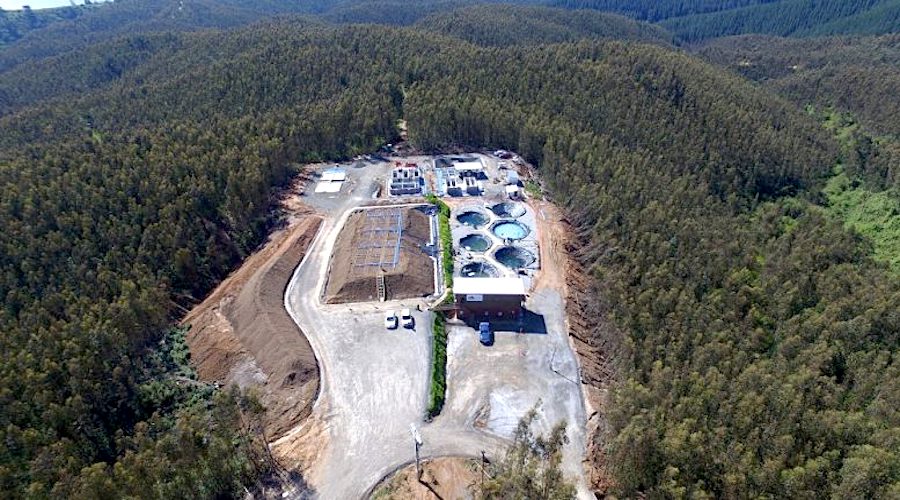 IMAGE: Pilot plant at Aclara Rare Earths Project in Chile (Source: Courtesy of Hochschild Mining)
Interestingly, Aclara’s own press releases and investor communications state that the Louisiana plant will be supplied by two ionic clay deposits in Brazil and Chile, including the Penco Module and Brazil’s Carina Project. The company projects these mining and concentration operations will be producing feedstock by mid‑2028, at which point the Louisiana facility will have a continuous, sustainable supply. This sequencing raises a legitimate question: how can a facility be built before its primary raw material source is operational? The key phrase from Aclara’s announcement is that the separation plant will have a “secured sustainable feed” once these deposits are in operation, which the company expects after mid‑2028, not immediately upon the plant’s completion. This could imply that they already know they will have access to these coveted rare minerals, which will be extracted from the Penco module upstream mining projects in Chile, which happen to be located where the fires are burning, right at the core of the Biobío mineral belt. The wildfires in Chile’s Biobío Region have directly impacted Penco, destroying structures, forcing evacuations, and spreading across landscapes immediately adjacent to Aclara’s Penco Module, affecting both urban and rural areas in the heart of the region’s mineral belt.
What we know is that Aclara submitted a newly optimised Environmental Impact Assessment (EIA) to Chile’s Environmental Evaluation Service (Servicio de Evaluación Ambiental, SEA). This updated EIA is being reviewed but has not yet been approved, meaning no mining exploitation permit has been issued. The company has recently submitted an addendum to respond to technical observations from the SEA, indicating the process is still ongoing and far from final licensing. In Chile, one of the key requirements before any exploitation rights can be granted includes the EIA approval and corresponding mining and exploitation permits issued by the Chilean authorities under the SEIA framework. This has not happened yet… It is therefore reasonable to assume that the fires are going to fast-track this process, hence the reason why critics speculate (without accusing) that these fires may not be totally innocent and may serve a purpose.
The Louisiana heavy rare earth separation facility represents the operational heart of this strategy. Backed by Louisiana Economic Development (LED Opportunity Louisiana, 2025) and supported by the Port of Vinton, the facility received permits and guidance from the U.S. Environmental Protection Agency (EPA), the U.S. Army Corps of Engineers, and the Bureau of Land Management. Senior officials, including Secretary Don Pierson of Louisiana Economic Development and EPA Regional Administrator Jessica Albright, have been directly involved in navigating complex regulatory requirements.
Aclara’s CEO, Ramón Barúa Costa, has emphasised the strategic considerations behind the location choice: proximity to key chemical suppliers, Gulf Coast logistics, and a skilled industrial workforce. The facility is expected to create 140 direct jobs and 456 indirect positions, with phased construction beginning in 2026 and expected completion in 2027. Future expansions may include downstream processing and alloy production, anchoring the plant as a hub for a vertically integrated U.S. rare earth supply chain. Incentives provided by Louisiana Economic Development, including infrastructure grants, workforce training through LED FastStart®, and industrial tax exemptions, underscore the alignment of corporate and state interests (opportunitylouisiana.gov).
The Penco Module: Strategic Wealth Beneath Chilean Hills
The Penco project encompasses roughly 27.5 million tonnes of ionic clay averaging 2,292 ppm TREO, equating to 62,900 tonnes of rare earth oxides, with an additional inferred 34,000 tonnes (MDPI, 2025). Heavy rare earths such as dysprosium and terbium make Penco a global strategic asset. At a conservative in-ground price of $100 per kilogram, the TREO resource alone is worth over $6.2 billion. The coincidence of massive wildfires destroying the Coihueco Estate, long a site of local resistance, creates conditions that materially reduce environmental and social barriers to mining. Burned landscapes lower ecological baselines, displace community opposition, and create regulatory windows under emergency powers.
REPORT: Preliminary Economic Assessment for Penco Module Project, prepared for: Aclara Resources Inc [Click here to View] (Source:Aclara)
Flames as Strategic Leverage
Though no direct evidence implicates Aclara or U.S. agencies in causing the fires, the alignment of disaster with corporate and national objectives is undeniable. Burned land facilitates environmental permitting, and the social disruption diminishes organised opposition. In the aftermath, mining projects can be reframed as reconstruction or economic revitalisation initiatives, echoing the dynamics Naomi Klein described in The Shock Doctrine (Naomi Klein, 2007). The coincidence of natural disaster and strategic extraction is too stark to ignore, suggesting a broader pattern in which crises serve as accelerants for geopolitical and corporate gain.
Global Stakes: Power, Profit, and Ethical Imperatives
The Penco project and the Louisiana facility together illustrate a coordinated effort to secure heavy rare earths outside China (CSIS, 2025). Parallel efforts in Patagonia, where mining and fossil fuel projects overlap sensitive ecological zones, reinforce the picture of a U.S.-driven strategy for critical mineral acquisition (Previous Article, 2025).
This story is a stark reminder that environmental disasters intersect with global strategic interests. The Chilean wildfires are not mere coincidences, they illuminate the convergence of corporate ambition, government policy, and resource geopolitics. Local communities pay the price, yet the strategic calculus of nations and corporations continues unabated. Penco and the Louisiana facility are emblematic of a new era in which profit, national security, and environmental vulnerability are intertwined in ways that demand transparency, scrutiny, and accountability.
DOCUMENT: Mining Development Project for Clay Extraction for Rare Earth Concentrate Production – Concepción-Penco Communes in Biobío Region, Chile [Click here to view doc] (Source: Chile Environmental Impact Assessment System | SEIA)
Conclusion: A Crisis Exploited for Strategic Gain
As the smoke clears from Chile’s forests, the reality becomes unmistakable: what appears at first glance to be a natural disaster is entangled with human ambition and strategic manoeuvring. The alignment of U.S. national security priorities with Aclara Resources’ mining and processing projects reveals a pursuit of rare earth dominance that extends from the scorched hills of Penco to the Gulf Coast of Louisiana. The wildfires have cleared resistance, altered landscapes, and shifted the political terrain, creating conditions highly favourable to extraction and control of resources deemed essential for defense and high-tech industry.
This is not merely a story of environmental devastation, but of structural power operating at the intersection of profit and geopolitics. The people of Chile and the ecosystems of Biobío and Ñuble have become collateral in a global scramble for strategic minerals, raising urgent questions about the ethics of resource security and the exploitation of crisis. As the world races to secure critical minerals outside China, the Chilean fires stand as both a warning and a symbol of the high stakes, illustrating the human and ecological costs of the US geopolitical imperatives pursued in the shadows of natural and man-made disasters.
_________
(TLB) PUBLISHED THIS ARTICLE FROM 21WIRE
SUPPORT INDEPENDENT MEDIA – BECOME A MEMBER @21WIRE.TV & VISIT OUR TELEGRAM CHANNEL
Header featured image (edited) credit: Org. post content. Emphasis added by (TLB)
••••

••••
Stay tuned…

••••
The Liberty Beacon Project is now expanding at a near exponential rate, and for this we are grateful and excited! But we must also be practical. For 7 years we have not asked for any donations, and have built this project with our own funds as we grew. We are now experiencing ever increasing growing pains due to the large number of websites and projects we represent. So we have just installed donation buttons on our websites and ask that you consider this when you visit them. Nothing is too small. We thank you for all your support and your considerations … (TLB)
••••
Comment Policy: As a privately owned web site, we reserve the right to remove comments that contain spam, advertising, vulgarity, threats of violence, racism, or personal/abusive attacks on other users. This also applies to trolling, the use of more than one alias, or just intentional mischief. Enforcement of this policy is at the discretion of this websites administrators. Repeat offenders may be blocked or permanently banned without prior warning.
••••
Disclaimer: TLB websites contain copyrighted material the use of which has not always been specifically authorized by the copyright owner. We are making such material available to our readers under the provisions of “fair use” in an effort to advance a better understanding of political, health, economic and social issues. The material on this site is distributed without profit to those who have expressed a prior interest in receiving it for research and educational purposes. If you wish to use copyrighted material for purposes other than “fair use” you must request permission from the copyright owner.
••••
Disclaimer: The information and opinions shared are for informational purposes only including, but not limited to, text, graphics, images and other material are not intended as medical advice or instruction. Nothing mentioned is intended to be a substitute for professional medical advice, diagnosis or treatment.


Leave a Reply