

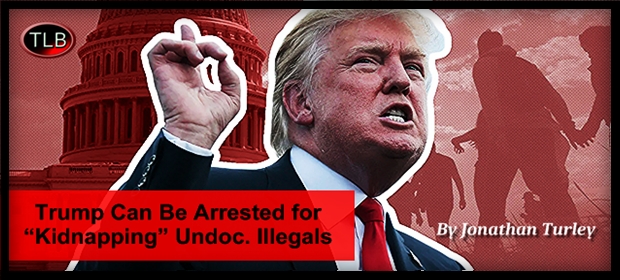
Raskin: Trump Officials Can Be Arrested for “Kidnapping” Undoc. Persons
Raskin prefaced his legal analysis with a heavy dose of hyperbole
By Jonathan Turley

For some on the far left, “The Rachel Maddow Show” is a godsend. Otherwise, you would have to go to the subway to compete against others raving about microchips and oligarchies. Just take Rep. Jamie Raskin (D-MD), who went on the show on Friday to explain that Trump officials can now be arrested for “interfering with a legal proceeding” or “kidnapping.” It now stands as second only to Harvard Professor Laurence Tribe’s claim on MSNBC that President Donald Trump could be charged (“without any doubt, beyond a reasonable doubt, beyond any doubt”) with the attempted murder of former Vice President Michael Pence.
(For the record, I have maintained since the start of this controversy that Garcia should have been returned to the United States and should still be brought back to what I believe would be an inevitable deportation).
Raskin prefaced his legal analysis with a heavy dose of hyperbole, warning viewers that “they’re arresting judges” and portraying Judge Hannah Dugan in Wisconsin as an innocent victim of a law-hating, authoritarian regime. It is a claim that was echoed by other leading Democrats before any of the underlying facts have been established.
He then explained his case for a mass arrest of Trump officials:
“all of the people in the Trump Administration who participated in defying that order by Judge Boasberg themselves could be arrested for interfering with a legal proceeding and perhaps other criminal charges like kidnapping.”
It was another fevered Democratic dream, imagining lines of Trump officials being frog-marched to the federal penitentiary as kidnappers.
This is not the first time that the left has claimed that officials have kidnapped undocumented persons. After Florida Gov. Ron DeSantis sent undocumented immigrants to California (after Gov. Gavin Newsom invited them to come to the state), Newsom and Attorney General Ron Bonta claimed that the trip constituted “State-sanctioned kidnapping.”
Other Democratic leaders and legal experts repeated the earlier claim. As is often the case, sites from MSNBC to NPR then gave fawning attention to the claims despite knowing that they are legally absurd. The breaking news angle is then forgotten for the next media jump scare.
The same is true for the widespread claims of experts that Trump could be charged with incitement due to his speech on Jan. 6th. Despite some of us noting that the speech was clearly protected under the First Amendment, the press portrayed such a charge as credible and heaped coverage on District of Columbia Attorney General Karl Racine who announced that he was considering arresting Trump, Donald Trump Jr., Rudy Giuliani and U.S. Rep. Mo Brooks and charging them with incitement. So what happened to that prosecution?
Racine’s failure to charge Trump was not due to any affection or loyalty to the former president. It was due to the utter lack of legal and factual foundation.
Under 18 U.S.C. 1201,
“whoever unlawfully seizes, confines, decoys, kidnaps, abducts, or carries away and holds for ransom or reward any person, or when the person is willfully transported in interstate or foreign commerce across a state boundary is guilty of kidnapping and shall be punished by imprisonment for any term of years or life and, if the death results, by death or life imprisonment.”
In this case, federal employees were acting under a claim of executive authority and a little-used federal statute. It is true that there was an order during the flight to return to the United States. However, the Administration has made a series of arguments as to why the Boasberg order was not carried out. Notably, other deportations were halted after additional court orders. There is no evidence of the specific intent to kidnap in this case.
Moreover, as to the alleged failure to “facilitate” his return, the decision of the Supreme Court is hopelessly vague and unclear on what that term means. Since most of us do not know what the term means, it would hardly be a credible basis for a criminal, let alone a kidnapping, charge.
There is also an interesting wrinkle under 18 USC 1201, which contains a 24-hour rule:
“With respect to subsection (a)(1), above, the failure to release the victim within twenty-four hours after he shall have been unlawfully seized, confined, inveigled, decoyed, kidnapped, abducted, or carried away shall create a rebuttable presumption that such person has been transported in interstate or foreign commerce. “
This would not be dispositive but shows the relatively short period of time for the order and flight. Within 24 hours of the court order, Garcia and others were released into the custody of the El Salvadorian government.
In Trump v. United States, the Supreme Court recently held:
“we conclude that the separation of powers principles explicated in our precedent necessitate at least a presumptive immunity from criminal prosecution for a President’s acts within the outer perimeter of his official responsibility. Such an immunity is required to safeguard the independence and effective functioning of the Executive Branch, and to enable the President to carry out his constitutional duties without undue caution. Indeed, if presumptive protection for the President is necessary to enable the ‘effective discharge’ of his powers when a prosecutor merely seeks evidence of his official papers and communications, id., at 711, it is certainly necessary when the prosecutor seeks to charge, try, and imprison the President himself for his official actions. At a minimum, the President must therefore be immune from prosecution for an official act unless the Government can show that applying a criminal prohibition to that act would pose no ‘dangers of intrusion on the authority and functions of the Executive Branch.’”
As for other federal officials, they have clear immunity for carrying out discretionary duties. Of course, a violation of a court order is not within that discretion. However, they were carrying out this order under the advice of the Justice Department under highly novel circumstances. This was a plane in international airspace and the Justice Department did not believe that it required the aircraft’s return. I disagree with that view, though we have not seen the entire record of what occurred. However, it would not constitute kidnapping even if the legal opinion of the Justice Department were rejected by the courts.
Notably, these individuals were arguably subject to being detained and held. It was the continued deportation after the issuance of the court order that was the primary conflict. The Administration still argues that it has this authority under federal laws and Article II of the Constitution. They can be wrong without converting that error into a federal crime.
Even civil actions alleging kidnapping have done poorly in the courts, as in El Masri v. Tenet. Khalid El Masri was kidnapped by the CIA and renditioned to a foreign prison where he was tortured. It was a horrific case that many of us condemned. Yet, the district court dismissed the lawsuit after the administration invoked the state secrets privilege. The United States Court of Appeals upheld the dismissal. The Supreme Court refused to hear the case.
Most courts would not seriously consider such a charge. Presumably, anyone assisting in these flights would be participants in the alleged mass kidnapping.
Taken to its full possible application, Raskin’s argument could produce an outcome where hundreds of alleged gang members and terrorists (according to the earlier presidential finding) would be freed from the El Salvadorian jail and brought back to the country while dozens of federal law enforcement officials could be sent to prison.
Raskin’s insistence that officials could be criminally charged with kidnapping is also curious given his silence on President Barack Obama actually killing an American citizen without a criminal charge, let alone a trial.
Of course, Judge Boasberg is considering the possible criminal contempt of officials for violating his orders. However, even that lesser offense seems doubtful. He would likely have to appoint a private lawyer to prosecute such a case, raising serious constitutional questions in the usurping of Article II authority.
*********
(TLB) published this article from Jonathan Turley with our appreciation for this perspective
Jonathan Turley is the Shapiro Professor of Public Interest Law at George Washington University. Follow him on Twitter @JonathanTurley.

Header featured image (edited) credit: Photo Adobe Stock. Emphasis added by (TLB)
••••

••••
Stay Tuned…

••••
The Liberty Beacon Project is now expanding at a near exponential rate, and for this we are grateful and excited! But we must also be practical. For 7 years we have not asked for any donations, and have built this project with our own funds as we grew. We are now experiencing ever increasing growing pains due to the large number of websites and projects we represent. So we have just installed donation buttons on our websites and ask that you consider this when you visit them. Nothing is too small. We thank you for all your support and your considerations … (TLB)
••••
Comment Policy: As a privately owned web site, we reserve the right to remove comments that contain spam, advertising, vulgarity, threats of violence, racism, or personal/abusive attacks on other users. This also applies to trolling, the use of more than one alias, or just intentional mischief. Enforcement of this policy is at the discretion of this websites administrators. Repeat offenders may be blocked or permanently banned without prior warning.
••••
Disclaimer: TLB websites contain copyrighted material the use of which has not always been specifically authorized by the copyright owner. We are making such material available to our readers under the provisions of “fair use” in an effort to advance a better understanding of political, health, economic and social issues. The material on this site is distributed without profit to those who have expressed a prior interest in receiving it for research and educational purposes. If you wish to use copyrighted material for purposes other than “fair use” you must request permission from the copyright owner.
••••
Disclaimer: The information and opinions shared are for informational purposes only including, but not limited to, text, graphics, images and other material are not intended as medical advice or instruction. Nothing mentioned is intended to be a substitute for professional medical advice, diagnosis or treatment.


Leave a Reply