

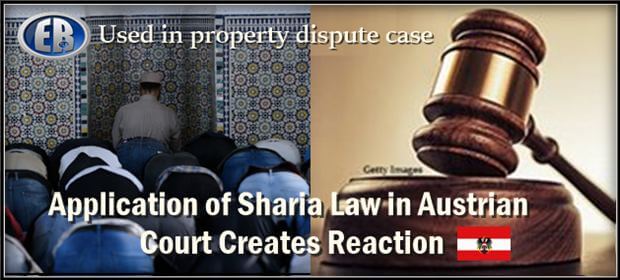
ER Editor: We believe this report is based on this as reported by Brussels Signal 3 days ago —
Austrian court allows use of Islamic Sharia law in private contracts
In a controversial decision, an Austrian court has ruled Islamic law (Sharia) can be used for arbitration purposes in the European country if the contract parties agree on it.
In the case in question two men had signed a contract which mandated that in case of conflicts an arbitration tribunal would decide “based on Islamic law (Ahlus-Sunnah wal-Jamaah) in accordance with equity in the matter to the best knowledge and belief.”
Worth reading in full.
This also carries the story; browsers will translate:
Vienna court decides that Sharia law is also valid in Austria
It does seem that Sharia law is only applicable in this case where property is at dispute. This one single case may be causing an overreaction; reference is made to the fact that Sharia law is already being used in German courts for certain cases.
********
Sharia Law Now Legal in Austria – What Next For Europe?
G. CALDER for THE EXPOSE
Vienna Regional Court just upheld a contract based on Islamic sharia law, a decision which has sparked uproar across Austria, Europe, and the West.
At face value a one-off exception, the precedent set by the ruling raises concerns that parallel legal systems are beginning to creep into the heart of Western democracies. The case centred around the enforcement of a €320,000 financial ruling under sharia contractual terms, and has been described as “deeply concerning” by politicians stating that it risks undermining the primacy of national law.
How Was Islamic Law Upheld in Austria?
A contract drawn up explicitly under Islamic law between two business partners was deemed valid and enforceable within Austria’s legal framework. And, while it’s true that Austrian law has occasionally recognised private religious agreements in specific cases in the past, this ruling appears to have gone much further. Effectively, the court endorsed the binding power of sharia principles in civil disputes.
For what seems like a majority of observers, it crossed a dangerous line.
And for the Austrian People’s Party (ÖVP), the ruling has been called “deeply concerning” pointing out that sharia law contains provisions that stand in direct contradiction with European values and legal equality – such as rules concerning women, inheritance and family rights. The ÖVP immediately announced new measures aimed at preventing similar cases, warning that Austria’s rule of law cannot be eroded by parallel systems.
Meanwhile, the Austrian Freedom Party (FPÖ) said in a press statement that “the ruling elevates Islamic parallel societies in Austria and weakens those forces that do not want to submit to Islam. A sad day for the secular constitutional state“. A party member echoed the sentiment, writing that “sharia law is incompatible with the Austrian understanding of law and violates all moral standards that I am familiar with.”
And even the Turkish Cultural Community (TKG) protested the decision to recognise sharia law, highlighting that the European Court of Human Rights (ECHR) had previously decided in 2003 that sharia law and the resulting introduction of parallel legal systems were in fact forbidden in Europe. The TKG’s general secretary wrote “the Vienna court’s decision is a major intervention, today in the secular economy, tomorrow perhaps in production, service, and sales regulations“
A Divided Reaction
Those who support the ruling argue that individuals should have the freedom to enter into contracts using whatever framework they wish, as long as it does not directly break Austrian law. They see this as a simple recognition of a contract while respecting multiculturalism and freedom of religion.
Opponents, including politicians and legal scholars, meanwhile warn of a slippery slope. If Austrian courts legitimise a business contract based on sharia law, then what other “agreements” made under sharia law will they enforce? What about divorce proceedings, inheritance disputes or custody battles? Once a parallel legal system gains recognition – which in this specific case, it has – critics worry that it could gradually expand beyond business contracts and begin challenging European law as a whole.
Case Study: What Happens When Laws Collide?
To understand the implications of this ruling, it’s important to understand an example of how the laws differ so vastly. For example, regarding inheritance:
- In Austrian law, children (sons and daughters equally) are entitled to equal shares of a parent’s estate. Spouses (male and female) also have protected rights.
- Under sharia law, however, daughters tend to only inherit half of what the sons do, and widows receive less than male relatives
So, if Austrian courts continue to recognise wills or contracts based on sharia values, families are likely to be drawn into bitter disputes where women are denied equal protection that Austrian law has guaranteed for decades. For many Europeans, this case study is just one example of how allowing sharia rulings to enter the legal system is a dangerous precedent, highlighting how the hard-won principles of equality are at risk of being replaced by religious codes imported from abroad.
Austria: A Country at the Crossroads
The country has long struggled trying to balance integration with cultural autonomy, especially given its growing Muslim population. Despite not being a new debate in terms of cultural differences and how best to manage them, the idea that Islamic law can be applied within a European court appears to have struck a nerve.
Other commentators have warned that this is not just about Austria. It’s easy for some to imagine this precedent rippling across the continent, given the EU’s interconnected legal systems. If it’s legally possible to uphold sharia-based contracts, then what’s stopping France, Belgium, or Germany from following suit?
European cities are already experiencing growing pressure from Islamist groups to gain local recognition for sharia arbitration in family or financial matters. The Austrian court ruling in this case is likely to embolden these efforts, and risks fragmenting legal standards within Europe’s borders.
Worries of a Growing Islamic Influence
At the heart of this single legal case is a deeper cultural anxiety: is Islam slowly reshaping European society, and its laws, from within?
For many critics, this ruling feels less like a one-off case and more like another piece of evidence of a quiet but growing influence over the West. Each legal victory is said to chip away at Europe’s secular, historic traditions, and begins to raise questions about who sets the rules. And the continuation of accommodating demands for Islamic traditions and laws to be recognised, is not easing minds worried about the cultural shift taking place.
So, What Next?
The Austrian government has promised legislative action to reaffirm the primacy of Austrian law over any religious code. However, for many, the damage may already be done, with Europe now forced to confront the question of how far multicultural accommodation should really be going.
This ruling may be solved by the government taking aforementioned action. But it also may prove to be a watershed moment, not just for Austria, but for Europe as a whole. Older generations say that this ruling represents an erosion of the legal certainty that has lingered their entire lives, and younger Europeans (particularly those worried about future freedoms) are asking: if national courts can validate sharia law today, what laws will govern our lives in future?
Is This a Warning for Europe?
The broader issue here goes far beyond the business contract. It asks the question about who makes the rules of a country – democratically elected parliaments, or imported religious codes? As critics point out, Europe’s legal systems were built over centuries to defend secular democracy and protect individual rights. Diluting that foundation, even in isolated cases, risks setting a precedent that could fundamentally change Europe’s society and character.
Final Thought
The Austrian ruling may appear like a technical decision, but the consequences of it could turn out profound and far-reaching. Whether Europe manages to draw a line here or not may well determine its cultural future, which many already fear looks bleak.
Join the Conversation
Where do we go from here? What do you think about Islamic law being upheld in a European court? Do you support or oppose this ruling? Tell us in the comments.
Source
Featured image source, Muslim men praying: https://brusselssignal.eu/2025/08/austrian-court-allows-use-of-islamic-sharia-law-in-private-contracts/
************
Published to The Liberty Beacon from EuropeReloaded.com


••••
The Liberty Beacon Project is now expanding at a near exponential rate, and for this we are grateful and excited! But we must also be practical. For 7 years we have not asked for any donations, and have built this project with our own funds as we grew. We are now experiencing ever increasing growing pains due to the large number of websites and projects we represent. So we have just installed donation buttons on our websites and ask that you consider this when you visit them. Nothing is too small. We thank you for all your support and your considerations … (TLB)
••••
Comment Policy: As a privately owned web site, we reserve the right to remove comments that contain spam, advertising, vulgarity, threats of violence, racism, or personal/abusive attacks on other users. This also applies to trolling, the use of more than one alias, or just intentional mischief. Enforcement of this policy is at the discretion of this websites administrators. Repeat offenders may be blocked or permanently banned without prior warning.
••••
Disclaimer: TLB websites contain copyrighted material the use of which has not always been specifically authorized by the copyright owner. We are making such material available to our readers under the provisions of “fair use” in an effort to advance a better understanding of political, health, economic and social issues. The material on this site is distributed without profit to those who have expressed a prior interest in receiving it for research and educational purposes. If you wish to use copyrighted material for purposes other than “fair use” you must request permission from the copyright owner.
••••
Disclaimer: The information and opinions shared are for informational purposes only including, but not limited to, text, graphics, images and other material are not intended as medical advice or instruction. Nothing mentioned is intended to be a substitute for professional medical advice, diagnosis or treatment.



Leave a Reply