
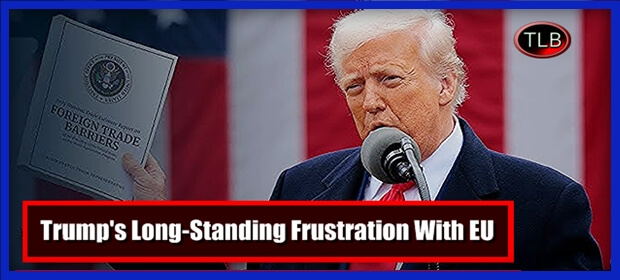
The Factors: Trump’s Long-Standing Frustration With EU
“It’s not really like negotiating with one country,” … “There are 27 member states, and each of them has a different set of trade priorities.” ~Wilbur Ross. fmr Commerce Sec
By Emel Akan and Andrew Moran | The Epoch Times
President Donald Trump’s recent threat to impose a 50 percent tariff on the European Union starting July 9 has spurred Brussels into action, with EU officials rushing to schedule meetings with U.S. counterparts ahead of the looming deadline.
While it remains uncertain whether the talks will yield substantial progress in narrowing the U.S. trade deficit or removing long-standing barriers to American exports, some observers believe the EU is negotiating from a position of weakness and may be more willing to make concessions this time.
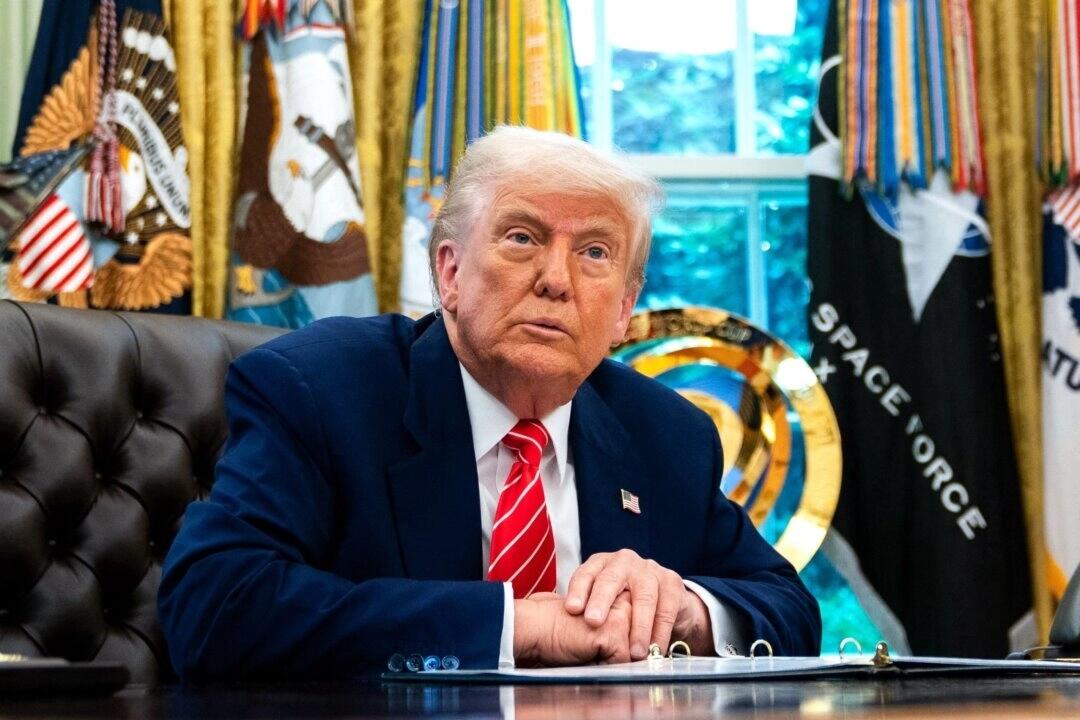
Trump initially announced that a 50 percent tariff on the EU would take effect on June 1, accusing the 27-member bloc of slow-walking the negotiations. However, after a phone call with European Commission President Ursula von der Leyen, he agreed to extend the deadline to July 9.
The EU is currently subject to U.S. tariffs of 10 percent on most goods, with 25 percent tariffs on automobiles, steel, and aluminum. The U.S. president announced this past week that the tariffs on steel and aluminum will increase to 50 percent beginning June 4.
Wilbur Ross, who served as Commerce secretary during Trump’s first term, recalled the difficulties of negotiating with the EU in a recent interview with The Epoch Times.
“It’s not really like negotiating with one country,” he said. “There are 27 member states, and each of them has a different set of trade priorities.”
Ross added that it’s “very tough” for Brussels to speak with one voice, making meaningful progress in trade talks especially difficult.
He also warned that no country can endure tariffs above 40 percent without suffering significant economic fallout. Imposing such steep tariffs on the EU, he said, would effectively signal that the United States has no intention of maintaining normal trade relations with the bloc.
Concerns over a potential trade war are mounting in Europe. A recent Financial Times survey of European economists found that 68 percent believe a trade conflict with the United States is the biggest threat to the region.
Daniel Lacalle, chief economist at Tressis, a Spain-based wealth management firm, echoed those concerns. He said such a high U.S. tariff on EU goods would be “devastating” for the European economy and equity markets.
“If you put a 50 percent tariff for the next 10 years on the European Union, you need to sell the European stocks like there’s no tomorrow,” he told The Epoch Times.
EU Trade Barriers
The United States and the EU share the largest bilateral economic relationship in the world.
In a lengthy report detailing foreign trade barriers, the U.S. Trade Representative (USTR) outlined the tariff and non-tariff barriers that American exporters face in the European market.
According to the latest annual report issued in March, certain goods face disproportionately high levies in the EU, such as fish and seafood (up to 26 percent), trucks (22 percent), bicycles (14 percent), passenger vehicles (10 percent), and fertilizers and plastics (6.5 percent).
In addition, many processed foods such as confectionary products and baked goods also face complex tariffs under the EU’s Meursing Table system, which calculates duties based on product composition.
Under this system, the EU charges a tariff on each imported good based on the product’s content of milk fat, milk protein, starch, and sugar. This system not only increases administrative burden but also creates uncertainty for U.S. food exporters, according to the USTR.

Additionally, the EU does not implement its laws through a single customs administration, which creates added complications for U.S. exporters. Each EU member nation enforces customs law independently, resulting in inconsistencies in interpretations and enforcement throughout the bloc.
The EU’s technical barriers to trade also remain a sticking point. For example, Europe’s adoption of regional standards for safety, quality, environmental protection, labeling, and packaging impedes market access for U.S. products even if they meet international standards, according to the USTR report.
Lacalle said the EU’s internal bureaucracy not only slows access to the market but also imposes hidden barriers under the guise of environmental or legislative rules.
“It’s a highly bureaucratic and politicized union, where many officials fear free trade,” Lacalle said. “They don’t want U.S. companies coming to Europe and selling GMCs and Pontiacs. They don’t want them.”
However, the EU officials are also aware that they hold little leverage in the event of a full-blown trade war with the United States, he noted.
“Obviously, they’re not stupid and they know that they don’t have any weapons.”
Another area of contention is the digital service tax adopted by several EU countries as well as the value-added tax (VAT), which Trump considers “far more punitive than a tariff.”
In 2024, the United States had a goods trade deficit of $235.6 billion with the EU, a 12.9 percent increase from 2023.
In a Truth Social post on May 27, Trump promoted his tariff proposal and accused EU negotiators of deliberately stalling the talks.
“I was extremely satisfied with the 50% Tariff allotment on the European Union, especially since they were ‘slow walking’ (to put it mildly!), our negotiations with them,” Trump wrote.
However, the president also voiced optimism about the EU’s willingness to “quickly establish meeting dates” to start negotiations with his trade officials.
“This is a positive event,” Trump said.
Countries With High Exposure
There are large differences in exposure to the high tariffs among member countries and sectors in the EU.
Lacalle noted that the automotive, agriculture, chemicals, luxury, and retail sectors in Europe depend heavily on the U.S. market and lack alternative buyers.
Ireland is by far the most exposed country, according to a recent report by Bruegel, a Brussels-based economic think tank. Ireland’s economy is heavily dependent on exports to the United States, especially in the pharmaceutical, chemicals, transport equipment, and food and beverage sectors.
Italy is the second most-exposed country, according to the report, with significant exports in transport equipment, fashion, automotive, and pharmaceuticals.
Treasury Secretary Scott Bessent, a lead trade negotiator, has pointed to a lack of communication and coordination among the 27 member countries of the bloc.
“I would hope that this would light a fire under the EU,” Bessent said in a recent interview with Fox News, referring to the 50 percent U.S. tariff proposed by Trump.
“The EU has a collective action problem,” he said. “It’s 27 countries, but they’re being represented by this one group in Brussels. So, some of the feedback that I’ve been getting is that the underlying countries don’t even know what the EU is negotiating on their behalf.”
Trump’s April 2 global tariffs have recently encountered legal hurdles, initially being struck down by a federal trade court before being reinstated by an appeals court. Commerce Secretary Howard Lutnick said the legal challenges have not disrupted U.S. negotiations with the EU.
“All of the countries that are negotiating with us understand the power of Donald Trump and his ability to protect the American worker,” Lutnick said during an interview with Fox News on June 1.
In response to Trump’s April 2 tariffs, the European Commission, the EU’s main executive body, approved tariffs on €21 billion ($23.8 billion) worth of U.S. goods. The move was later suspended after Trump announced a 90-day pause on his reciprocal tariffs, set to end on July 9.
Former Secretary of Commerce Ross sees little chance of both sides coming to an agreement before the July 9 deadline. However, if the parties can reach a mutual understanding, he noted, that could be enough to delay implementation of the U.S. tariffs.
“I think it’s good to give the EU a little more time,” Ross said. “I just hope that the time is well spent.”
_________
Header featured image (edited) credit: WCHS Eyewitness News Youtube article tease. Emphasis added by (TLB)
••••

••••
Stay Tuned…

••••
The Liberty Beacon Project is now expanding at a near exponential rate, and for this we are grateful and excited! But we must also be practical. For 7 years we have not asked for any donations, and have built this project with our own funds as we grew. We are now experiencing ever increasing growing pains due to the large number of websites and projects we represent. So we have just installed donation buttons on our websites and ask that you consider this when you visit them. Nothing is too small. We thank you for all your support and your considerations … (TLB)
••••
Comment Policy: As a privately owned web site, we reserve the right to remove comments that contain spam, advertising, vulgarity, threats of violence, racism, or personal/abusive attacks on other users. This also applies to trolling, the use of more than one alias, or just intentional mischief. Enforcement of this policy is at the discretion of this websites administrators. Repeat offenders may be blocked or permanently banned without prior warning.
••••
Disclaimer: TLB websites contain copyrighted material the use of which has not always been specifically authorized by the copyright owner. We are making such material available to our readers under the provisions of “fair use” in an effort to advance a better understanding of political, health, economic and social issues. The material on this site is distributed without profit to those who have expressed a prior interest in receiving it for research and educational purposes. If you wish to use copyrighted material for purposes other than “fair use” you must request permission from the copyright owner.
••••
Disclaimer: The information and opinions shared are for informational purposes only including, but not limited to, text, graphics, images and other material are not intended as medical advice or instruction. Nothing mentioned is intended to be a substitute for professional medical advice, diagnosis or treatment.

Leave a Reply