
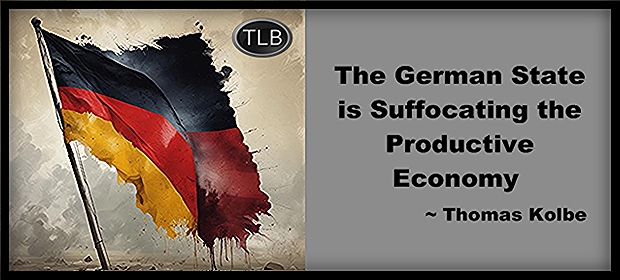
The German State is Suffocating the Productive Economy
We are witnessing before our eyes is the transformation of the German economy into a command economy…
Thomas Kolbe | American Thinker
Contrary to repeated assurances by the Federal Chancellor, the German state apparatus is growing at an accelerating pace. What we are witnessing before our eyes is the transformation of the economy into a command economy.
You may recall: In the days between last year’s federal election and the appointment of the new government, a political window opened in which Germany committed fundamental breaches of its own fiscal rules. The outgoing Bundestag decided on a redefinition of the debt brake and ultimately executed its substantive demise by outsourcing massive new debt.
The legitimization of financing gimmicks, the establishment of sectoral exemptions and special funds constitutes a fiscal original sin. It opens the door wide for the state to finance administration, the welfare system, and economic policy interventions with ever more debt. Taxpayers are left holding the bag for this budgetary deregulation, while capital markets — thanks to the hypothetically unlimited backstop of the European Central Bank — remain wide open. Fiat credit flows freely, the state sector expands, and in doing so crowds out the productive forces of society.
The Classic Bureaucracy-Reduction Rhetoric
Chancellor-in-waiting Friedrich Merz used this phase of political power vacuum in April to offer glimpses into his political agenda. Alongside well-worn political platitudes such as “switching into growth mode” and launching an “investment offensive,” one familiar media trope made its appearance: cutting bureaucracy.
At first glance, cutting bureaucracy sounds citizen-friendly and suggests a responsible approach to public finances. A lean state would be tangible proof of serious fiscal policy and a guarantee that the private sector — the true engine of societal performance — is not burdened unnecessarily with documentation requirements and bureaucratic drudgery.
Friedrich Merz knows this. Cutting bureaucracy sounds good. It sounds reasonable. And it has devolved into a hollow political phrase — cheap to invoke while, at the same time, a veritable hyperstate is being constructed.
For it is public administration itself — now employing 5.5 million people — that  exposes the political rhetoric as fiction. The gigantic special fund, adding €50 billion in new debt annually, must be administratively distributed. Thousands of individual subsidy projects must be reviewed, approved, and monitored. This requires massive bureaucratic expansion. Merz and Klingbeil were well aware of this when they wove the narrative of a lean state into their media messaging.
Moreover, since it has become clear that the conflict in the Donbas is not going away anytime soon, the build-up of a substantial military-industrial production system has emerged — under the shadow of stoked fears of Russia — alongside the green “art economy.” This year, Germany’s defense budget amounts to €120 billion. Distributing these additional funds equally necessitates additional layers of public administration, from ministerial departments down to local governments.
A Man of the Strong State
Friedrich Merz is by no means a man of the lean state. He is a committed advocate of centralized industrial steering under political primacy. He believes Germany can successfully pursue its transformation toward a green and militarized command economy through massive borrowing.
Politics now interprets the decline of German industrial production as a mandate to deliberately repurpose empty factories for arms manufacturing.
At the same time, the deep economic crisis — having already cost Germany 400,000 industrial jobs since 2019 — is largely kept out of public debate. Meanwhile, the public sector is being transformed into a buffer for an impending labor market catastrophe, expanding its workforce by roughly two percent annually.
By the end of the third quarter of 2025 alone, employment in public services, education, and healthcare increased by 205,000, according to Focus. Without disparaging these jobs, it must nonetheless be emphasized that they represent social services that must first be financed by value creation in the private sector.
In manufacturing — the core of Germany’s economic strength — around 143,000 jobs were cut last year. Fewer than eight million people now work in this fundamental sector. The automotive industry alone laid off more than 60,000 workers last year — six percent of its total workforce in Germany. This reflects a dramatic collapse in production activity, which has lost more than 15 percent of its volume across all industrial sectors since 2018.
The causes of this economic decline are well known: a self-inflicted energy crisis, high fiscal burdens, and mounting competitive pressure from China, India, and the United States — countries not subjected to the same regulatory pressure continuously imposed by the German state and the European Union.
We recall what Friedrich Merz promised in April of last year: to reduce bureaucratic costs — estimated by the ifo Institute at around €146 billion annually — by 25 percent, while simultaneously shrinking public-sector employment by eight percent over the coming years due to demographic effects alone.
A Distorted Reality
Ignorance or deception? The brazenness with which Merz distorted political reality at precisely this point is striking when viewed against the continued expansion of the public sector. People are migrating out of the productive parts of the economy into the state apparatus out of sheer self-preservation — the very apparatus that represents the greatest destroyer of economic performance.
Germany is facing a profound economic asymmetry that is being deliberately intensified by political action.
The expansion of the German state apparatus, which has pushed the government share of GDP above 50 percent, reveals one thing clearly: the social dislocations caused by a politically engineered energy crisis and subsequent deindustrialization are being papered over with cheap credit. More state, less private economy. New government debt is nothing more than confirmation that policymakers are rejecting reform pressure and shifting the costs of delay onto future generations.
If this debt camouflage succeeds — leading to net new borrowing exceeding 5.5 percent this year once the finance minister’s accounting tricks are included — politics buys time. Time it urgently needs in its battle against the economic reality of the green transformation.
The question is: how long can the federal government postpone unavoidable reforms through the credit pump? The social costs of open-border policies and the delayed adaptation of the welfare state to economic reality are accumulating into a socioeconomic fiasco — one that will unfold abruptly once capital markets begin to question Germany’s creditworthiness.
••••

••••
Stay tuned…

••••
The Liberty Beacon Project is now expanding at a near exponential rate, and for this we are grateful and excited! But we must also be practical. For 7 years we have not asked for any donations, and have built this project with our own funds as we grew. We are now experiencing ever increasing growing pains due to the large number of websites and projects we represent. So we have just installed donation buttons on our websites and ask that you consider this when you visit them. Nothing is too small. We thank you for all your support and your considerations … (TLB)
••••
Comment Policy: As a privately owned web site, we reserve the right to remove comments that contain spam, advertising, vulgarity, threats of violence, racism, or personal/abusive attacks on other users. This also applies to trolling, the use of more than one alias, or just intentional mischief. Enforcement of this policy is at the discretion of this websites administrators. Repeat offenders may be blocked or permanently banned without prior warning.
••••
Disclaimer: TLB websites contain copyrighted material the use of which has not always been specifically authorized by the copyright owner. We are making such material available to our readers under the provisions of “fair use” in an effort to advance a better understanding of political, health, economic and social issues. The material on this site is distributed without profit to those who have expressed a prior interest in receiving it for research and educational purposes. If you wish to use copyrighted material for purposes other than “fair use” you must request permission from the copyright owner.
••••
Disclaimer: The information and opinions shared are for informational purposes only including, but not limited to, text, graphics, images and other material are not intended as medical advice or instruction. Nothing mentioned is intended to be a substitute for professional medical advice, diagnosis or treatment.

Sounds like Australia.Sad and stupid.Destroying the economy and spending like a drunk sailor.