

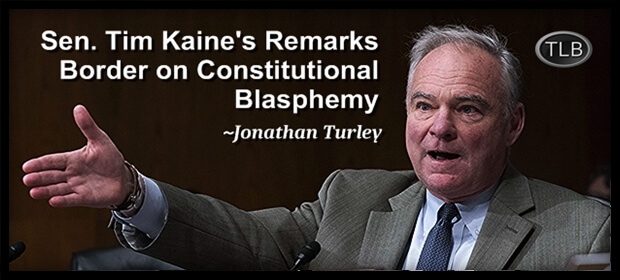
The Mark of Kaine: A Senator’s Remarks Border on Constitutional Blasphemy
By Jonathan Turley

Below is my column in The Hill on the controversial remarks of Sen. Tim Kaine (D. Va.) denouncing a nominee who believed in natural law and the concept of God-given rights. By the end of the hearing, Kaine effectively lumped Alexander Hamilton with Ayatollah Khomeini in his statement at the committee hearing.
Here is the column:
Sen. Tim Kaine (D-Va.) this week warned the American people that a Trump nominee for a State Department position was an extremist, cut from the same cloth as the Iranian mullahs and religious extremists.
Riley Barnes, nominated to serve as assistant secretary of State for democracy, human rights and labor, revealed his dangerous proclivities to Kaine in his opening statement when he said that “all men are created equal because our rights come from God, our creator; not from our laws, not from our governments.”
It was a line that should be familiar to any citizen — virtually ripped from the Declaration of Independence, our founding document that is about to celebrate its 250th anniversary.
Yet Kaine offered a very surprising response in the Senate Foreign Relations Committee hearing.
“The notion that rights don’t come from laws and don’t come from the government, but come from the Creator — that’s what the Iranian government believes,” he said. “It’s a theocratic regime that bases its rule on Shia (sic) law and targets Sunnis, Bahá’ís, Jews, Christians, and other religious minorities. They do it because they believe that they understand what natural rights are from their Creator. So, the statement that our rights do not come from our laws or our governments is extremely troubling.”
In my forthcoming book celebrating the 250th anniversary, Rage and the Republic: The Unfinished Story of the American Revolution, I detail how the Declaration of Independence (and our nation as a whole) was founded on a deep belief in natural laws coming from our Creator, not government.
That view is captured in the Declaration, which states, “We hold these truths to be self-evident, that all men are created equal, that they are endowed by their Creator with certain unalienable Rights, that among these are Life, Liberty and the pursuit of Happiness.”
Kaine represents Virginia, the state that played such a critical role in those very principles that he now associates with religious fanatics and terrorists.
 In fact, Kaine’s view did exist at the founding — and it was rejected. Alexander Hamilton wrote that “The sacred rights of mankind are not to be rummaged for among old parchments or musty records. They are written, as with a sunbeam, in the whole volume of human nature, by the hand of the Divinity itself, and can never be erased or obscured by mortal power.”
Although the Framers were clear, Kaine seemed hopelessly confused. He later insisted that “I’m a strong believer in natural rights, but I have a feeling if we were to have a debate about natural rights in the room and put people around the table with different religious traditions, there would be some significant differences in the definitions of those natural rights.”
This country was founded on core, shared principles of natural law, including a deep commitment to individual rights against the government. The government was not the source but the scourge of individual rights.
 This belief in preexisting rights was based on such Enlightenment philosophers as John Locke who believed that, even at the beginning when no society existed, there was law, “The state of nature has a law of nature to govern it, which obliges every one,” he wrote. “And reason, which is that law, teaches all mankind.”
Note that a natural law can also be based on a view of the inherent rights of human beings — a view of those rights needed to be fully human. Like divinely ordained rights, these are rights (such as free speech) that belong to all humans, regardless of the whim or want of a given government. They are still not “rights [that] come from our laws or our governments.”
The danger of legal positivism is that what government giveth, government can take away. Our prized unalienable rights become entirely alienable if they are merely the product of legislatures and courts.
It also means that constitutional protections or even the constitutional system itself is discardable, like out-of-fashion tricorn hats. As discussed in the book, a new generation of Jacobins is rising on the American left, challenging our constitutional traditions. Commentator Jennifer Szalai has denounced what she called “Constitution worship” and argued that “Americans have long assumed that the Constitution could save us. A growing chorus now wonders whether we need to be saved from it.”
That chorus includes establishment figures such as Erwin Chemerinsky, dean of the Berkeley Law School and author of “No Democracy Lasts Forever: How the Constitution Threatens the United States.”
Other law professors, such as Ryan D. Doerfler of Harvard and Samuel Moyn of Yale, have called for the nation to “reclaim America from constitutionalism.”
That “reclamation” is easier if our rights are based not in natural law, but rather in the evolving priorities of lawmakers like Kaine. Protections then become not the manifestations of human rights, but of rights invented by humans.
Kaine’s view — that advocates of natural law are no different from mullahs applying Sharia law — is not just ill-informed but would have been considered by the founders as constitutionally blasphemous.
He is, regrettably, the embodiment of a new crisis of faith in the foundations of our republic on the very eve of its 250th anniversary. This is a crisis of faith not just in our Constitution, but in each other as human beings “endowed by their Creator with certain unalienable Rights.”
***
Jonathan Turley is a best-selling author whose forthcoming“Rage and the Republic: The Unfinished Story of the American Revolution” explores the foundations and the future of American democracy.
*********
(TLB) published this article from Jonathan Turley with our appreciation for this perspective
Jonathan Turley is the Shapiro Professor of Public Interest Law at George Washington University. Follow him on Twitter @JonathanTurley.

Header featured image (edited) credit: Jose Luis Magana/AP
Emphasis added by (TLB)
••••

••••
Stay Tuned…

••••
The Liberty Beacon Project is now expanding at a near exponential rate, and for this we are grateful and excited! But we must also be practical. For 7 years we have not asked for any donations, and have built this project with our own funds as we grew. We are now experiencing ever increasing growing pains due to the large number of websites and projects we represent. So we have just installed donation buttons on our websites and ask that you consider this when you visit them. Nothing is too small. We thank you for all your support and your considerations … (TLB)
••••
Comment Policy: As a privately owned web site, we reserve the right to remove comments that contain spam, advertising, vulgarity, threats of violence, racism, or personal/abusive attacks on other users. This also applies to trolling, the use of more than one alias, or just intentional mischief. Enforcement of this policy is at the discretion of this websites administrators. Repeat offenders may be blocked or permanently banned without prior warning.
••••
Disclaimer: TLB websites contain copyrighted material the use of which has not always been specifically authorized by the copyright owner. We are making such material available to our readers under the provisions of “fair use” in an effort to advance a better understanding of political, health, economic and social issues. The material on this site is distributed without profit to those who have expressed a prior interest in receiving it for research and educational purposes. If you wish to use copyrighted material for purposes other than “fair use” you must request permission from the copyright owner.
••••
Disclaimer: The information and opinions shared are for informational purposes only including, but not limited to, text, graphics, images and other material are not intended as medical advice or instruction. Nothing mentioned is intended to be a substitute for professional medical advice, diagnosis or treatment.



Leave a Reply