

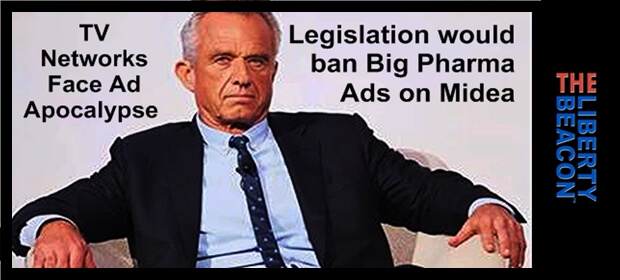
TV Networks Face Ad Apocalypse After Trump Adm Mulls Pharma Restrictions
Legislation would ban pharmaceutical companies from promoting prescription drugs directly to consumers through Media
(ZH) Last week independent Senators Bernie Sanders (VT) and Angus King (ME) introduced legislation that would ban pharmaceutical companies from promoting prescription drugs directly to consumers – including through television, radio, print, digital platforms, and social media.

Today, Bloomberg reports that the Trump administration is now ‘discussing policies that would make it harder and more expensive for pharmaceutical companies to advertise directly to patients.’
Although the US is the only place, besides New Zealand, where pharma companies can directly advertise, banning pharma ads outright could make the administration vulnerable to lawsuits, so it’s instead focusing on cutting down on the practice by adding legal and financial hurdles, according to people familiar with the plans who weren’t authorized to speak publicly on the matter.
The two policies the administration has focused in on would be to require greater disclosures of side effects of a drug within each ad — likely making broadcast ads much longer and prohibitively expensive — or removing the industry’s ability to deduct direct-to-consumer advertising as a business expense for tax purposes, these people said.
If this happens, it would mark a major victory for Health and Human Services Secretary RFK Jr., who says he believes Americans consume more drugs than people in other countries due to the ability of US drug companies to directly advertise to consumers.
While running for president, Mr. Kennedy said he would issue an executive order removing pharmaceutical ads from television, citing overmedication and industry influence on news coverage.
Advertising Apocalypse
As we noted last week, the move would mark a sweeping shift in the U.S. advertising landscape, where pharmaceutical companies are among the largest spenders. Prescription drug brands accounted for roughly 13 percent of all ad spending on linear television in 2025, totaling approximately $2.18 billion so far this year, according to iSpot data. In 2024, the industry spent $3.4 billion on traditional TV ads between January and August alone, according to ad-tracking data.
Since 1997, when the Food and Drug Administration relaxed disclosure requirements for DTC ads, pharmaceutical companies have increasingly leaned on consumer advertising to drive demand. Under current rules, companies need only disclose a drug’s “most important” risks during commercials.
The result has been a media environment saturated with pharmaceutical messaging. Drug ads made up 24.4 percent of all advertising minutes on evening news broadcasts across major networks — including ABC, CBS, CNN, Fox News, MSNBC, and NBC — through May of this year, according iSpot. On CBS Evening News, pharmaceutical companies appeared in more than 70 percent of commercial breaks, per Kantar Media.
_________
Header featured image (edited) credit: Org. post tease. Emphasis added by (TLB)
••••

••••
Stay tuned…

••••
The Liberty Beacon Project is now expanding at a near exponential rate, and for this we are grateful and excited! But we must also be practical. For 7 years we have not asked for any donations, and have built this project with our own funds as we grew. We are now experiencing ever increasing growing pains due to the large number of websites and projects we represent. So we have just installed donation buttons on our websites and ask that you consider this when you visit them. Nothing is too small. We thank you for all your support and your considerations … (TLB)
••••
Comment Policy: As a privately owned web site, we reserve the right to remove comments that contain spam, advertising, vulgarity, threats of violence, racism, or personal/abusive attacks on other users. This also applies to trolling, the use of more than one alias, or just intentional mischief. Enforcement of this policy is at the discretion of this websites administrators. Repeat offenders may be blocked or permanently banned without prior warning.
••••
Disclaimer: TLB websites contain copyrighted material the use of which has not always been specifically authorized by the copyright owner. We are making such material available to our readers under the provisions of “fair use” in an effort to advance a better understanding of political, health, economic and social issues. The material on this site is distributed without profit to those who have expressed a prior interest in receiving it for research and educational purposes. If you wish to use copyrighted material for purposes other than “fair use” you must request permission from the copyright owner.
••••
Disclaimer: The information and opinions shared are for informational purposes only including, but not limited to, text, graphics, images and other material are not intended as medical advice or instruction. Nothing mentioned is intended to be a substitute for professional medical advice, diagnosis or treatment.
Leave a Reply