

Ukraine on the Brink: Europe Scrambles Over Trump-Putin Peace Plan
Berlin, Paris, and London have moved quickly to close ranks. All three reaffirmed their steadfast support for Kyiv…
21WIRE – Freddie Ponton
Europe awoke to a diplomatic shock [earlier this week.] A confidential 28-point peace blueprint, quietly assembled by aides to Donald Trump and Vladimir Putin, after weeks of secretive shuttle diplomacy, was placed before Kyiv. The scale, ambition, and raw audacity of the proposal stunned European capitals. It offered territorial giveaways, troop caps, sweeping economic reintegration for Moscow, and even a Trump-chaired “Peace Council” empowered to police the agreement. Within hours, European leaders were on the phone in a scramble, trying to understand how such a plan emerged without their input, and what it meant for the future of the continent.
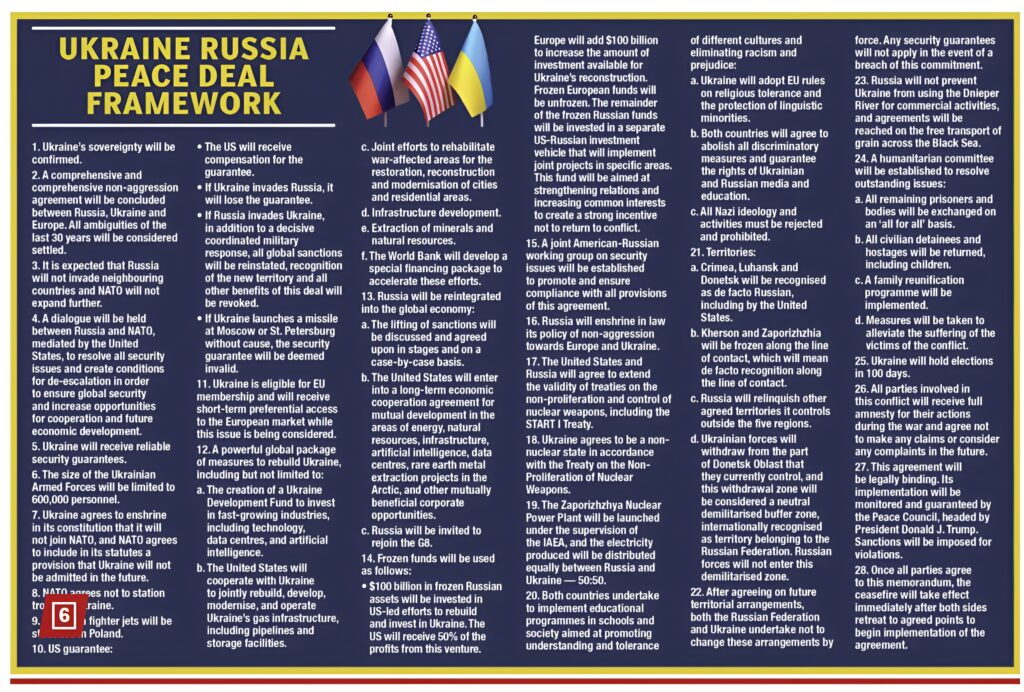 IMAGE: A plan has been put into place to end the war, though neither side has publicly accepted the agreement.(Source: NYP)
By this morning, the tone across Europe had shifted from cautious concern to something far sharper: urgency laced with unease. EU foreign policy chief Kaja Kallas did not hide her apprehension, reminding allies that any credible peace plan “must be owned by Ukraine and by Europe.” A deal hammered out over European heads, she warned, risks not just sidelining the continent but effectively rewarding Moscow.
Berlin, Paris, and London have since moved quickly to close ranks. All three reaffirmed their steadfast support for Kyiv and stressed that any agreement must reflect the current realities on the ground, not force Ukraine into further territorial concessions.
Across Europe’s strategic circles, the reaction has been just as stark. Military analysts and former officials caution that the proposal could erode Europe’s broader security posture, dilute NATO’s central role, and, perhaps most dangerously, open the door to future Russian advances. In their view, the plan doesn’t merely fall short; it risks reshaping the balance of power in Europe in ways that could haunt the continent for years to come.
American officials claimed the proposal drew from extensive talks with both sides. They said Ukraine’s security chief, Rustem Umerov, provided “positive feedback” during meetings in Miami, agreeing to “the majority” of its provisions, though Kyiv has not publicly confirmed this. Zelensky acknowledged receiving the American “vision,” framing the next phase as “clear and honest work” among Ukraine, the United States, Europe, and global partners. But if Washington believed the plan was ready for primetime, Europe did not.
The contents were explosive. Under the blueprint, the U.S. would recognize the entire Donbas as Russian territory, including areas Moscow has never fully captured, and freeze parts of Kherson and Zaporizhzhia along current battle lines. Ukrainian forces would withdraw from zones they still hold in Donetsk, creating a demilitarized buffer that Russia would be barred from entering. Strategically, it would concede to Moscow a permanent military cushion along frontiers it has fought for since 2014.
Security guarantees from Washington would be conditional: the U.S. would react forcefully if Russia reinvaded, but all guarantees evaporate if Ukraine strikes Russian territory or fires missiles at Moscow or St. Petersburg “without cause.” Pro-Ukraine analysts immediately flagged the asymmetry. Russia gains borders; Ukraine gains promises that can be nullified by a single miscalculated launch.
The plan demands Ukraine permanently renounce NATO membership and enshrine neutrality in its own constitution, while capping its military at 600,000 troops. NATO, in turn, would agree never to station forces in Ukraine. European jets could patrol from Poland, but Ukraine itself would remain a security no-man’s-land. For many strategists, the plan effectively writes Moscow’s long-standing demands into international law.
Economic provisions go even further. One hundred billion dollars in frozen Russian assets would be redirected into U.S.-led reconstruction projects, with Washington keeping half the profits. Europe would match that with another $100 billion. Remaining Russian funds would be unfrozen for future U.S.-Russian economic ventures in energy, AI, rare-earth minerals, and digital infrastructure. European officials were aghast: sanctions designed to restrain Moscow could end up financing Russian–American cooperation. They are fuming…
The political components were even more challenging. Ukraine would be required to hold national elections within 100 days, even though wartime voting is constitutionally barred. A blanket amnesty for all wartime actions would wipe away future legal claims on both sides. Senior U.S. officials say this amnesty was proposed by Kyiv, though Ukraine has not confirmed it. Critics warn this would permanently close the door on accountability for atrocities.
Meanwhile, Rustem Umerov, Ukraine’s Secretary of the National Security and Defense Council, strongly denied media claims that he had approved key points of a 28-point U.S. peace plan with Russia. According to Umerov, his visit to the United States was purely technical; he organised meetings and facilitated dialogue, but did not evaluate or endorse any of the plan’s provisions. He rejected reports of him modifying or removing clauses, calling such stories “unverified.” Umerov emphasized that Ukraine is carefully reviewing all partner proposals in line with its core principles: sovereignty, security, and a just peace
The plan goes further still: Russia could rejoin the G8, restart long-term cooperation agreements with the United States, and re-enter high-level security dialogues with NATO. The Zaporizhzhia nuclear plant would restart under IAEA supervision, its electricity split evenly between Russia and Ukraine. Humanitarian provisions include an “all-for-all” prisoner exchange and the return of abducted Ukrainian children. On paper, it is sweeping; in practice, it may be unworkable.
Western critics warn that the plan essentially consecrates territorial conquest and shreds the European security order. To them, it risks rewarding aggression and signaling that borders in Europe can be redrawn by force. However, many military and intelligence experts and commentators on Ukraine tell a very different story, one with its own political potency. They argue that the roots of the conflict long predate 2022: that the war began when Kyiv used force to suppress separatist sentiment in the Donbas in 2014; that the U.S. and NATO were heavily involved in supporting the Maidan uprising, which Russia calls a coup; and that Washington spent years arming Ukraine “to the teeth” while expanding NATO eastward, leaving Russia feeling cornered. These narratives, widely disputed in the West, nonetheless shape the worldview of many who see the conflict as the culmination of Western overreach.
For some, the peace plan doesn’t go far enough. They believe Russia’s battlefield advantage gives it the upper hand and that any settlement should reflect not just recent gains but the broader strategic grievances Moscow has held for decades. Some argue Ukraine should be even more thoroughly demilitarized; others say Moscow should not freeze the conflict at all while it continues advancing. And many insist that Russia deserves a full restructuring of Europe’s security architecture, not merely recognition of territory.
Undeniably, and to some degree, these perspectives, though contested, influence how Moscow calculates leverage, how Western hardliners interpret the risks of concession, and how the global South views Western claims about rules-based order.
Across Europe, meanwhile, the sense of being sidelined grows sharper. Washington’s unilateral diplomacy has revived deep anxieties about transatlantic drift, especially as America appears increasingly split between competing factions in its own government. Secretary of State Marco Rubio publicly tempered expectations, insisting the administration had not endorsed any final plan. Chaos deepened when the proposal leaked to Axios, reportedly via Russian financier Kirill Dmitriev, prompting accusations he was trying to claim early credit for a Russian diplomatic win. Steve Witkoff inadvertently confirmed the suspicion before deleting his post.
As the dust settles, one reality stands out: the negotiation space is shrinking. Russia’s battlefield momentum reduces its incentive to compromise. Ukraine is unlikely to accept terms that cement the loss of its territory and sovereignty. Europe fears a settlement that undermines its own security. And the United States appears divided between transactional diplomacy and alliance commitments.
The 28-point plan may be the most ambitious attempt yet to impose an endgame on the war, but events on the ground are moving faster than diplomacy. European capitals watch with growing unease, aware that unless something changes, the battlefield, and not the negotiating table, may end up writing the final terms of peace.
__________
(TLB) PUBLISHED THIS ARTICLE FROM 21WIRE
SUPPORT INDEPENDENT MEDIA – BECOME A MEMBER @21WIRE.TV & VISIT OUR TELEGRAM CHANNEL
Header featured image (edited) credit: Org. post content. E,phasis & additional editing by (TLB)
••••

••••
Stay tuned…

••••
The Liberty Beacon Project is now expanding at a near exponential rate, and for this we are grateful and excited! But we must also be practical. For 7 years we have not asked for any donations, and have built this project with our own funds as we grew. We are now experiencing ever increasing growing pains due to the large number of websites and projects we represent. So we have just installed donation buttons on our websites and ask that you consider this when you visit them. Nothing is too small. We thank you for all your support and your considerations … (TLB)
••••
Comment Policy: As a privately owned web site, we reserve the right to remove comments that contain spam, advertising, vulgarity, threats of violence, racism, or personal/abusive attacks on other users. This also applies to trolling, the use of more than one alias, or just intentional mischief. Enforcement of this policy is at the discretion of this websites administrators. Repeat offenders may be blocked or permanently banned without prior warning.
••••
Disclaimer: TLB websites contain copyrighted material the use of which has not always been specifically authorized by the copyright owner. We are making such material available to our readers under the provisions of “fair use” in an effort to advance a better understanding of political, health, economic and social issues. The material on this site is distributed without profit to those who have expressed a prior interest in receiving it for research and educational purposes. If you wish to use copyrighted material for purposes other than “fair use” you must request permission from the copyright owner.
••••
Disclaimer: The information and opinions shared are for informational purposes only including, but not limited to, text, graphics, images and other material are not intended as medical advice or instruction. Nothing mentioned is intended to be a substitute for professional medical advice, diagnosis or treatment.

Ha Ha Ha Ha… Trump didn’t ask for europes’s input bcyz it doesnt’t matter!!! The bulk of aid the ukraine receives is from the divided states NOT europe!!! Good show Mr. President!!! 😅