

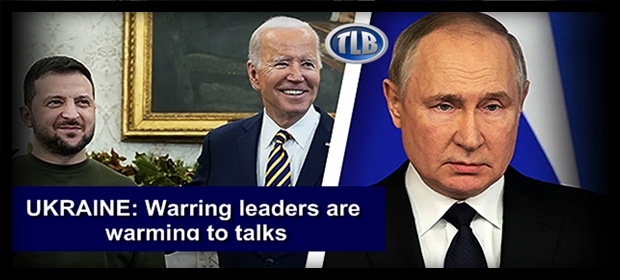
UKRAINE: Putin, Zelensky Signal New Willingness to Talk
Warring leaders are warming to talks as both claim recent battlefield successes to negotiate from positions of strength
21WIRE
If only the Ukrainians had been paying attention and weren’t so easily duped by Washington and London to begin with. If only Zelensky had ratified the Minsk Accords as he promised millions of voters in Ukraine back in 2019. Maybe then, the country, Europe, and the world at large, could have been spared the unmitigated geopolitical disaster we are witnessing today.
Certainly, its proponents will insist that Ukraine has fought bravely for its right to leave the Russian sphere of influence, and that they ‘deserve ‘ to be part of Europe, and by extension, NATO. That’s all well and good in a rhetorical vacuum, but unfortunately, it will never square with reality. That’s because for decades, Russia has been very clear about what its policy for Ukraine is. Putin has wanted to turn Ukraine into a neutral state, and not a militarized, Nazi-ridden NATO outpost on Russia’s borders. On that point, because this is an existential issue for Moscow, it will continue to hold an insurmountable advantage in its balance of resolve.
So here we are, two and a half years into NATO’s proxy war against Russia in Ukraine, and the fait accompli is finally being verbalised by western hawks and their subordinates in Ukraine alike: the sheer amount of men and resources required to win their war is too much for the collective West and the beleaguered Ukrainians to sustain. And no amount of “democracy!” virtue-signaling, deliveries of ‘wonder weapons’, or fantasy projection can ever change that.
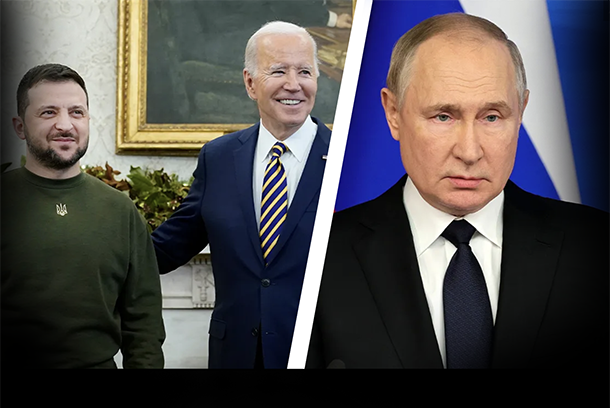
Meanwhile, warring leaders are warming to talks as both claim recent battlefield successes to negotiate from positions of strength…
Daniel Williams from Asia Times reports…
After months of resolute refusals to negotiate, both Ukrainian President Volodymyr Zelensky and Russia’s President Vladimir Putin are finally expressing a desire to talk.
It’s difficult to establish whether either leader is sincere, though Zelensky said he will deliver his plan to US President Joe Biden, Ukraine’s biggest wartime booster, sometime in November. Putin, whose army invaded Ukraine first in 2014 and then again in 2022, hasn’t articulated exactly what he has in mind.
At the current conflict’s outset, the warring leaders specified concrete peace terms that required the other to give up their war aims unconditionally. Ukraine demanded the full withdrawal of Russian troops that took over the Crimean Peninsula and a swath of eastern Ukraine in 2014. Putin, meanwhile, declared a goal of incorporating Ukraine into the Russian Federation.
Zelensky’s shift, announced last month, is more formal. It was contained in a four-point outline that represents a shrunken version of a ten-point peace proposal he outlined in 2022.
The 2022 “Peace Formula” emphasized the demand for the complete withdrawal of all Russian troops and a Kremlin promise never to invade again. His current “Victory Plan” includes a call “to end the war in a diplomatic way.”
“We understand that it is very difficult to diplomatically end this war without the Russian side,” he said, answering requests from Western European allies to invite Russia to talks.
The “victory” scheme was heralded by the recent Ukrainian conquest of territory in and around the city of Kursk in far western Russia, which Zelensky suggested should inspire allies to provide more economic and military aid.
“The main point of this plan is to force Russia to end the war,” Zelensky said. He announced he will present the plan in detail to Biden sometime this fall.
At first, the Kremlin brushed off the call for diplomacy and stuck to Putin’s original war aims. “Our proposals for the demilitarization and denazification of the territories controlled by the regime, the elimination of threats to Russia’s security emanating from there, including our new lands, are well known to the enemy,” said Russian Foreign Minister Sergei Lavrov.
But in brief comments last week, Putin appeared to warm to talks. “If there is a desire to negotiate, we will not refuse,” he said. “We have never rejected them.”
So, is all this just pretense or serious message-sending reflecting some sort of war weariness?
For nearly two years, the battlefield fortunes of each side have shifted wildly. First, Russia launched a blitzkrieg-like ground offensive that targeted major Ukrainian cities, including the capital Kiev but which Ukrainian defenders repulsed.
The following year, Ukraine launched a counteroffensive meant to drive the Russians out of the country but could not penetrate more than a few hundred meters into Russian-defended territory. The Ukrainians got stymied by acres of Russian-laid minefields and suffered horrific casualties from artillery and rocket barrages.
This year, Putin ordered a new offensive, which has taken some territory in the Donbas region in eastern Ukraine but which has resulted in a limited, hard-fought rollback of Ukrainian forces.
Putin has declared success anyway. “We are not talking about advancing 200 or 300 meters,” Putin said last week. “We haven’t had this kind of pace in the offensive in Donbas for a long time.”
For the moment, the main goal of the Russian campaign is to take the town of Pokrovsk, a communications hub held by the Ukrainians. More brutally consistent assaults have come in the form of scorched earth assaults via artillery fire and rocket and armed drone attacks nationwide. The daily bombardments have destroyed energy infrastructure and civilian targets, including residences and schools, across Ukraine.
Finally, Ukrainian troops flexed newfound offensive skills by launching a surprise cross-border attack into Russia. The August thrust resulted in the conquest of dozens of square miles of territory and the capture of the Russian city of Kursk.
“Everyone can see that the Ukrainian army knows how to surprise,” Zelensky declared as he handed out medals to his soldiers. “This is demonstrated on the battlefield, where our soldiers not only withstood the overwhelming force of the occupiers but also are destroying it in the way necessary to protect Ukraine.”
Ukraine has also fielded an impressive array of domestically produced drones that have hit targets far inside Russia and sank ships in the Black Sea.
So, who is actually winning and would have the advantages in negotiations?
On paper, nuclear power Russia seems to have the edge, even if its offensive moves are slow. It has thrown about 600,000 soldiers into battle backed by heavy weaponry and domestically made drones as well as many imported from Iran. North Korea has supplied rockets. Steady income from petroleum sales, especially to India and China, has helped to pay for it all.
Russian casualties number over 300,000, according to US officials, and almost a third of them are reportedly dead. Whether those figures are higher or lower than reality, Putin seems willing to pay a high human price, despite scattered complaints from relatives of the dead and wounded.
However, winning the war on terms originally expected by Putin—occupation and absorption of Ukraine—is unrealistic and would be bad for Russia, according to an article in the foreign policy journal Responsible Statecraft. “Instead, Russia’s incentive is to use its growing advantages as a lever for negotiating with the West,” the article contended.
Nonetheless, the article concluded that establishing “demilitarized buffer zones in Ukraine,” would be enough of an achievement.
Ukraine, on the other hand, is hampered by dependence for arms on sometimes wavering outsiders, especially in Europe, and difficulties in recruiting fresh soldiers at home.
“Domestic mass production of ammunition is still lagging. As things stand, Ukraine is highly dependent on foreign supplies,” said Huseyn Aliyev, a researcher at the University of Glasgow specializing in Russia and Ukraine.
Last month, Harvard University’s Belfer Center for Science and International Affairs put the number of Ukrainian dead, “severely wounded,” and missing at at least 130,000. In April, Zelensky lowered the draft age from 27 years old to 25 in hopes of boosting troop numbers.
“Ukraine may come to feel it can’t win,” suggested General Richard Barrons, former head of Britain’s Joint Force Command. “And when it gets to that point, why will people want to fight and die any longer – just to defend the indefensible?”
Continue this analysis at Asia Times
*********
(TLB) published this artifle from 21WIRE
READ MORE UKRAINE NEWS AT: 21st Century Wire Ukraine Files
PLEASE HELP SUPPORT OUR INDEPENDENT MEDIA PLATFORM HERE
ALSO JOIN OUR TELEGRAM CHANNEL
Header featured image (edited) credit: org.21W article tease
Emphasis added by (TLB)
••••

••••
Stay tuned tuned…

••••
The Liberty Beacon Project is now expanding at a near exponential rate, and for this we are grateful and excited! But we must also be practical. For 7 years we have not asked for any donations, and have built this project with our own funds as we grew. We are now experiencing ever increasing growing pains due to the large number of websites and projects we represent. So we have just installed donation buttons on our websites and ask that you consider this when you visit them. Nothing is too small. We thank you for all your support and your considerations … (TLB)
••••
Comment Policy: As a privately owned web site, we reserve the right to remove comments that contain spam, advertising, vulgarity, threats of violence, racism, or personal/abusive attacks on other users. This also applies to trolling, the use of more than one alias, or just intentional mischief. Enforcement of this policy is at the discretion of this websites administrators. Repeat offenders may be blocked or permanently banned without prior warning.
••••
Disclaimer: TLB websites contain copyrighted material the use of which has not always been specifically authorized by the copyright owner. We are making such material available to our readers under the provisions of “fair use” in an effort to advance a better understanding of political, health, economic and social issues. The material on this site is distributed without profit to those who have expressed a prior interest in receiving it for research and educational purposes. If you wish to use copyrighted material for purposes other than “fair use” you must request permission from the copyright owner.
••••
Disclaimer: The information and opinions shared are for informational purposes only including, but not limited to, text, graphics, images and other material are not intended as medical advice or instruction. Nothing mentioned is intended to be a substitute for professional medical advice, diagnosis or treatment.

Leave a Reply