

Walz Leads Effort to Block Rule in Acts of Self-Defense
(The “No Duty to Retreat” Rule)
By Jonathan Turley

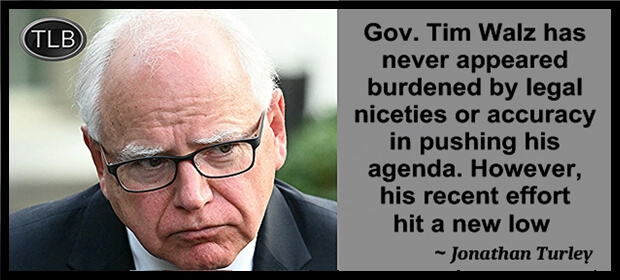
Gov. Tim Walz has never appeared burdened by legal niceties or accuracy in pushing his agenda, including his anti-free speech policies. However, his recent effort to block an effort to enact a “no duty to retreat” rule for self-defense hit a new low. Walz completely misrepresented not only the underlying bill, HF 13, but ignored the common law on self-defense.
Gun control groups opposed the bill that would have clarified the rule that citizens did not have a duty to retreat in the use of self-defense. Walz immediately fell in line and helped defeat the bill by a single vote — and a gross misrepresentation.
The bill would have aligned the Minnesota self-defense law with the common law, which did not require a retreat when it is possible before the use of force. The new law would have simply added the following line:
“(b) An actor may use reasonable force under the circumstances described in paragraph (a), clause (3), regardless of whether a reasonable possibility of retreat to avoid the danger exists.”
Walz told the media that the new language would allow citizens to “shoot somebody for taking your parking space.”
There is nothing in the law that would support such a claim. The law states in pertinent part that citizens can use reasonable force:
“(3) when used by any person in resisting or aiding another to resist an offense against the person; or
(4) when used by any person in lawful possession of real or personal property, or by another assisting the person in lawful possession, in resisting a trespass upon or other unlawful interference with such property; or
(5) when used by any person to prevent the escape, or to retake following the escape, of a person lawfully held on a charge or conviction of a crime…”
How is claiming a parking space an “offense” or a denial of “real or personal property”?
It is a knowingly baseless and sensational claim by Walz.
The controversy highlights rivaling doctrines that we often discuss in Torts. Many states now have “Castle doctrine” laws, which allow people to use lethal force in defense of their homes. Called “Make My Day” laws in some states, there are also “Make My Day Better” laws allowing people to use lethal force in defense of other property like cars. There are also laws like “Stand Your Ground” discussed in such well-known cases as the trial of George Zimmerman (though it was ultimately not used in favor of a conventional self-defense claim).
The common law does not impose a duty to retreat. It preexisted the SYG law in most states. If it didn’t, hundreds of thousands of cases of self-defense would have had different results after people defended themselves rather than flee. Indeed, this is a point that I often made in opposing these laws: you already have the right to defend yourself and not to retreat.
In Beard v. United States, 158 U.S. 550, 562 (1895), the Supreme Court held that
“The weight of modern authority, in our judgment, establishes the doctrine that when a person, being without fault, and in a place where he has a right to be, is violently assaulted, he may, without retreating, repel force by force, and if, in the reasonable exercise of his right of self-defense, his assailant is killed, he is justifiable.”
That does not mean that the state cannot preempt common law by requiring retreat when available. Other states have imposed such a requirement. However, Walz has again shown his signature tendency to exaggerate or misrepresent the law when it serves political ends.
The rule on “no duty to retreat” may warrant debate, but does not warrant false claims. Ironically, Walz has a reputation as an anti-free speech figure, including censorship of things that he deems disinformation. This is disinformation, but I would not seek to censor him for spreading it. It is enough to point out the absurdity of the claim and to allow free speech to protect against bad speech.
***
Jonathan Turley is the author of “The Indispensable Right: Free Speech in an Age of Rage.
*********
(TLB) published this article from Jonathan Turley with our appreciation for this perspective
Jonathan Turley is the Shapiro Professor of Public Interest Law at George Washington University. Follow him on Twitter @JonathanTurley.

Header featured image (edited) credit: Jim Watson/AFP/Getty. Emphasis added by (TLB)
••••

••••
Stay Tuned…

••••
The Liberty Beacon Project is now expanding at a near exponential rate, and for this we are grateful and excited! But we must also be practical. For 7 years we have not asked for any donations, and have built this project with our own funds as we grew. We are now experiencing ever increasing growing pains due to the large number of websites and projects we represent. So we have just installed donation buttons on our websites and ask that you consider this when you visit them. Nothing is too small. We thank you for all your support and your considerations … (TLB)
••••
Comment Policy: As a privately owned web site, we reserve the right to remove comments that contain spam, advertising, vulgarity, threats of violence, racism, or personal/abusive attacks on other users. This also applies to trolling, the use of more than one alias, or just intentional mischief. Enforcement of this policy is at the discretion of this websites administrators. Repeat offenders may be blocked or permanently banned without prior warning.
••••
Disclaimer: TLB websites contain copyrighted material the use of which has not always been specifically authorized by the copyright owner. We are making such material available to our readers under the provisions of “fair use” in an effort to advance a better understanding of political, health, economic and social issues. The material on this site is distributed without profit to those who have expressed a prior interest in receiving it for research and educational purposes. If you wish to use copyrighted material for purposes other than “fair use” you must request permission from the copyright owner.
••••
Disclaimer: The information and opinions shared are for informational purposes only including, but not limited to, text, graphics, images and other material are not intended as medical advice or instruction. Nothing mentioned is intended to be a substitute for professional medical advice, diagnosis or treatment.



Leave a Reply