
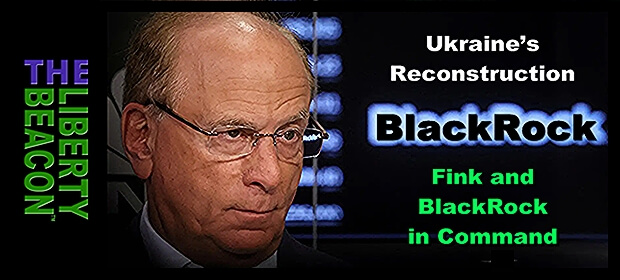
Why BlackRock CEO Fink is suddenly involved in Ukraine negotiations
The peace negotiations regarding Ukraine are taking on a new dimension: An American reconstruction paper reveals economic priorities – and explains why Wall Street giants like Larry Fink are suddenly sitting at the negotiating table.
Investment Week
Washington shifts the focus of the negotiations
The latest statement from the Chancellor’s Office sounds matter-of-fact – but its significance is anything but. Chancellor Merz, President Macron, Prime Minister Starmer, and US President Trump speak of a “decisive moment” in the ceasefire negotiations. Behind this phrase lies a conflict that runs deeper than previously known: The US has presented a confidential document intended to reorganize Ukraine’s economic reconstruction while simultaneously paving the way for Russia’s return to global markets.
The Europeans received the document not as a basis for discussion, but for their information. The message is clear: Washington claims the dominant role in shaping the economy after a deal – with its own priorities and its own actors.
The frozen Russian assets are being used as leverage for American interests.
At the heart of the plan are Russian assets worth approximately €183 billion that have been frozen since the start of the war. While Europe intends to use these funds directly for reconstruction projects in Ukraine, the US government is pursuing a different approach: The capital is to be invested by American companies in large-scale infrastructure projects such as data centers, whose energy supply could allegedly come from the Zaporizhzhia nuclear power plant, which remains under Russian control.
The ambition is clear: with professional asset management, the fund is to grow to up to $800 billion. The implicit accusation against Europe: you want to finance, we want to multiply.
The emergence of Wall Street changes the dynamics
The fact that Treasury Secretary Scott Bessent and BlackRock CEO Larry Fink suddenly joined a conversation between President Zelensky, Trump’s chief negotiator Steve Witkoff, and Jared Kushner is no coincidence – it’s a signal. The negotiations have taken on a second dimension, in which geopolitical goals and financial interests are intertwined.
This round of negotiations is delicate for Europe. The EU views “frozen assets” as a solidarity instrument, not an investment vehicle. The fact that Fink – whose ministry was already involved with Ukrainian reconstruction plans – is now being included in a closer coordination group demonstrates how strongly economic considerations shape the American strategy on Ukraine.
Merz is caught between political responsibility and personal history.
The situation is particularly precarious for Chancellor Friedrich Merz. As the former chairman of the supervisory board of BlackRock Germany, he is under heightened scrutiny. At the same time, he is fighting in Brussels to release the frozen assets in order to give Ukraine immediate room to maneuver. Belgium’s resistance is considered the biggest obstacle.
However, the US plans suddenly make these efforts seem like a secondary strategy. Europeans are wondering whether Washington intends to shift the political burden of asset release onto the EU while American companies gain operational control.
Economic interests shape the peace agenda
The US vision goes far beyond reconstruction. It includes ideas about economic cooperation with Russia – for example in the Arctic or in the mining of rare earth elements. This shifts the hierarchy of objectives: security issues recede into the background, while economic arrangements following a potential ceasefire take center stage.
This prioritization is causing mistrust in Kyiv. After the meeting, Zelenskyy spoke of “ideas that could work”—but immediately added that security remained the prerequisite for everything else. This statement illustrates how sensitive the negotiations have become: Ukraine must prevent economic considerations from forcing territorial compromises.
The risk of political imbalance is growing.
The fact that the US government is willing to put border issues aside is shaking the European position. Should the “economy first” logic prevail, Ukraine could be confronted with demands it has categorically rejected so far. A scenario in which Russia regains access to Western technologies and markets through economic cooperation – without clear security guarantees for Kyiv – would be particularly critical.
The upcoming rounds of negotiations in Paris and Berlin will therefore become a kind of referendum: Should a ceasefire be primarily geopolitical or primarily economic?
The real break lies in the distribution of roles.
Europe sees itself as an anchor of political stability. The US is increasingly presenting itself as the architect of economic reconstruction – and claiming operational leadership. When Larry Fink sits at the negotiating table, it is not as a symbol of “greedy Wall Street,” but as an expression of a strategic reorientation of American foreign policy: reconstruction as a business venture, not as a project of solidarity.
This is precisely where the new conflict line between Washington and the European capitals lies – and the realization that the question of peace in Ukraine will in future be decided in the markets as much as at the borders.
_________
Header featured image (edited) credit: NYPost article tease public card. Emphasis added by (TLB) editors
••••

••••
Stay tuned…

••••
The Liberty Beacon Project is now expanding at a near exponential rate, and for this we are grateful and excited! But we must also be practical. For 7 years we have not asked for any donations, and have built this project with our own funds as we grew. We are now experiencing ever increasing growing pains due to the large number of websites and projects we represent. So we have just installed donation buttons on our websites and ask that you consider this when you visit them. Nothing is too small. We thank you for all your support and your considerations … (TLB)
••••
Comment Policy: As a privately owned web site, we reserve the right to remove comments that contain spam, advertising, vulgarity, threats of violence, racism, or personal/abusive attacks on other users. This also applies to trolling, the use of more than one alias, or just intentional mischief. Enforcement of this policy is at the discretion of this websites administrators. Repeat offenders may be blocked or permanently banned without prior warning.
••••
Disclaimer: TLB websites contain copyrighted material the use of which has not always been specifically authorized by the copyright owner. We are making such material available to our readers under the provisions of “fair use” in an effort to advance a better understanding of political, health, economic and social issues. The material on this site is distributed without profit to those who have expressed a prior interest in receiving it for research and educational purposes. If you wish to use copyrighted material for purposes other than “fair use” you must request permission from the copyright owner.
••••
Disclaimer: The information and opinions shared are for informational purposes only including, but not limited to, text, graphics, images and other material are not intended as medical advice or instruction. Nothing mentioned is intended to be a substitute for professional medical advice, diagnosis or treatment.
No matter how you spin it, it sounds like Russia’s frozen assets are still going to be stolen by the West.