

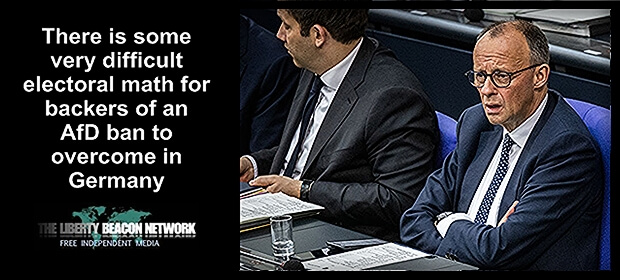
Will the AfD party be banned in Germany?
There is some very difficult electoral math for backers of an AfD ban to overcome
There are once again efforts to ban the Alternative for Germany (AfD) in the Bundestag, with the far-left Social Democrats (SPD) leading the way. However, there is some difficult math facing the proponents of an AfD ban, which makes it unlikely — but not impossible — for the party to be banned.
In order to understand why a ban is unlikely, let us first look at what would actually happen if a ban of the AfD went forward.
The AfD is currently the most popular party in the country, according to multiple polls, scoring between 25 and 27 percent of the vote. This alone makes a ban unthinkable to many, but the German establishment does not especially care what the electorate thinks on a number of key issues, so why not just ban the party?
For starters, and most importantly, a ban of the AfD would radically reshape the German electorate in favor of the left. This would translate into the Christian Democrats (CDU) losing a massive amount of power, and potentially being relegated to the political dustbin. Due to this cold, hard reality, a ban could be suicidal for the CDU.
How one local elections tells us about the federal election
What happened in the local mayoral election in Ludwigshafen tells us what the likely outcome of an AfD ban would be for the country at the federal level. In Ludwigshafen, the AfD’s Joachim Paul was leading the polls to become mayor before he was banned from running through backroom bureaucratic channels, a move later confirmed by judges during a number of appeals. The judges all argued Paul would have to challenge the ban after the election. Paul is still filing legal actions against the decision, but the outcome of the appeal could take months or even years.

German election turns into farce after AfD candidate banned from running, only 29% of voters participate in Ludwigshafen
Germany’s left have long claimed that the Alternative for Germany (AfD) is a threat to democracy, and due to this claim, they argue the party should be banned entirely. Although banning parties is typically reserved for authoritarian regimes, this outcome remains a very real possibility in Germany, and a local election in the city of … Continue reading
Regardless of the outcome of Paul’s appeal, the election had some interesting outcomes.
First, the voter participation rate crashed to a record low of just 29.3 percent. In 2017’s mayoral election in Ludwigshafen, the then-SPD candidate Jutta Steinruck won with 60.2 percent participation. That means voter turnout was cut in half from that election.
That is not all. For those who did vote, many of them appear to have submitted “spoiled” ballots. A record-high number of ballots were ruled invalid, at 9.2 percent. Eight years ago, that number was just 2.6 percent. The number of “spoiled ballots” jumped by nearly 400 percent.
If this same outcome occurred at the federal level, including a dramatic crash in the voter participation rate as AfD supporters boycott the election, it would be a disaster for the CDU’s electoral chances.
The way the German system works means that the pool of right-wing voters would shrink dramatically, leaving CDU voters and the left as the only remaining voting pool. However, this remaining, much smaller pool, would then feature a dramatically larger share of left-wing voters consisting of the SPD, the Greens, and the Left Party.
These three parties would be looking at a potential supermajority.

Germany: CDU leadership wants to end talks of AfD ban in party ranks, Söder says a ban would ‘hardly be legally enforceable’
Numerous members of Germany’s Christian Democrats (CDU) have been lobbying for a ban of the Alternative for Germany (AfD) party, but CDU’s leadership is calling for an end to such discussions. Now, against the expectations of many, a ban of the party may not be going forward, at least not anytime soon. Currently, CDU General-Secretary … Continue reading
Even with a CDU scoring 30 to 35 percent of the vote, the party could be easily sidelined by this new far-left coalition.
This is what the CDU fears.
To understand this, it is important to understand that the German left does not need to increase the number of votes it receives; it just needs to increase its share of the vote. Let us consider an imaginary scenario where only 35 percent of the population votes in the next German federal election. It would be a disaster for democracy, but it could still be a huge win for the left. If the right drops out of the voting process. Suddenly, the remaining voting pie looks more left-wing, and the left can win a bigger share of this smaller voting pie.
Voilà, the left now have a super majority with just a small fraction of voters coming out to vote.
The trouble for the left is that it still needs the CDU to vote for an AfD ban in the Bundestag, otherwise they would not have the majority needed to pass such a motion. However, the CDU has no incentive to do this.
Death of democracy, rise of the left
On top of this electoral math problem for the CDU, it would not only make the electoral map vastly more favorable to the left, but it could also tear a giant hole in the CDU party itself.
A plurality of voters are against a ban on the AfD. A new Insa poll shows that 43 percent of respondents are against a ban, while 35 percent are in favor. Another 10 percent were indifferent, and 12 percent refused to comment.
Germany: In panic mode, CDU retreats from far-left judge who backs AfD ban, mandatory vaccinations, and potentially even late-term abortions
The Christian Democratic Union (CDU) has long been known to sell out every last so-called value the party is supposed to represent, but it appears that backing controversial far-left candidate Frauke Brosius-Gersdorf is now a bridge too far. The CDU/CSU has now decided that a special session on the election of Brosius-Gersdorf should now be … Continue readingGermany: In panic mode, CDU retreats from far-left judge who backs AfD ban, mandatory vaccinations, and potentially even late-term abortions
However, for CDU voters, the issue was evenly split, with 42 percent supporting a ban, while 41 percent were against it.
Many CDU voters have already switched their voting intentions towards the AfD. A ban could further fuel an exodus towards the AfD party while the ban works its way through the system, all the way to the Constitutional Court, which is the final arbiter of the ban process. That could take well over a year, plenty of time to enact massive damage on the CDU.
Chancellor Friedrich Merz already said that a ban of the AfD “smacks to much of the elimination of political rivals.” CDU voters all heard this statement. For him and his party to backtrack now on this issue would not sit well with many voters, many who are already dissatisfied with the economy and migration.

German democracy still alive? Merz speaks out against AfD ban, says it ‘smacks too much of the elimination of political rivals’
In recent months, a ban of the Alternative for Germany (AfD) appeared to be inching closer and closer, but now a key voice has clearly spoken out against such a move. Chancellor Friedrich Merz has now said that voting on an AfD ban in the Bundestag is not the right path, saying it “smacks too … Continue reading
The Insa poll also shows that while a majority of supporters of left-wing parties back a ban, they are by no means in full agreement. Many Germans, even those on the left, believe a ban on the AfD would be a stake in the heart of democracy.
If a ban goes through, and a national vote is held featuring an abysmal voter participation rate due to mass boycotts, it would likely send the German system into chaos, leaving a massive democratic hole in the country’s landscape. It could even shake the entire foundation of the German state, calling into question the legitimacy of any government that is elected into power with an extremely low voter share and a ban on the most popular party.
What is the most likely scenario?
The left is likely to continue with its full-court press to proceed with a ban on the AfD. It would only benefit them, after all. The CDU is also likely to continue to talk of a ban, demonize the AfD, and try to snipe at the party using all the tools of the state, but is unlikely to actually back a ban. Doing so would be very foolish from a purely strategic point of view.
Of course, that is not a foregone conclusion. There are potential political realities, power struggles, and wild cards that could lead Merz and much of the CDU leadership to reverse course. However, the current risks of such a move outnumber the potential benefits by a clear margin.
_________
Header featured image (edited) credit: (Photo by Nadja Wohlleben/Getty Images) . Emphasis added by (TLB)
••••

••••
Stay tuned…

••••
The Liberty Beacon Project is now expanding at a near exponential rate, and for this we are grateful and excited! But we must also be practical. For 7 years we have not asked for any donations, and have built this project with our own funds as we grew. We are now experiencing ever increasing growing pains due to the large number of websites and projects we represent. So we have just installed donation buttons on our websites and ask that you consider this when you visit them. Nothing is too small. We thank you for all your support and your considerations … (TLB)
••••
Comment Policy: As a privately owned web site, we reserve the right to remove comments that contain spam, advertising, vulgarity, threats of violence, racism, or personal/abusive attacks on other users. This also applies to trolling, the use of more than one alias, or just intentional mischief. Enforcement of this policy is at the discretion of this websites administrators. Repeat offenders may be blocked or permanently banned without prior warning.
••••
Disclaimer: TLB websites contain copyrighted material the use of which has not always been specifically authorized by the copyright owner. We are making such material available to our readers under the provisions of “fair use” in an effort to advance a better understanding of political, health, economic and social issues. The material on this site is distributed without profit to those who have expressed a prior interest in receiving it for research and educational purposes. If you wish to use copyrighted material for purposes other than “fair use” you must request permission from the copyright owner.
••••
Disclaimer: The information and opinions shared are for informational purposes only including, but not limited to, text, graphics, images and other material are not intended as medical advice or instruction. Nothing mentioned is intended to be a substitute for professional medical advice, diagnosis or treatment.



Leave a Reply