

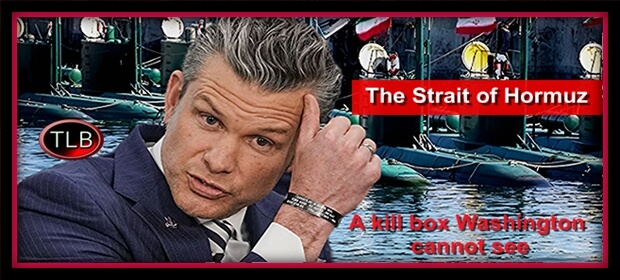
A $15 billion threat dressed up as Deterrence, A Sitting Duck
The Strait of Hormuz: A kill box Washington cannot see into….
By Freddie Ponton | 21st Century Wire
While diplomats talk, the Iranian Ghadir submarines are already on the move. The USS Abraham Lincoln floats twenty miles off the Iranian coast, a $15 billion threat dressed up as deterrence, while twenty mini-submarines slip into the shallow waters below, turning the Strait of Hormuz into a kill box Washington cannot see into. The reality is that you cannot negotiate peace with a gun to the head, nor de-escalate while preparing “weeks-long operations” against a nation that has already learned to fight invisible wars. The talks are in the theatre, but the torpedoes are real.
The first thing you notice about the Persian Gulf is how small it feels. This is not the open ocean. It is a bathtub. A narrow, hot, shallow bathtub where the horizon presses in on all sides and the world’s most lethal warships must thread a needle barely ninety miles wide at its choke point. It is here, in these claustrophobic waters, that the USS Abraham Lincoln and its carrier strike group have arrived as part of what analysts describe as one of the largest American military buildups in the region in years. Its flight deck stretches four and a half acres, and its strike group bristles with enough firepower to level small nations. And somewhere beneath the hull, in the acoustic confusion of shipping lanes and the restless sediment of the seabed, Iranian forces have reportedly deployed more than twenty Ghadir-class midget submarines, vessels that, according to open-source assessments, are practising the art of going completely still. IMAGE: Iran’s Ghadir-class midget submarines, tiny diesel-electric boats built for the Persian Gulf’s shallow, noisy waters, can ambush with torpedoes, mines, and possibly sub-launched anti-ship missiles, forcing U.S. carrier strike groups to slow down, widen standoff distances, and spend heavily on anti-submarine warfare just to operate safely near Iran (Source: Irna)
The ghosts here are not new. In 1988, the cruiser USS Vincennes was patrolling these same waters when it shot down Iran Air Flight 655, killing 290 civilians, including 66 children. The ship’s captain received a medal. The United States expressed “deep regret” and later agreed to financial compensation, but never issued a formal apology—an event that remains seared into Iranian national memory and that Iranian state media frequently references as evidence of American impunity in these waters.
Iranian submariners training today in the Ghadir fleet grew up on stories of that massacre, knowing that American “defensive” postures in these waters have precedent for catastrophic miscalculation. The Lincoln is not conducting a routine patrol. According to Reuters, it is positioned at the edge of a potential war zone as the Trump administration reportedly prepares for what military officials have described as potentially weeks-long operations targeting Iran’s nuclear infrastructure and military command systems. According to multiple policy analysts, such operations would primarily serve Israeli strategic interests while placing American sailors in the crosshairs.
This is not the romantic warfare of submarine movies. It is compact and serviced by crews of two or three professionals operating a vessel barely larger than a city bus with precision and dedication. These submarines cost tens of millions to build, roughly what the United States spends on carrier fuel in a single week. The asymmetry is stark, especially when Washington deploys assets valued in the tens of billions. Iranian crews maintain constant readiness in these tight quarters, preparing for a conflict that neither population wants and that peace advocates warn could be triggered by the slightest miscalculation.
The Invisible Weapon
Drawing less than ten feet of water according to technical specifications, the Ghadir navigates where America’s billion-dollar carriers dare not go. Its diesel-electric engine can reportedly shut down completely, allowing the vessel to settle onto the muddy bottom and become, for all practical purposes, a geological feature, part of the decor. In the Persian Gulf’s notoriously difficult acoustic environment, where sonar beams fracture against temperature gradients and the ocean floor throws back endless false echoes, military analysts assess that a silent submarine resting on the seabed could be functionally invisible. The thermoclines and acoustic shadow zones, combined with heavy ambient noise and bottom clutter, complicate consistent tracking of a small battery-running submarine in ways that favour the attacker (or in this case, the defender). Yet military analysts quietly acknowledge that these vessels have never fired a shot in anger, that their crews have limited hours of actual combat training, and that their diesel engines require them to surface or snorkel periodically to recharge—windows of vulnerability that American surveillance satellites reportedly watch constantly.
 IMAGE: Iran Ghadir Midget Class Submarines (Source: Iran Press)
The story of how these vessels came to haunt the Gulf begins in North Korea, where Iranian engineers reportedly studied the Yono-class midget submarine in the early 2000s. What they learned was not how to build a better submarine but how to build a submarine that could never be found. According to estimates from the International Institute for Strategic Studies and other defense analysts, fleet numbers range between roughly twenty and twenty-three operational boats. This, according to military assessments, is sufficient to seed multiple chokepoints simultaneously. But the Ghadir is not merely hiding. It is armed with weapons that, according to Iranian state media and defense exhibitions, turn geography into lethality. Each vessel reportedly carries two 533mm torpedo tubes capable of firing the Valfajr, a domestically produced weapon that Iranian officials claim carries a warhead of roughly 220 kilograms and can be prepared for firing in mere minutes.
More ominously, the class is believed capable of launching the Hoot supercavitating torpedo, a weapon Iranian engineers reportedly reverse-engineered from Russian designs, with claimed speeds exceeding 200 miles per hour. In early 2026, Iranian state media announced that the larger Fateh-class submarine launched cruise missiles during drills, underscoring what analysts describe as an evolution in Iranian undersea capabilities.
The Strait of Hormuz, through which roughly twenty to twenty-five percent of globally traded oil shipments must pass, according to U.S. government estimates, becomes a potential kill box where the mere possibility of a successful hit forces commanders into slower timelines and heavier defensive postures. Every transit becomes a gamble, and the Pentagon knows this. Its MH-60R Seahawks reportedly carry advanced dipping sonar systems optimised for littoral detection, and the Navy has invested in unmanned surface and underwater vehicles to enhance maritime domain awareness. Yet the central reality remains that anti-submarine warfare in the Persian Gulf is a contest against physics, clutter, and time. Midget submarines are built to operate inside that uncertainty and are designed to take advantage of the operational environment in which they operate. The advantage is not that each Ghadir is a wonder-weapon, but that a flotilla of relatively expendable submarines can force the world’s most powerful navy to question every movement, while American taxpayers bankroll a deployment that costs more per day than Iran’s entire submarine program, according to rough estimates of military operating costs.
The Manufactured Crisis
The true weapon, however, is not the torpedo or the missile. It is the mathematics of asymmetric warfare, and the political theatre that makes such warfare inevitable. Tehran reportedly understands something fundamental that Washington’s war planners seem determined to ignore. You do not need to sink a carrier to defeat a carrier strike group; you only need to make the cost of operating in its presence unpredictable and potentially catastrophic. The Islamic Republic cannot compete symmetrically. It cannot build aircraft carriers or nuclear submarines, or networked battle fleets. However, it can reportedly build enough small, cheap, nearly undetectable submarines to ensure that any conflict begins with the understanding that American sailors will die in the first hours, serving, according to critics of the current policy, as human shields for Israeli airstrikes that Tel Aviv wants but Washington would pay for in blood.
We have seen this pattern before. In 2003, the Bush administration insisted that Saddam Hussein possessed weapons of mass destruction that threatened regional security. UN inspectors found nothing. The invasion proceeded anyway, leaving hundreds of thousands dead and the region in ruins. Now, two decades later, we are told that Iranian mini-submarines threaten carrier groups sufficiently to justify a military buildup that mirrors the Iraq pre-positioning. The playbook is always the same. The US manufactures the threat, deploys the forces, demands the concessions, and when the targeted nation prepares to defend itself, cites those preparations as proof of aggressive intent. The difference is that this time, the war would be waged on behalf of an Israeli ally that has repeatedly threatened to strike Iran unilaterally, while expecting American carriers to absorb the risk of retaliation.
When twenty or more Ghadir-class vessels can reportedly be seeded across the Strait of Hormuz, each one capable of mining a channel or inserting combat divers or loitering motionless until an American destroyer passes overhead, the entire calculus of naval operations shifts. The carrier must slow down. The escorts must widen their defensive screens. Helicopters must fly longer sorties, dipping their sonar into the murk again and again, hunting for ghosts in a haunted house.
American sonar technicians reportedly describe tracking Iranian submarines as a psychological ordeal, with the constant stress of knowing that death might come from below at any moment, creating combat fatigue before the war even starts. This is the doctrine Iran has refined over decades of watching American ships dominate its coastline, a strategy of asymmetric naval warfare detailed extensively by the Washington Institute and other defense research organisations.
The Revolutionary Guard has explicitly warned that the response to any U.S. attack would not be “limited.” If the Ghadir fleet deploys sea mines in response to American provocation, the first victims will not be carriers; they will be oil tankers, merchant crews, and fishermen. The “strategic deterrence” kills civilians first, while the architects of escalation in Washington and Tel Aviv watch from safe distances. This is the deliberate manufacture of a crisis that neither the American nor the Iranian people want, driven by actors who believe that diplomacy is weakness and that only the threat of annihilation constitutes credible foreign policy.
The Path to Peace or the Road to Ruin
There is a special kind of arrogance that comes with possessing the world’s most powerful navy, a belief that technological superiority translates inevitably into strategic safety. The Ghadir submarine stands as a refutation of that arrogance. It is reportedly cheap to build, and it is primitive by blue-water standards. It is, by the metrics of modern naval warfare, almost ridiculously small, yet it has created a space in the Persian Gulf where American power cannot operate with confidence, where the advantage of the attacker (or defender) is baked into the geography, the physics, and the very nature of detection in shallow waters. The officers aboard the American carrier know they are being watched. They know that somewhere in the thermal layers below, in the acoustic shadows where sonar becomes useless, small crews of Iranian sailors are reportedly training their unique periscopes on the surface, practising the calculus of ambush, running through the drills that would precede a launch.
The Ghadir fleet represents the underwater component of Iran’s deterrence strategy, the threat that cannot be photographed by reconnaissance satellites or destroyed by the precision airstrikes that Washington seems to prefer over negotiation. Iranian officials have responded to the American buildup with their own warnings of all-out war and have conducted live-fire naval drills in the Strait of Hormuz within sight of U.S. vessels. This is not the tension of certain battle but of permanent uncertainty manufactured by those who refuse to pursue the diplomatic solutions that could resolve this standoff without a single shot being fired. The ghost fleet does not need to fire to be effective. It only needs to be believed, to be factored into the decision-making of commanders who must weigh the risk of every movement against the possibility that the seabed beneath them is not as empty as their sensors suggest.
The Ghadir submarine is not a weapon of conquest. It is reportedly a desperate measure, a declaration that Iran would rather see the Strait of Hormuz become a graveyard for global commerce than submit to American and Israeli dictates delivered through the barrel of a gun. The sailors aboard these vessels are not preparing for victory. They are reportedly preparing for a chance to wound the empire before they die. The tragedy is that the empire keeps sailing into their waters, pretending that the threat justifies the provocation, that the provocation justifies the buildup, and that the buildup won’t eventually demand the bloodshed it pretends to prevent.
The way out of this death spiral is not more carriers, more submarines, more threats. It is the serious, sustained diplomacy that Washington has consistently undermined, the return to the nuclear agreement that the Trump administration shredded, and the recognition that security in the Persian Gulf cannot be built on sanctions, intimidation or show of force against Iran.
The Ghadir doesn’t need to sink a carrier to prove its point. It only needs to be there when the missiles finally fly, reminding everyone that when giants refuse to talk and instead pick fights with an adversary prepared to address an existential threat, the only guaranteed outcome is that everyone gets bitten, and that peace, once discarded, rarely returns without a terrible price.
___________
Header featured image (edited) credit: Org. post content. Emphasis added by (TLB) editors
••••

••••
Stay tuned…

••••
The Liberty Beacon Project is now expanding at a near exponential rate, and for this we are grateful and excited! But we must also be practical. For 7 years we have not asked for any donations, and have built this project with our own funds as we grew. We are now experiencing ever increasing growing pains due to the large number of websites and projects we represent. So we have just installed donation buttons on our websites and ask that you consider this when you visit them. Nothing is too small. We thank you for all your support and your considerations … (TLB)
••••
Comment Policy: As a privately owned web site, we reserve the right to remove comments that contain spam, advertising, vulgarity, threats of violence, racism, or personal/abusive attacks on other users. This also applies to trolling, the use of more than one alias, or just intentional mischief. Enforcement of this policy is at the discretion of this websites administrators. Repeat offenders may be blocked or permanently banned without prior warning.
••••
Disclaimer: TLB websites contain copyrighted material the use of which has not always been specifically authorized by the copyright owner. We are making such material available to our readers under the provisions of “fair use” in an effort to advance a better understanding of political, health, economic and social issues. The material on this site is distributed without profit to those who have expressed a prior interest in receiving it for research and educational purposes. If you wish to use copyrighted material for purposes other than “fair use” you must request permission from the copyright owner.
••••
Disclaimer: The information and opinions shared are for informational purposes only including, but not limited to, text, graphics, images and other material are not intended as medical advice or instruction. Nothing mentioned is intended to be a substitute for professional medical advice, diagnosis or treatment.



Leave a Reply