
China is Scrambling
The Overnight Pivot…
By Zineb Riboua via Substack
This piece was originally published in National Review
I have added edits given today’s developments.
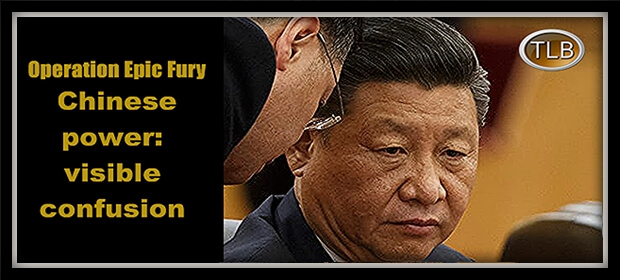
The men in Zhongnanhai do not rattle easily. Decades of patient statecraft, a foreign policy built on studied ambiguity, and an economy engineered to absorb external shocks have granted Beijing’s leadership a remarkable tolerance for turbulence. Operation Epic Fury, the American-Israeli air campaign now dismantling Iran’s military architecture, has produced something unusual in the corridors of Chinese power: visible confusion.
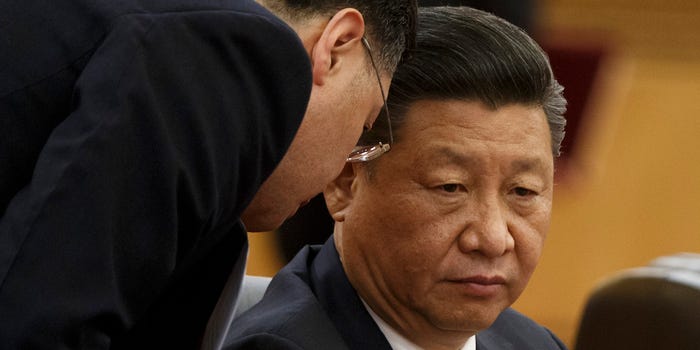
Xi Jinping is scrambling. The word is not used lightly. For a leader who has built his image on strategic composure and long-horizon thinking, the current moment is acutely dangerous. Not because China faces a direct military threat, but because every available response to the crisis in the Persian Gulf leads Beijing into a trap of its own contradictions.

Three Reasons Operation Epic Fury Is Catastrophic for Xi
First, the Iranian counterweight is gone. In 2021, Xi told senior Party officials that “the East is rising and the West is declining,” that America was “the biggest source of chaos in the present-day world,” and that China was entering a period of strategic opportunity. Iran was central to that thesis. Beijing needed a defiant Tehran to keep Washington pinned down in the Gulf, to sustain a sanctions-proof energy corridor, and above all, to stand as living evidence that American power had hard limits. The entire architecture of CCP’s dogma of inevitability, which rested on Iran’s ability to endure, and Epic Fury removed the foundation in a single afternoon.
Khamenei was the man who made the thesis feel real. Beijing’s relationship with the Islamic Republic was never really ideological, but Khamenei’s survival was the single most useful fact in Chinese foreign policy. Here was a man Washington had threatened, sanctioned, plotted against, and encircled for over four decades, and he was still giving Friday sermons. Xi personally signed the comprehensive strategic partnership with Khamenei’s government. He personally authorized the weapons transfers. And he personally wielded the Security Council veto. None of it kept Khamenei alive for one additional hour once Washington decided he was finished.
Second, Xi’s own story is collapsing from the inside. The story he told 1.4 billion people, that America is a declining power incapable of decisive force projection, does not match what happened in seventy-two hours over Tehran. State media can suppress the footage and the censors can scrub Weibo, but the ones who matter most, the military planners, the foreign policy professionals, the provincial officials who read between the lines for a living, know what they saw. And if the story is wrong about Iran, the unavoidable next question is whether it was ever right about anything else.
Third, the energy math turns against Beijing. China bought 1.38 million barrels per day of Iranian oil last year and takes over 80% of everything Iran ships. Half of China’s total oil imports pass through the Strait of Hormuz. With Ayatollah Khamenei now dead and Iran’s military leadership weakened, the Gulf’s strategic balance shifts decisively toward Saudi Arabia and the United Arab Emirates, whose energy ties with the United States are strengthening. China’s old selling point was very simple and transactional: we buy your oil and never mention human rights. That pitch loses its utility when Gulf producers already feel protected by an American security guarantee that just proved, on live television, that it works.
The Messaging Trap
Xi’s communications problem may be worse than his strategic one, because there is no good answer. If Beijing endorses the strikes, it loses the “Global South.” If Beijing condemns the strikes, it attaches Chinese prestige to a dead man’s regime, and risks provoking a Trump administration that has just demonstrated, through the act itself, that it does not bluff.
So Beijing chose the remaining option: hide behind the United Nations. Mao Ning called the killing “a grave violation of sovereignty.” The language sounds forceful, but the Belt and Road countries are watching, and what they see so far is a confused superpower reading from a script while American carriers do the actual deciding.
Every Iranian Move Is a Chinese Loss
The truly vicious part of Beijing’s situation is that Iran’s entire playbook for retaliation was designed to punish Washington, but the geography and economics of each weapon mean the damage lands on China instead. Iranian missiles aimed at Gulf states threaten the very oil infrastructure and port facilities that Chinese companies have spent billions investing in across the region.
The Strait of Hormuz is worse. Iran’s Revolutionary Guard announced within hours that no ship would pass through the channel, a threat designed as leverage against the West, except that the United States has a shale industry and a crisis-proof strategic petroleum reserve. In fact, according to Kayrros, as of March 31, 2025, China had only filled 56% percent of its above-ground strategic and commercial storage facilities.
Which means that nearly 45% of China’s own oil imports now sit/would sit hostage to a blockade that was never meant to hurt Beijing. The Houthis have resumed attacks on Red Sea shipping, every flare-up in Iraq threatens oil concessions that Chinese companies spent billions building, and the sum of Iran’s resistance amounts to a systematic disruption of Chinese commercial interests across every waterway and energy corridor Beijing depends on, executed in Khamenei’s name, with no regard for who actually pays the price.
Counting Moves
The clearest sign of Beijing’s disorientation is the absence of action: no emergency summits, no diplomatic maneuvers, no military repositioning, even as a Chinese citizen was killed in crossfire in Tehran and over 300 nationals were evacuated. The sum total of Beijing’s response to the largest American military operation in a generation remains a press conference.
Xi bet a decade of foreign policy on Khamenei’s ability to withstand American pressure, and the bet did not pay off. Operation Epic Fury was designed to break the Islamic Republic, but it may also have exposed the uncomfortable truth that Chinese influence in the Middle East was only as durable as the assumption that no one would ever call it into question, and in Zhongnanhai, they know it.
__________
Header featured image (edited) credkt: Org. post content. Emphasis added by (TLB) editors
••••

••••
Stay tuned…

••••
The Liberty Beacon Project is now expanding at a near exponential rate, and for this we are grateful and excited! But we must also be practical. For 7 years we have not asked for any donations, and have built this project with our own funds as we grew. We are now experiencing ever increasing growing pains due to the large number of websites and projects we represent. So we have just installed donation buttons on our websites and ask that you consider this when you visit them. Nothing is too small. We thank you for all your support and your considerations … (TLB)
••••
Comment Policy: As a privately owned web site, we reserve the right to remove comments that contain spam, advertising, vulgarity, threats of violence, racism, or personal/abusive attacks on other users. This also applies to trolling, the use of more than one alias, or just intentional mischief. Enforcement of this policy is at the discretion of this websites administrators. Repeat offenders may be blocked or permanently banned without prior warning.
••••
Disclaimer: TLB websites contain copyrighted material the use of which has not always been specifically authorized by the copyright owner. We are making such material available to our readers under the provisions of “fair use” in an effort to advance a better understanding of political, health, economic and social issues. The material on this site is distributed without profit to those who have expressed a prior interest in receiving it for research and educational purposes. If you wish to use copyrighted material for purposes other than “fair use” you must request permission from the copyright owner.
••••
Disclaimer: The information and opinions shared are for informational purposes only including, but not limited to, text, graphics, images and other material are not intended as medical advice or instruction. Nothing mentioned is intended to be a substitute for professional medical advice, diagnosis or treatment.


Leave a Reply