

“Here We are Again”: Fed District Courts Piling on Injunctions to Stop Trump
Trump has already faced a record number of national injunctions by district courts. His administration has objected to forum- and judge-shopping by political opponents
By Jonathan Turley
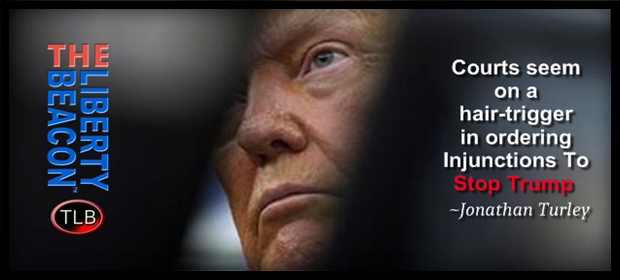
Below is my column in the Hill on the slew of additional injunctions imposed by district courts last week. Some of these courts seem on a hair-trigger in ordering the record number of injunctions racked up in the first 100 days.
Here is the column:

“Here we are again.” Those words of Senior U.S. District Judge William H. Orrick may be the only uncontested line in his opinion this week, enjoining the Trump Administration from withholding federal funds to “sanctuary jurisdictions.”
In President Trump’s first term, efforts to implement sweeping changes on immigration and other issues were met by a slew of injunctions. In 2017, one of those orders was from Judge Orrick, an Obama appointee in San Francisco.
Trump has already faced a record number of national injunctions by district courts. His administration has objected to forum- and judge-shopping by political opponents by bringing the majority of such challenges in overwhelmingly Democratic states like California.
Such injunctions did not exist at the founding, and only relatively recently became the rage among district court judges. Under President George W. Bush, there were only six such injunctions, which increased to 12 under Obama.
Both Democratic and Republican presidents have complained about district judges tying down presidents like so many judicial Lilliputians. However, when Trump came to office, the taste for national injunctions became a full-fledged addiction. Trump faced 64 such orders in his first term.
Now, however, with less than 100 days in office, Trump 2.0 has already surpassed that number for the entirety of Biden’s term.
The Supreme Court bears some of the blame for this. Although a majority of justices, including liberal Justice Elena Kagan, have complained about district courts’ issuance of national injunctions, the high court has done little to rein in district court judges. On May 15, the justices are poised to consider the issue in a case involving birthright citizenship. Many hope that the justices will bring what they have consistently failed to supply to lower courts: clarity and finality.
Some judges have already seen their stays lifted by appellate courts. However, in just one day this week, three more major injunctions were issued on sanctuary cities, voter registration, and deportations.
Some of these orders appear premature and overbroad. Take Judge Orrick’s order. Again, Trump is targeting cities offering sanctuary to unlawful immigrants as imposing high costs on the country, including increasing burdens for federal programs and grants to these cities.
Orrick previously stopped that effort in the first Trump term, and he was affirmed by the United States Court of Appeals for the Ninth Circuit. However, the orders are not identical, and so far no action has been taken against these cities.
Under one of the orders, titled “Protecting the American People against Invasion,” Trump has ordered the attorney general and the secretary of Homeland Security to “evaluate and undertake any lawful actions to ensure that so-called “sanctuary” jurisdictions, which seek to interfere with the lawful exercise of Federal law enforcement operations, do not receive access to Federal funds.”
Orrick noted that the term “sanctuary jurisdiction” was not defined and dismissed the express reservation that such actions can only proceed to the extent that they are allowed under law.
The irony is that the opinion itself is overly broad and imprecise. There are indeed cases limiting the ability of the federal government to “commandeer” states and cities into carrying out federal functions. However, there are also cases upholding the right to withhold federal funds that contravene federal laws and policies.
The operative language in the order is the focus on sanctuary policies that “interfere” or prevent federal enforcement. There must be some accommodation for the federal government in refusing to pay for the rope that it will hang by.
Justice Robert Jackson famously wrote in Terminiello v. City of Chicago that the Constitution cannot be construed as a “suicide pact.” I have never been fond of that quote, which has often been used to justify the curtailment of individual rights. But these cases could bring a new meaning to the quote in immigration cases. If one accepts the Trump administration’s data, then continued funding of these jurisdictions might be more akin to being forced to pay for your own hit man and then calling it suicide.
There is a reason courts generally wait for these conflicts to become “ripe.” The administration could easily engage in impermissible “commandeering,” but it could also “evaluate and undertake” more focused and defensible withholdings of federal funds. Judge Orrick decided not to wait to find out.
These are difficult questions, but the Supreme Court can reduce these cases by actually ruling with clarity. The court has often left these issues mired in ambiguity, kicking cases like cans down the road for any final resolution.
Consider the order out of the District of Columbia blocking an effort to change federal voting forms to require proof of citizenship. Trump campaigned on the issue, and, according to a Gallup poll, 84 percent of U.S. adults are in favor of requiring voters to show such identification.
Judge Colleen Kollar-Kotelly barred the federal government from changing the standardized national voter registration form and to have federal voter registration agencies “assess” the citizenship of individuals who receive public assistance before providing them a voter registration form.
Kollar-Kotelly raises good-faith limits on presidents’ ability to regulate elections, a power mainly left to the states. However, this is a policy that does not necessarily impose a new condition on states.
After all, non-citizens are barred from voting in federal elections in all states. Again, there must be some ability of the administration to act to address a national priority in the funding of election reforms and practices. The question is whether the court will recognize such a federal interest.
The problem with some of these orders is not that they are without foundation, but that courts appear on a hair-trigger to enjoin the Trump administration on any subject whatsoever. There is a need to deescalate in both branches as we expedite these appeals. We are indeed “here again,” but this is not a good place for anyone.
Jonathan Turley is the author of best-selling book “The Indispensable Right: Free Speech in an Age of Rage.”
*********
(TLB) published this article from Jonathan Turley with our appreciation for this perspective
Jonathan Turley is the Shapiro Professor of Public Interest Law at George Washington University. Follow him on Twitter @JonathanTurley.

Header featured image (edited) credit: WP open card. Emphasis added by (TLB)
••••

••••
Stay Tuned…

••••
The Liberty Beacon Project is now expanding at a near exponential rate, and for this we are grateful and excited! But we must also be practical. For 7 years we have not asked for any donations, and have built this project with our own funds as we grew. We are now experiencing ever increasing growing pains due to the large number of websites and projects we represent. So we have just installed donation buttons on our websites and ask that you consider this when you visit them. Nothing is too small. We thank you for all your support and your considerations … (TLB)
••••
Comment Policy: As a privately owned web site, we reserve the right to remove comments that contain spam, advertising, vulgarity, threats of violence, racism, or personal/abusive attacks on other users. This also applies to trolling, the use of more than one alias, or just intentional mischief. Enforcement of this policy is at the discretion of this websites administrators. Repeat offenders may be blocked or permanently banned without prior warning.
••••
Disclaimer: TLB websites contain copyrighted material the use of which has not always been specifically authorized by the copyright owner. We are making such material available to our readers under the provisions of “fair use” in an effort to advance a better understanding of political, health, economic and social issues. The material on this site is distributed without profit to those who have expressed a prior interest in receiving it for research and educational purposes. If you wish to use copyrighted material for purposes other than “fair use” you must request permission from the copyright owner.
••••
Disclaimer: The information and opinions shared are for informational purposes only including, but not limited to, text, graphics, images and other material are not intended as medical advice or instruction. Nothing mentioned is intended to be a substitute for professional medical advice, diagnosis or treatment.


Leave a Reply