

Hormuz Red: The Coalition of the Sanctioned Declares Independence
The new security architecture in southern waters is not designed to fight the U.S. Navy. It is designed to make the U.S. Navy irrelevant… And Washington has not yet heard it…
By Freddie Ponton | 21st Century Wire
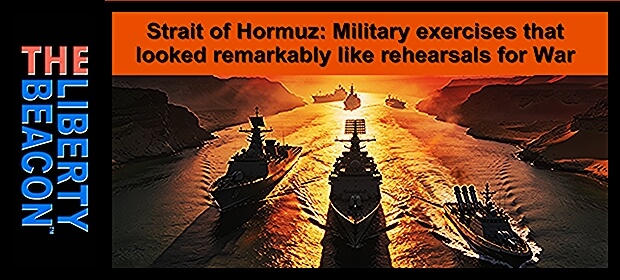
Donald Trump has ten days to decide whether to bomb Iran. That was the message from the White House on February 19 as the USS Abraham Lincoln and the Gerald R. Ford steamed toward the Persian Gulf with F-35s and F-22s marshalling on flight decks for potential strikes. The ultimatum was meant to force capitulation and coerce Iran to negotiate or face the consequences. Instead, it produced something Washington never anticipated. A Russian frigate docked in Bandar Abbas. Joint naval drills began in the Gulf of Oman, while Iranian Revolutionary Guards closed the Strait of Hormuz for military exercises that looked remarkably like rehearsals for war.
The Russian helicopter carrier Cruiser slipped into Bandar Abbas on the same morning Trump’s deadline made headlines—its sailors mingling with Iranian counterparts on a pier that had never before hosted a NATO adversary. Three hundred miles away, the Chinese destroyers loitered in the Arabian Sea, whilst in the Strait of Hormuz, Iranian speedboats buzzed past American warships in coordinated defiance. For the first time since 1945, the United States did not control the terms of engagement in the world’s most vital waterway.
What appeared to Western observers as a regional crisis was, in retrospect, the opening phase of a fundamental restructuring, led by the operationalisation of a “multipolar world order in the ocean.” This phrase, until recently confined to the theoretical pronouncements of Russian strategists and Belt and Road planning documents, was being forged in the waters of the Indian Ocean, the Arctic, and the South China Sea through a convergence of interests that united three powers separated by geography but united by a common adversary.
To understand what happened in the Gulf in 2026, one must abandon the comfortable fiction that this was simply about Iranian nuclear ambitions or Houthi piracy. It was about the fundamental restructuring of how security is produced, who provides it, and who gets to write the rules of the world’s most important trade routes. And most critically, it was about how Washington, through seven decades of policy miscalculation, built the very coalition of the sanctioned that now challenges its supremacy.
The Underestimation: How Washington Built Its Own Replacement
The February 2026 convergence was not an accident. It was the predictable culmination of American strategic myopia.
For two decades, Washington operated on a set of assumptions that proved catastrophically wrong. The sanctions regime, imposed with escalating severity from 2010 to 2025, was designed to fracture the Russia-Iran relationship to make Tehran so economically desperate that it would abandon its regional ambitions and its partnerships with Moscow. Instead, sanctions created the opposite—the pressure forging solidarity rather than submission.
The real moment of convergence arrived not in a war room, but in the middle of a banking crisis. In 2024, when Washington imposed maximum sanctions, freezing the assets of selected individuals and entities, Moscow and Beijing had already built the escape infrastructure. Barter arrangements, yuan-denominated energy contracts, and SWIFT workarounds that Russia had stress-tested for years were already in place.
The coalition wasn’t born through diplomatic cables. It was forged in the shared experience of watching the same weapon—financial exclusion—deployed against all three.
The U.S. intelligence community assessed in 2024 that Iran was approaching “maximum isolation” and by December 2025 was confident that the “Maximum Pressure 2.0″ campaign had severed its economic lifelines and left it vulnerable to either regime change or capitulation. The assessment was not wrong in its observations, but it was wrong in its theory of victory. Washington assumed that economic pain would translate into political compliance. What it failed to appreciate was that coercion without exit ramps produces not surrender but national unity, and that Russia and China, themselves targets of Western sanctions, had both the motivation and the means to transform Iranian isolation into trilateral convergence.
The ten-day ultimatum was not the opening gambit—it was the confession. When the January protests failed to deliver the regime change that Washington and Tel Aviv had engineered, the dagger simply changed hands. The February deadline admitted what the streets could not achieve—The Islamic Republic had survived the soft coup, so now it would face the hard one. The Russian frigate in Bandar Abbas was not a diplomatic flourish, only the wall Tehran built after the drawbridge of foreign subversion had been lowered and repelled.
While the USS Abraham Lincoln and USS Theodore Roosevelt rotated between the South China Sea and the Persian Gulf like exhausted prizefighters shuttling between arenas, Russia and China were constructing the architecture of an alternative order, including port agreements, military exercises, technological transfers, and energy investments that bound Iran into a network of relationships impervious to Western pressure.
The result was a strategic surprise that should not have been surprising. By 2026, Iran had achieved its deepest great power alignment since 1979—not despite Western pressure, but because of it.
From Imported to Indigenous: The Iranian Revolution in Maritime Thinking
For Tehran, the February 2026 exercises marked the culmination of a 70-year struggle to reclaim sovereignty—not just political, but maritime.
The Iranian narrative of this confrontation is rooted in the original trauma of 1953, when the CIA and MI6 toppled Prime Minister Mohammad Mossadegh for the crime of nationalising Iran’s oil. From the Iranian perspective, that coup established the template for Western intervention in which economic interests are disguised as security concerns, and sovereignty sacrificed for the flow of hydrocarbons. The subsequent decades saw the 1979 Revolution, the 444-day hostage crisis, the Iran-Iraq War, and a “Maximum Pressure” sanctions campaign, which served only to reinforce Iran’s understanding of the Western-led security order and how it is designed to subordinate Iranian interests to American and Israeli hegemony.
Over the years, Tehran learned to make the most of its geography. The Strait of Hormuz, through which 20% of the world’s oil passes, can no longer be considered merely as a trade route, because it is an invaluable geopolitical leverage. In January 2024, Iranian commandos fast-roped from helicopters onto the St. Nikolas (formerly known as the Suez Rajan) like a scene from a pirate film, except this was statecraft. The 19 crew members became hostages to geopolitics; the vessel was rerouted to Iranian waters, not as theft but to demonstrate that Tehran could reverse the logic of sanctions, turning economic pressure to its advantage.
This is the doctrine of “indigenous security”, a paradigm shift articulated with unusual clarity in Iranian strategic discourse. As the Islam Times analysis noted: “the mere physical presence of extra-regional fleets is no longer decisive; instead, indigenous capabilities, strategic networking, and regional alliances play the primary role.”
This was not a military assessment. It was a declaration of independence.
Where the old order relied on “extra-regional fleets” to guarantee safe passage, the new architecture emphasises “indigenous capacities and the shared will of coastal actors. The message is deliberate and directed at the region. Today, such security must be provided by regional countries and for regional countries.
The February 2026 joint exercise with Russia, occurring simultaneously with IRGC drills in Hormuz, presents what Iranian planners call a “multi-layered security architecture”—one rooted first in domestic capability (swarm boats, missiles, mines) and then expanded toward “regional synergy.” The naval drill is not an isolated military event, and must be regarded as the security arm of a broader convergence that includes Russia’s investment in Iran’s oil and gas industries, the Rasht-Astara corridor, and the completion of nuclear power plant capacities.
The subtext is unmistakable and in the open for everyone to appreciate. Iran is no longer seeking security from the West. It is busy building security with the East.
The Three Scripts: How Each Power Reads the Ocean
The Russia-China-Iran alignment is not a formal alliance, even though some analysts refer to it as a coordination of convenience; it undeniably makes it more durable and more difficult to counter than a traditional military pact, as each power reads the maritime order through a distinct strategic script.
Russia’s Script
Russia plays the long game of great power restoration, accepting direct confrontation risk to reclaim status lost in 1991. It’s 2022 Maritime Doctrine and Putin’s subsequent 2050 naval strategy reveal a long-term ambition to fully restore the country’s status as a preeminent global maritime power. This is not merely about prestige, but more about creating an alternative to the American-led security architecture. The Doctrine ranks the Indian Ocean and “southern vector” as main naval areas of opportunity, explicitly acknowledging NATO’s dominance in the Atlantic while seeking to expand Russian influence where Western power is more diffuse.
The Russian strategy is triangular: Arctic dominance in the north, Mediterranean access through Syria in the west, and Indian Ocean partnerships with Iran and China in the south. The Northern Sea Route, envisioned as “an uncontested Russian waterway”, provides the economic and strategic depth to support operations in warmer waters. By 2026, Russia had refurbished Cold War-era Arctic bases, launched ice-capable warships, and positioned itself as the gatekeeper between the Atlantic and Pacific.
China’s Script
China hedges—never committing fully, always maintaining ambiguity, using naval cooperation as economic insurance rather than military doctrine. Beijing has learned from Russia’s frontal confrontation with the West and Iran’s isolation. China’s strategy is minilateralism, which privileges flexibility and issue-based security cooperation that avoids the rigid commitments of traditional alliances while achieving many of the same effects. The Belt and Road Initiative (BRI) provides the economic architecture, while the naval exercises provide the security envelope.
The logic is rooted in the “Malacca Dilemma“, a strategic vulnerability for the People’s Republic of China due to its heavy reliance on the strait of Malacca, a critical maritime choke point connecting the Indian Ocean and the South China Sea. BRI mitigates this through port investments (Gwadar, Hambantota, Kyaukpyu), the China-Pakistan Economic Corridor, and the Djibouti military support base. But the Maritime Security Belt exercises add a new dimension by demonstrating that China, Russia, and Iran can coordinate to protect sea lanes outside U.S. control.
Unlike Russia, China maintains careful ambiguity. It participates in Hormuz exercises while continuing to import oil from Saudi Arabia and the UAE. It challenges U.S. dominance without explicitly seeking to overthrow it. This hedging is possible because China’s power is primarily economic; in other words, the PRC does not need Hormuz to be closed to benefit from the instability that multipolar competition creates.
Iran has no such luxury; facing existential threats from Israel and the US, it plays the highest-risk hand, weaponising geography because it cannot win a conventional arms race.
“Three hundred Spartans at Thermopylae proved that a narrow pass can stop an empire”. Today, Iran holds the Strait of Hormuz.. (Battle of Thermopylae)
The Islamic Republic accepts the highest risk tolerance of the three because it has the most to lose. Its endgame is an indigenous security zone where regional powers control regional waters, free from the extra-regional fleets that have dictated terms since 1945.
Israel: The Unintended Architect of Multipolarity
If Washington’s sanctions created the economic conditions for the coalition of the sanctioned, Israel’s military strategy provided the security rationale.
The June 2025 war represents a paradigm shift that accelerated the very alignment it sought to prevent. Israel’s “Operation Rising Lion”, launched during an IAEA vote on Iranian non-compliance, was designed to break Iranian will through decisive military action. Instead, it validated the Iranian narrative of Western aggression and pushed Tehran into accelerated alignment with Russia and China.
General Hossein Salami was eating breakfast when the missile struck. The IRGC chief, who had spent his career warning that Israel would never dare attack Iranian soil, was killed in his own headquarters by a weapon that should have been impossible to deploy undetected. The message was not just military, but also ontological. The Iranian leadership was forced to acknowledge that there was nowhere in Iran that Mossad could not reach, no sanctuary that American intelligence could not penetrate.
The Israeli strikes killed at least 20 high-level Iranian commanders, including armed forces chief Mohammad Bagheri. Six nuclear scientists were assassinated, including Fereydoun Abbasi-Davani, former head of the Atomic Energy Organisation of Iran. Mossad operatives had smuggled precision weapons and established a covert drone base near Tehran, launching strikes that killed Iranian generals in minutes through internal sabotage.
Israel Prime Minister Benjamin Netanyahu’s doctrine was explicit: “Iran is the one that financed and armed the ring of strangulation around Israel and stood behind the plans for its destruction…Israel will strike back ‘wherever required.’” By December 2025, he was visiting Trump’s Mar-a-Lago estate to discuss “possible round 2” strikes. Naturally, Netanyahu, who is wanted by the International Criminal Court for war crimes, which amount to crimes against humanity/ Genocide, never bothered to address the root cause behind Iran’s frustration wth Israel.
But the strikes achieved the opposite of their intended effect. They demonstrated three realities that Iranian strategists had long suspected:
- Unilateral deterrence had failed. Iran’s conventional forces could not prevent Israeli penetration
- The U.S. would not restrain Israeli adventurism—American intelligence and coordination enabled the strikes
- Only superpower alignment could provide security guarantees—Russia’s presence and China’s economic interests created a deterrent that Iran’s own forces could not
The irony is stark: Israel’s “mow the grass” strategy, intended to prevent Iranian nuclear capability and regional expansion, created the multipolar architecture it feared most. By demonstrating that the U.S. would not protect Iran but would facilitate attacks on it, and that the UN and IAEA could be weaponised against Iranian interests, the 2025 strikes made the “indigenous security” doctrine not just appealing but existential.
The Chokepoint Strategy: Geography as Power
What unites these three perspectives is a shared recognition that in the multipolar era, control over strategic geography is more valuable than overall naval tonnage. The U.S. Navy remains the world’s most powerful by any conventional metric. But it cannot be everywhere at once. This is why Russia, China, and Iran are coordinating to ensure that it must be everywhere simultaneously.
The legal ambiguity is the weapon. When Iranian Revolutionary Guards board a tanker in Hormuz, they are not technically blockading—they are “inspecting” or “responding to distress.” The Strait’s shipping lanes fall entirely within Iranian and Omani territorial waters, creating what admiralty lawyers call a “legal vortex.” Iran can threaten twenty percent of the world’s oil without firing a shot, leveraging a UN treaty the US helped write but cannot enforce against a coordinated adversary.
The Iranians have perfected this strategy through “lawfare in the grey zone” and the legal ambiguities in UNCLOS to contest maritime order without clearly violating international law. Iran can threaten closure without actually closing the Strait; it can harass tankers without formally blockading, and it can certainly leverage global energy markets without triggering the Article 5 response that an attack on a NATO ally would provoke.
The 1980s Tanker War provides the historical template. Operation Praying Mantis demonstrated that chokepoint disruptions invariably escalate to superpower involvement when global oil flows are threatened. Today, the difference is that Iran does not stand alone. Russian warships and Chinese economic interests mean that any U.S. intervention carries the risk of broader confrontation.
The New Security Architecture: What Comes After Hegemony?
The “New Security Architecture in Southern Waters” is not a formal alliance. It is a coordination of convenience, where a coalition of the sanctioned, more broadly referred to as CRINK, united by common hostility against the U.S hegemony and relentless sanctions.
The architecture has three pillars:
- First, indigenous security. The rejection of U.S. naval protection in favour of regional partnerships. This is the Iranian contribution. The argument that “the mere physical presence of extra-regional fleets is no longer decisive” and that “indigenous capabilities, strategic networking, and regional alliances play the primary role.”
- Second, multidimensional convergence: The integration of military, economic, and technological cooperation. The Russia-Iran relationship exemplifies this. Naval drills are the security arm of broader cooperation in energy, transit corridors, and nuclear technology. The message is that security is not separable from economics, and that the new order will be built on trade routes that do not require American protection.
- Third, institutional alternatives—the use of BRICS, the Shanghai Cooperation Organisation, and the Eurasian Economic Union to create a parallel structure of international relations. Iran’s membership in these organisations demonstrates that the multipolar order is not merely a bilateral phenomenon (Russia-Iran, China-Iran) but a systemic alternative to the U.S.-led institutions that have governed the world order since 1945.
The shift is transformative. The multipolar maritime order does not replace one hegemon with another. It replaces foreign oversight with regional stewardship. The Indian Ocean ceases to be an American lake policed by carriers in perpetual rotation. The South China Sea exits the realm of the Seventh Fleet. The Strait of Hormuz becomes what it always was: a waterway managed by the littoral states that flank it, not by admirals headquartered in Norfolk. The “risk premium” the West warns of is not the cost of multipolarity. It is the cost of Washington’s refusal to accept that the oceans were never its property to patrol. The United States can choose recognition and accept that sovereignty means maritime nations controlling their own waters, or it can exhaust itself chasing phantoms through seas that have already slipped its grasp. The BRICS+ vision is not fragmentation—it is just pluralism embracing shared stewardship.
The Global South is not asking permission to swim in its own waters anymore.
The End of the Unipolar Ocean
The 2026 crisis in the Gulf was not an isolated event. It was the operationalisation of a theoretical shift that had been brewing since the 2008 financial crisis exposed the vulnerabilities of American-led globalisation and the rise of China challenged the economic foundations of U.S. hegemony.
What happened in the waters off Iran was the maritime dimension of a broader transformation, which ultimately could well bring the end of the unipolar moment. The United States might not be defeated at sea, but it is likely to be outmanoeuvred by powers that learned to leverage geography, economics, and coordination to negate American advantages.
The “multipolar world order in the ocean” is not a future possibility. It is the present reality, one in which Russian warships dock in Iranian ports while Chinese destroyers patrol the Arabian Sea, all while American carriers steam in circles, deterring a conflict that their very presence helps to provoke.
The new security architecture in southern waters is not designed to fight the U.S. Navy. It is designed to make the U.S. Navy irrelevant, and this one drill, one port visit, one “indigenous” security arrangement at a time.
The February 2026 drills were not a declaration of war. They were a declaration of irrelevance. And Washington has not yet heard it.
_________
Header featured image (edited) credit: Org. post content. Emphasis added by (TLB) editors
••••

••••
Stay tuned…

••••
The Liberty Beacon Project is now expanding at a near exponential rate, and for this we are grateful and excited! But we must also be practical. For 7 years we have not asked for any donations, and have built this project with our own funds as we grew. We are now experiencing ever increasing growing pains due to the large number of websites and projects we represent. So we have just installed donation buttons on our websites and ask that you consider this when you visit them. Nothing is too small. We thank you for all your support and your considerations … (TLB)
••••
Comment Policy: As a privately owned web site, we reserve the right to remove comments that contain spam, advertising, vulgarity, threats of violence, racism, or personal/abusive attacks on other users. This also applies to trolling, the use of more than one alias, or just intentional mischief. Enforcement of this policy is at the discretion of this websites administrators. Repeat offenders may be blocked or permanently banned without prior warning.
••••
Disclaimer: TLB websites contain copyrighted material the use of which has not always been specifically authorized by the copyright owner. We are making such material available to our readers under the provisions of “fair use” in an effort to advance a better understanding of political, health, economic and social issues. The material on this site is distributed without profit to those who have expressed a prior interest in receiving it for research and educational purposes. If you wish to use copyrighted material for purposes other than “fair use” you must request permission from the copyright owner.
••••
Disclaimer: The information and opinions shared are for informational purposes only including, but not limited to, text, graphics, images and other material are not intended as medical advice or instruction. Nothing mentioned is intended to be a substitute for professional medical advice, diagnosis or treatment.


Leave a Reply