

How Milei is Rewriting Argentina for Foreign Profits
The Capitalist Mafia’s Playground
Freddie Ponton
21st Century Wire
There is a way a country disappears without anyone noticing. It does not happen with sirens or tanks or foreign flags. It happens quietly, in offices and courtrooms, in registries and decrees, through signatures that never make the front page and numbers averaged until they lose all meaning. Argentina is disappearing this way, from the ground up. More than 13 million hectares of Argentine land are now in foreign hands. That is not an opinion. It is not rhetoric. It is the outcome of years of meticulous research by the Land Observatory, a project born at the University of Buenos Aires (UBA) and CONICET, where historians and social scientists have done what the state increasingly refuses: look closely at who owns the territory, and where.
 IMAGE: Interactive map of foreign land ownership across Argentina — highlighting departments where foreign control exceeds legal limits.(Source: Observatorio de Tierras)
Thirteen million hectares, five percent of the country, an area the size of England. And yet even those numbers deceive. Because land does not matter equally everywhere. And power is never distributed evenly across space.
In their recent report, the Land Observatory’s georeferenced map exposes a reality that the official narrative hides. While government statements insist no province exceeds the 15 percent limit established under Law 26,737, a closer look reveals 36 departments where the law has already been violated, including Lácar, General Lamadrid, Molinos, and San Carlos, where foreign ownership exceeds 50 percent. These are not obscure corners. They are strategic landscapes, rich in water, minerals, and logistical leverage. In places like Iguazú, Berón de Astrada, and along the Paraná River, foreign control surpasses 30 per cent, a direct influence over lifelines critical to millions of Argentines.
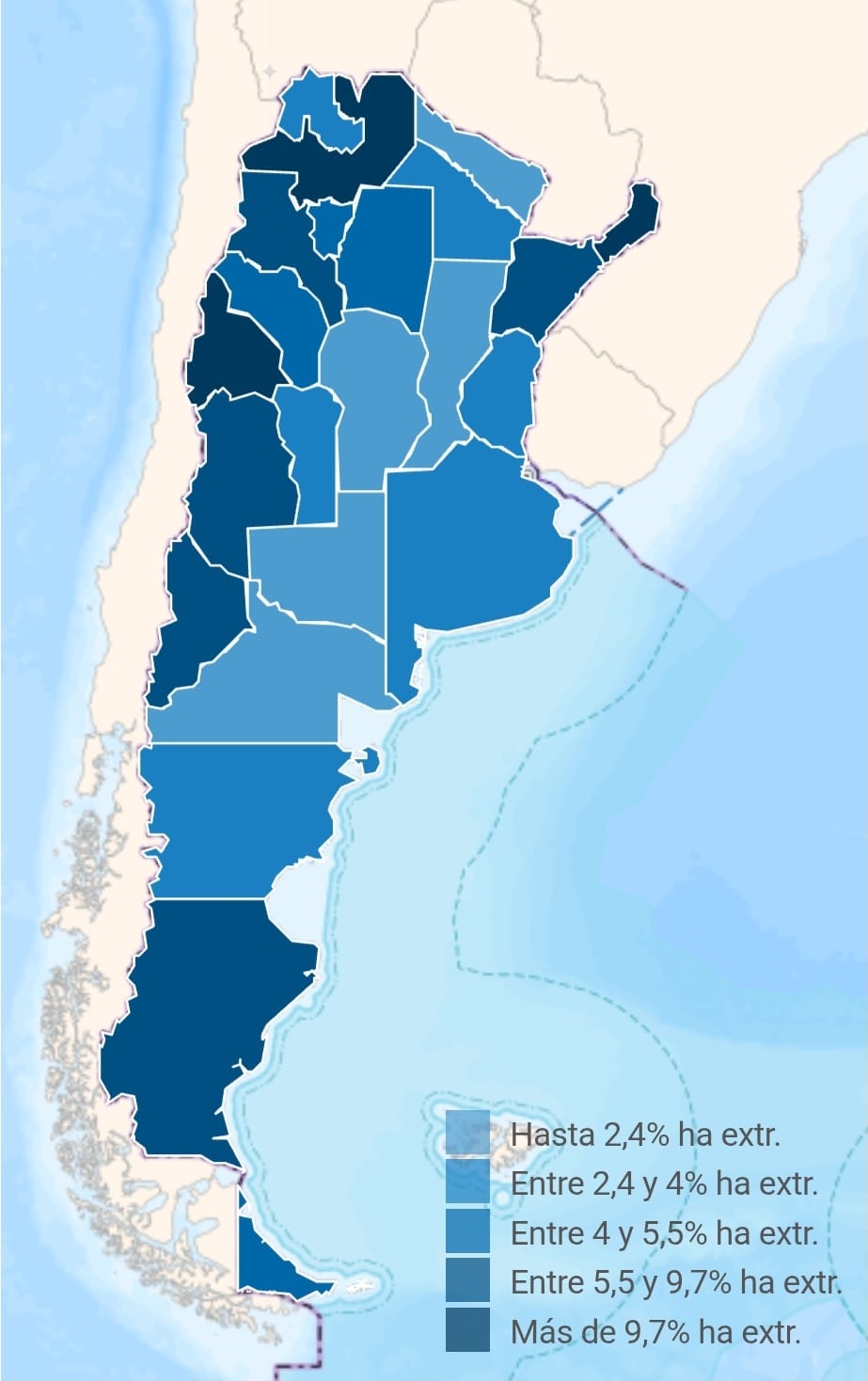 IMAGE: Map of Argentine departments where foreign ownership exceeds the legal 15% limit, highlighting strategic zones with water, minerals, and logistical advantages. (Source: Observatorio de Tierras)
The story of foreignization is not new. It stretches back to the 1990s, when the Secretariat of Internal Security began allowing sales in border areas historically protected for Argentine citizens, violating or bypassing Decree 15,385 of 1944, which had safeguarded national territory since then. The 2000s food-price boom, coupled with a weak peso, made fertile and strategic lands irresistible to foreign capital. On June 29, 2016, the Argentine government issued Decree 820/2016 (the New Decree), which relaxed some of the limitations previously set by law regarding the purchase and leasing of rural land by foreign individuals and legal entities. This cumulative process prompted the 2011 Land Law, a legal firewall that, while imperfect, at least slowed the flow of land out of national hands.
Yet that firewall is now under assault. The Milei administration has made it clear: the law constrains foreign interests. Through decrees, budget cuts, and legislative proposals, the government is systematically weaponising Argentina’s legal system to serve transnational capital.
Patagonia burns, and the fires tell their own story. In January 2026, blazes ravaged Los Alerces National Park and Epuyén in Chubut, El Bolsón in Río Negro, Lanín National Park in Neuquén, and large swaths of Santa Cruz, where mining zones like La Manchuria were threatened. Government officials point fingers at Mapuche communities, blaming the so-called RAM for arson, and conveniently label them “terrorists. But this narrative is a deceptive smoke screen. Overlay the Observatory’s maps with fire perimeters, and a more unsettling pattern emerges: the most valuable, strategically located lands, often under foreign ownership or earmarked for mining and fossil fuel development, are burning. Coincidence?
SEE MORE: Patagonia Under Siege: How Fires, Foreign Capital, and the Isaac Accords Are Reshaping Argentina’s Last Frontier
It is no accident that the Federal Fire Management Service (SFMF) has seen its budget slashed by 70 percent, crippling prevention, detection, and containment capabilities. While the flames rage, the state’s ability to protect land seems to have been deliberately weakened. The result is a structural vulnerability that benefits extractive and foreign actors while Argentine communities and ecosystems are left to suffer.
Under Milei, deregulation is a central feature of governance. Vaca Muerta, the world’s second-largest shale formation, with an estimated 308 trillion cubic feet of gas and 16.2 billion barrels of oil, is now at the heart of a push to accelerate fossil fuel extraction. Projects across Neuquén, Río Negro, La Pampa, and Mendoza, from pipelines to LNG export facilities, are moving forward at a breakneck pace, involving companies such as TotalEnergies, Chevron, and YPF. Mining projects in Calcatreu (Río Negro) and La Manchuria (Santa Cruz) are similarly advancing. Many of these initiatives overlap precisely with areas impacted by recent fires. When digging further, you will find that YPF and Israel’s XtraLit are collaborating to create direct lithium extraction initiatives in Argentina. Reportedly, Israel is embroiled in a battle over a $1.8 billion oil development, which sparked a diplomatic rift, with drilling activity planned by UK-based exploration firm Rockhopper Exploration and Israel Navitas Petroleum in the Falkland Islands. The energy company controlled by Israeli businessman and former ambassador of Israel to Peru, Gideon Tadmor, is planning to develop the Sea Lion oil reservoir, considered the world’s fourth-largest undeveloped oil discovery, and a project that the Argentinian government characterises as “unilateral and illegitimate. Both companies have already been formally sanctioned for operating on the Argentine continental shelf without authorisation.
Argentina and Patagonia are becoming a resource battleground, echoing Venezuela, where Trump’s U.S. seized oil under legal and “security” pretexts. Foreign capital and extractive networks are bending laws and likely burning forests to access shale, minerals, and water. The pattern is clear: sovereignty sacrificed for profit, while locals pay the environmental and social cost.
Meanwhile, Milei has sent proposals to reform the Glacier Protection Law, transferring permitting power to provincial authorities and opening Andean watersheds and periglacial zones to industrial exploitation. These territories are not just scenic landscapes: they supply freshwater to millions and hold strategic minerals, including lithium and rare earths. The legal and environmental safeguards that once constrained extraction are being dismantled.
The Land Observatory map, based on public registry requests, corporate data, and cadastral archives, shows that the majority of foreign-owned lands are held by U.S., Italian, and Spanish interests, with the United States alone controlling more than 2.7 million hectares. These holdings are concentrated in the most valuable areas: fertile river corridors, aquifer-rich regions, and mineral-rich hills. In northern departments, often overlooked by national media, foreign ownership breaches legal limits just as sharply as in Patagonia. (read more here)
Viewed in the wider context, these dynamics are not purely domestic. The Isaac Accords, energy diplomacy, and global competition for resources mean that Argentina’s land, water, minerals, and hydrocarbons are now strategic assets in international contests for supply and control. Deregulation and foreign ownership shifts transform the country into a node in global markets, but one where Argentine sovereignty is diminished, and communities rarely benefit.
The story is unfolding in real time. Fires sweep through forests that feed rivers, shale fields are fractured for energy, and laws are rewritten to favour outsiders. Ordinary Argentines, farmers, town residents, and indigenous communities watch as lands they once had access to vanish into corporate portfolios, while regulatory and fire protection mechanisms are stripped away.
Who truly benefits? Certainly not the people whose water, soil, and forests are being reallocated.
This is sovereignty measured in hectares, in aquifers, in forests, and in minerals. It is not abstract; it is lived and mapped on the ground. And the longer the country lets laws be weaponised for foreign interests, the harder it will be to reclaim what is rightfully national. Argentina is at a crossroads, and the choices made now, in courtrooms, congresses, and executive offices, will define who controls this land for generations to come.
_________
(TLB) PUBLISHED THIS ARTICLE FROM 21WIRE
SUPPORT INDEPENDENT MEDIA – BECOME A MEMBER @21WIRE.TV & VISIT OUR TELEGRAM CHANNEL
Header featured image (edited) credit: Org. post content. Emphasis added by (TLB) editors
••••

••••
Stay tuned…

••••
The Liberty Beacon Project is now expanding at a near exponential rate, and for this we are grateful and excited! But we must also be practical. For 7 years we have not asked for any donations, and have built this project with our own funds as we grew. We are now experiencing ever increasing growing pains due to the large number of websites and projects we represent. So we have just installed donation buttons on our websites and ask that you consider this when you visit them. Nothing is too small. We thank you for all your support and your considerations … (TLB)
••••
Comment Policy: As a privately owned web site, we reserve the right to remove comments that contain spam, advertising, vulgarity, threats of violence, racism, or personal/abusive attacks on other users. This also applies to trolling, the use of more than one alias, or just intentional mischief. Enforcement of this policy is at the discretion of this websites administrators. Repeat offenders may be blocked or permanently banned without prior warning.
••••
Disclaimer: TLB websites contain copyrighted material the use of which has not always been specifically authorized by the copyright owner. We are making such material available to our readers under the provisions of “fair use” in an effort to advance a better understanding of political, health, economic and social issues. The material on this site is distributed without profit to those who have expressed a prior interest in receiving it for research and educational purposes. If you wish to use copyrighted material for purposes other than “fair use” you must request permission from the copyright owner.
••••
Disclaimer: The information and opinions shared are for informational purposes only including, but not limited to, text, graphics, images and other material are not intended as medical advice or instruction. Nothing mentioned is intended to be a substitute for professional medical advice, diagnosis or treatment.



Leave a Reply