

Operation Epic Disaster: US-Israel War Was Built on Coercion, Not Precision
The Arrests That Prove It
Freddie Ponton | 21Wire
Read this sentence carefully. Read it like your understanding of the war depends on it… because it does.
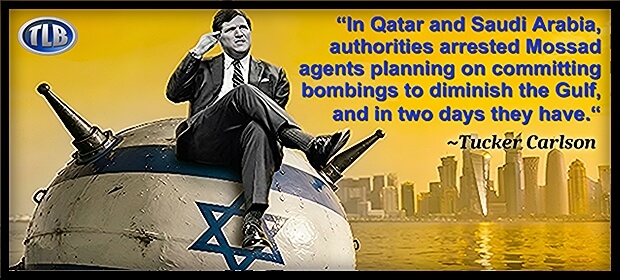
“In Qatar and Saudi Arabia, authorities arrested Mossad agents planning on committing bombings in those countries.“
Tucker Carlson spoke those words on March 2, 2026. While the United States and Israel were still basking in the afterglow of “Operation Epic Fury”, still selling the world the story of a surgical precision campaign that had eliminated Iran’s Supreme Leader Ayatollah Ali Khamenei in a single night of dazzling tactical brilliance, their own intelligence operatives were apparently sitting in handcuffs in Riyadh and Doha—caught red-handed, planning to blow up the very Arab capitals that host America’s largest military bases in the region.
Not Tehran’s agents. Not IRGC proxies. But rather, Israeli intelligence agents from the Mossad, who reportedly have been arrested by America’s own allies for plotting to bomb them.
Carlson did not merely allege that Mossad had people on the ground. He described bomb teams, not note-takers, while many reports suggest that Gulf intelligence services in Riyadh and Doha coordinated to detain people tasked with carrying out kinetic operations (bombings) on their own soil. On his broadcast, he asked the only question that matters, “Why would the Israelis be committing bombings in Gulf countries, which are also being attacked by Iran? Aren’t they on the same side?” and then answered it himself. “Israel wants to hurt Iran—and Qatar, and the UAE, and Saudi Arabia, and Bahrain, and Oman and Kuwait. They wanted to diminish the Gulf, and in two days they have.“
These would be classic false flag attacks, carefully designed to sow confusion, and set countries against each other. The obvious beneficiaries would be Israel and the US.
Even if official confirmation never comes, the fact that such allegations can be aired at this level, and echoed across regional media—tells you just how far the mask has slipped.
If you want to understand what the dubiously titled Operation Epic Fury really is, do not look at the Pentagon’s press releases about degraded leadership capacity and restored deterrence. Look at those arrests, and at the panic disguised as strategy, but above all, look at a coalition that has already abandoned the pretense of winning hearts and minds and has moved directly to burning down the neighbourhood and blaming the victim for the smoke.
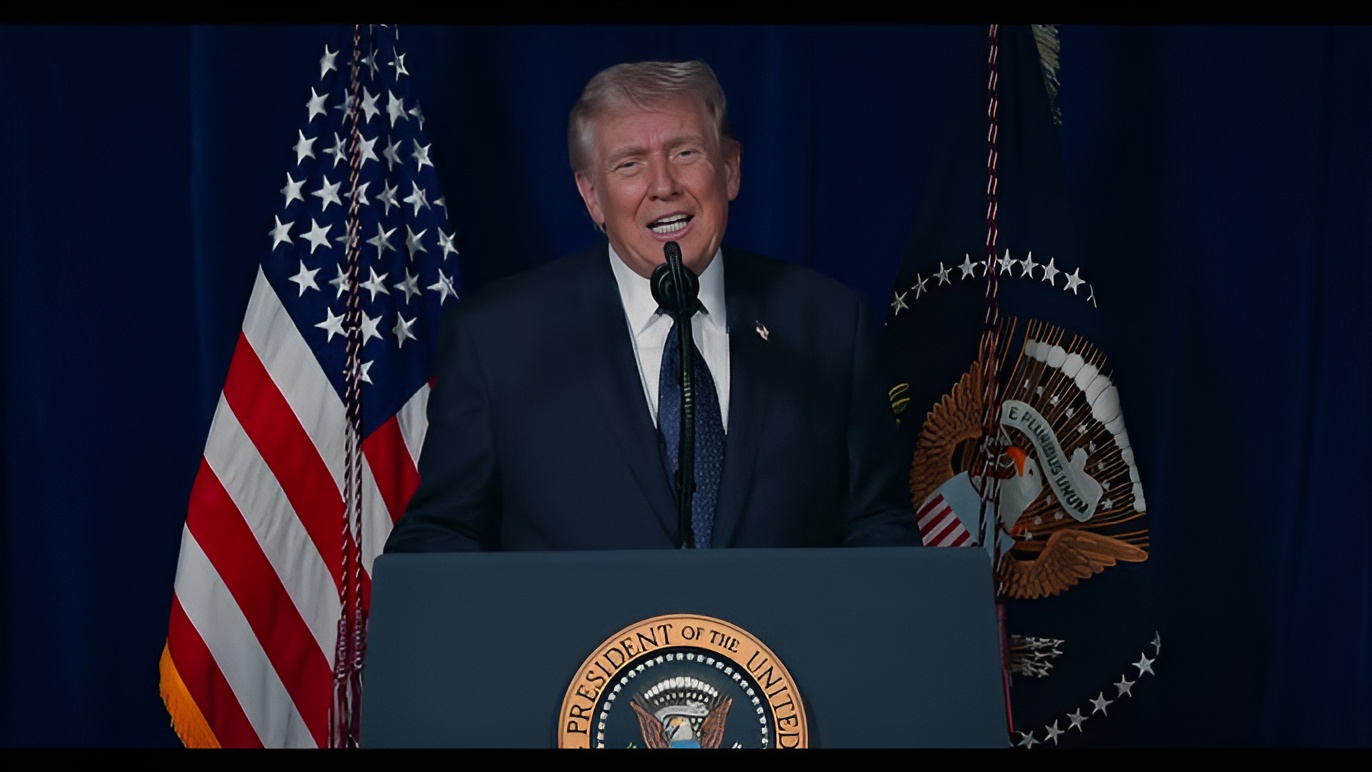 IMAGE: President Donald J. Trump announces update on Operation Epic Fury – March 2, 2026 (Source: The White House | Youtube)
The precision strikes that killed Ayatollah Ali Khamenei and forty of Iran’s senior leaders on the night of February 28 were, by every military metric, a triumph. The missiles found their targets, the intelligence was flawless, and the coordination between American and Israeli forces was seamless. However, none of it matters because within seventy-two hours, the tactical masterpiece had dissolved into a strategic nightmare that is now threatening to engulf the entire Middle East.
Within seventy-two hours, the Smart Bomb Trap had snapped shut.
This is a tale of how Washington walked into that trap with its eyes open, guided by the same delusion that destroyed American credibility in Vietnam and Iraq and Libya before it. It is the story of how a civilisation with ninety-two million people and a military doctrine purposely built to survive exactly this kind of assault is proving that you cannot decapitate a web. It is also the story of a desperate empire, cornered by its own failed strategy, now allegedly resorting to the oldest trick in the intelligence playbook. Stage the violence, blame the enemy, and hope the world is too distracted to notice the fingerprints on the detonator.
But here is what the arrests really reveal. They do not merely show Israeli desperation; they actually expose the blueprint. The coalition launched Operation Epic Fury, knowing full well that decapitation would not collapse Iran. They knew the Mosaic Doctrine existed. They knew the IRGC was designed to survive this exact scenario. They launched the strikes anyway, not because they believed the headshot would work, but because the headshot would create the conditions for what comes next. The decapitation was the pretext, whilst the regional war was the objective. If the Gulf states would not join willingly, they would be forced in through staged violence attributed to Tehran. This was never about precision. This was always about coercion—the arrests of Mossad agents in Qatar and Saudi Arabia are evidence of it.
The war you are watching is not the war you are being sold. The precision is a mirage, but the trap is real.
The Kill List That Killed Nothing
They told us the head was all that mattered. They told us that if you eliminated the Supreme Leader and his inner circle, the Iranian state would fold like a house of cards. They told us this with the absolute certainty of people who have never bothered to understand what they were bombing.
On February 28, 2026, Operation Epic Fury achieved exactly what it set out to achieve. The missiles slammed into Khamenei’s residential compound in Tehran. The IRGC aerospace command went dark, while the defense ministry leadership vanished in clouds of precision-guided fire. According to the Jerusalem Post, forty senior Iranian officials died in coordinated waves that struck multiple provinces simultaneously. President Trump took to the airwaves to declare the operation decisive, whilst Vice President Vance spoke of degrading leadership capacity and stepping back. The premise was elegant in its simplicity. Remove the head. Watch the body collapse.
The theory is as old as assassination itself. It is also a lie that has been disproven consistently and catastrophically across more than a century of modern warfare. And it took less than three hours for the lie to explode in their faces.
By midnight Tehran time, while the wreckage of the Supreme Leader’s compound was still smoking, Iran launched Operation True Promise Four. Seven hundred ballistic missiles and advanced drones tore through Israeli airspace and slammed into targets across the region. Tel Aviv’s skyline was torn open, and Al Udeid Air Base in Qatar shook under direct impact. Al Dhafra in the UAE took fire. American installations in Kuwait, Jordan and Bahrain all came under simultaneous assault. The Iron Dome, that miracle of Israeli engineering that was supposed to make the Jewish state invulnerable, buckled under the weight of the salvo. Emergency crews moved block by block through Tel Aviv’s residential towers, pulling survivors from the rubble. The body was not collapsing; it was fighting back with a fury that Washington apparently never calculated.
Here is what the Pentagon’s PowerPoint presentations about high-value targeting fail to explain. Iran is not a dictatorship resting on a handful of individuals who can be eliminated like figures on a chessboard. It is a governing civilisation with a security apparatus numbering between hundreds of thousands and over a million active personnel, depending on how one counts IRGC formations, Basij paramilitary units and affiliated regional forces. Roughly one in eight Iranians works for the state or in state-linked institutions. The regime’s authority is threaded through provincial administrations and economic networks, as well as religious infrastructure and local security structures that span a territory four times the size of California. Removing several dozen senior leaders touches only the outermost layer of that apparatus. It does not dismantle the structure—all it does is activate every node in the web.
Behind every grand phrase about degrading capabilities lies a body count. In the opening waves of Epic Fury, at least 153 girls were killed when a school in southern Iran was struck, one of hundreds of civilians wiped out in what Washington still dares to call a clean war. Iran has answered not only as a state under attack but as a society in mourning. The Iranian people have made it clear that their grief is not weakening their resolve; instead, it is hardening it.
University of Chicago political scientist Professor Robert Pape, who has studied every air campaign since the First World War, stated the obvious with surgical precision in the immediate aftermath of the strikes. Precision removes individuals. It does not remove incentives. A regime that absorbs the killing of its supreme leader without answering it invites internal collapse. Retaliation was never optional. It was structurally compelled. The greater the tactical success, the stronger the political necessity to answer it. Here is an extract from his recent interview on Sky News:
“I have studied every air campaign since WWI… I’ve modelled the bombing of Fordow and regime change in Iran for 20 years… We are now in the grip of the escalation trap… This has never worked in over 100 years… Trump is up against the weight of history” – @ProfessorPape. pic.twitter.com/zcequ4NGl3
— Adam Schwarz (@AdamJSchwarz) March 2, 2026
The decapitation worked perfectly, and that is precisely why it has failed so badly.
The Twenty-Year Lesson
In March 2003, the United States Army rolled into Baghdad in twenty-one days. The entire command structure of the Iraqi Ba’athist state collapsed the moment American tanks reached the city centre. Saddam Hussein’s regime was a pyramid. Remove the apex, and the geometry failed. Washington took notes on the wrong side of that lesson. They learned that precision works; howver they failed to learn that precision only works against pyramids.
Iran watched Baghdad fall and spent the next twenty years building the exact opposite of a pyramid.
We have had two decades to study the defeats of the US military to our immediate east and west, Foreign Minister Abbas Araghchi wrote on March 1, 2026. We have incorporated lessons accordingly. Bombings in our capital have no impact on our ability to conduct war. Decentralised Mosaic Defense enables us to decide when and how war will end.
“Decentralised Mosaic Defense “sounds like diplomatic jargon until you understand what it actually means. It means that Iran’s military architects spent twenty years studying how the Americans dismantled Iraq’s centralised command structure in three weeks. And then Iran went on building something that cannot be dismantled, something that has no centre, and designed specifically to absorb a decapitation strike and keep fighting.
The Decentralised Mosaic Defense (DMD) is not a slogan. It is a genuine military doctrine developed within the IRGC that fundamentally redesigns the relationship between command and action. Rather than concentrating decision-making in a single headquarters in Tehran, vulnerable to precision strikes, the DMD empowers regional commanders across Iran’s 1.65 million square kilometres to operate autonomously the moment communications with the centre are disrupted. Weapons systems are dispersed across mountain ranges and underground facilities. Ballistic missile units are pre-authorised to launch without waiting for orders from Tehran. Drone production is distributed across facilities that do not depend on central logistics chains. The whole architecture is designed to survive the exact scenario that just unfolded on February 28.
A study by the Centre for Strategic and Budgetary Assessments (CSBA) describes this as a defence-in-depth or layered depth, specifically calibrated to defeat a technologically superior opponent. The Air University, which is the US Air and Space Force’s own centre for professional military education, published an analysis confirming that Iran tailored its entire doctrine to offset American precision with a distributed asymmetric force. The Americans wrote the doctrine manual. Iran read it, inverted it, and built a military designed to make the manual obsolete.
Ali Larijani, head of Tehran’s Supreme National Security Council, made the implications unmistakably clear on March 2. Iran, unlike the United States, has prepared itself for a long war. This is not bluster. After the first wave of retaliatory strikes penetrated Israeli air defenses and degraded Iron Dome coverage in the Tel Aviv corridor, Iran demonstrated that the mosaic was not only defensive but offensive. Each autonomous unit operating without central coordination executed complex multi-vector attacks with devastating precision. Hezbollah’s entry from Lebanon on the same day, forcing Israel to declare an official declaration of war on its northern front, is the mosaic extending its reach beyond Iran’s borders.
The web, it turns out, has no edge, no centre, and no single point of failure. You cannot kill what has no head.
The Confidence Trap
The Mossad arrests in Riyadh and Doha reveal something far more damning than Israeli desperation. They reveal that the coalition never believed its own propaganda. They never thought the decapitation would work. The precision strike was never the endgame. It was the opening move in a playbook that required the Gulf states to join the war, and required them to join not by choice but by coercion.
Think about what the arrests actually mean. Israel and the United States possess the most sophisticated intelligence apparatuses on earth. Their operational security is legendary. Their capacity for covert action is unparalleled. And yet their agents were caught—Sloppily and obviously, in the capitals of their own allies. This is not the tradecraft of a confident power; it is rather the tradecraft of a power rushing to execute Plan B before the window closes.
Plan A assumed that killing Khamenei would create a shock so profound that Iran would hesitate and the Gulf would cling harder to Washington. Instead, Tehran retaliated within hours, the IRGC’s mosaic command structure held, the Strait of Hormuz came under Iranian control, and Gulf governments suddenly saw that standing too close to an unhinged superpower might be more dangerous than standing at arm’s length from Iran.
It is abundantly clear that Plan A collapsed before the sun rose on March 1.
Plan B is a scenario to address the possibility that the Gulf states will not join the war willingly, and that manufactures the threat that forces them in by staging Iranian attacks on their soil. The arrests did not come in isolation. Within forty-eight hours, an Iranian military official accused Israel of staging the drone attack on Saudi Aramco’s massive Ras Tanura refinery as a false-flag operation, a way to drag Saudi Arabia deeper into the conflict while distracting from Israel’s own strikes on Iranian civilian sites. Tasnim-linked reporting even warned that the port of Fujairah in the UAE could be next on this list of manufactured Iranian targets. Taken together, the refinery strike and the alleged bombing plots form a pattern, not an anomaly.
This is why the arrests are so explosive. They prove that the coalition is fighting two wars simultaneously. On one side, the public war against Iran, which they are losing tactically, and on the other, the secret war to coerce their own allies, which they just lost operationally. With this in mind, we must conclude that the decapitation was the pretext and that the regional escalation was always the objective.
And here is the deepest cut. The coalition knew the decapitation would fail because they knew the Mosaic Doctrine existed. American intelligence has been tracking Iran’s military evolution for two decades. They knew the IRGC was designed to survive exactly this scenario. They launched Operation Epic Fury anyway, not because they believed the precision war would work, but because they needed the chaos it would create to justify the wider war they actually wanted. The Smart Bomb Trap is not a trap they fell into. It is a trap they built for themselves, believing they could control the escalation they were unleashing.
They were wrong.
Running Out of Targets
There is a moment in every failed air campaign when the generals look at the target list and realise they have a serious problem in their hands.
The list is getting shorter. The war is not.
In his substack, Professor Pape calls this “Target Depletion”, the very phase in which a coalition exhausts its inventory of high-value objectives while the adversary remains fundamentally intact. Operation Epic Fury has hit many targets, including the Supreme Leader’s compound, the IRGC aerospace command, the ballistic missile infrastructure, nuclear enrichment sites, military airfields, hardened bunkers and drone production facilities. However, the coalition has run out of leaders to kill. while the Iranian state has not run out of the will to fight.
The list of high-value leadership and military targets in Iran is finite, but the political will driving the retaliation is not. It is this very asymmetry that is killing the American strategy.
Iran’s response to this impasse is what Pape describes as horizontal escalation, a strategic pivot from responding to the strikes militarily to making the entire regional system ungovernable for Washington. The Strait of Hormuz remains open for now. But Iran’s capacity to mine it and to deploy asymmetric naval units capable of threatening the US Fifth Fleet and to target the energy infrastructure that underpins the Gulf’s economic integration with the West is fully intact. The nuclear enrichment sites were struck, but no confirmation that enriched uranium stockpiles were destroyed. The nuclear dimension has not been resolved. It has likely been radicalised. A state that has just watched its Supreme Leader be killed and its capital bombed has dramatically fewer incentives for nuclear restraint than it had the week before.
Beyond the Strait, Iran’s cyber capabilities and its network of affiliated forces across Iraq, Syria, Yemen and Lebanon give it an almost unlimited menu of horizontal pressure points. The Houthis in Yemen are watching and calculating. Iraqi militia commanders with long memories of American occupation are watching and calculating too. Every actor in the Axis of Resistance is now determining what this moment demands of them. The war that Washington thought it was containing is spreading in every direction, fed by the very precision that was supposed to end it.
The coalition is running out of things to blow up. Iran is not running out of ways to fight back. That is the mathematics of attrition. And that mathematics does not favour the empire.
The Ghost of Lyndon Johnson
In 1965, Lyndon Johnson authorised Operation Rolling Thunder, a sustained bombing campaign against North Vietnam designed to destroy the enemy’s will to fight. Over three years, American aircraft dropped more ordnance on Vietnam than was used in the entirety of the Second World War. North Vietnam’s leadership remained intact. The Ho Chi Minh Trail remained open. The war lasted another decade and consumed fifty-eight thousand American lives, and ended in a defeat so total that it has shaped American foreign policy and American trauma ever since.
Johnson believed that tactical success would lead to strategic victory. He believed that if we just dropped enough bombs, the enemy would come to the table. He believed that American technological superiority guaranteed American political dominance. He was wrong, and he destroyed his presidency and his legacy, finding out how wrong he was.
In 1999, during Operation Allied Force, NATO bombed Serbia for seventy-eight days until Milosevic agreed to withdraw from Kosovo. This is the one case air-power advocates cite as proof that air campaigns work. What they omit is that Milosevic capitulated only when faced with the credible threat of a NATO ground invasion and diplomatic isolation from Russia and the complete encirclement of Yugoslavia. None of these conditions exist in 2026. There is no ground invasion threat (at least none that we can foresee). Russia has not isolated Iran, and the region is not encircling Tehran. Everyone is watching Washington.
In 2011, NATO’s air campaign in Libya toppled Muammar Gaddafi in eight months. The Libyan state then collapsed into a decade of civil war, becoming a failed state and a slave market. Air power might have won, and the country was destroyed, but the Iran parallel is certainly not comforting.
“I have studied every air campaign since the First World War,” Professor Pape said in the days following the strikes. “We are now in the grip of the escalation trap. This has never worked in over one hundred years. Trump is up against the weight of history.” Professor Pape
The weight of history is heavy. It is the weight of Vietnam and Iraq and Libya and every other precision war that promised quick victory and delivered only quagmire. It is the weight of a hundred years of evidence that you cannot win a war from thirty thousand feet against a determined population with a distributed military doctrine. And it is the weight of the choice that now faces the president. Of course, Trump could and should cut his losses now and pay the political price to stop the war, but his arrogance and the hole he has digged for himself will likley be too deep, and force him to play for the long run and become Lyndon Johnson, trapped in a widening catastrophe, presiding over a conflict that cannot be won from the air and cannot be abandoned without political ruin.
The irony is devastating. A president who built his political brand on America First and the explicit rejection of endless wars has launched the most destabilising military operation in the Middle East in a generation. He did it eleven days after Iranian negotiators sat across the table from his own diplomats in Geneva. He did it while his ally’s intelligence services were allegedly attempting to bomb America’s own partners. He did it against a country that had spent twenty years preparing for exactly this scenario. And he did it knowing, or at least his generals knew, that the precision strike would fail to achieve its stated objectives.
To Summarise:
Operation Epic Fury has not weakened Iran. To the contrary, it has galvanised an entire nation.
The coalition struck the head of a state that does not depend on having one. It bombed a negotiating table at which a deal was being made. It allegedly attempted to manufacture the regional consensus it could not build diplomatically through the oldest and most cynical tool in the intelligence playbook, staging violence on allied soil. And it has now entered the target-depletion phase of an air campaign, running low on high-value objectives (and ammunition) while Iran pivots to a horizontal war of attrition that threatens the entire economic architecture of the Gulf, and beyond.
Iran is not losing this war. It is absorbing it and distributing it and returning it slowly and methodically across a dozen vectors simultaneously. Every node of its mosaic has a reason to fight. Every missile that lands in Tel Aviv and every drone that reaches a Gulf base and every Hezbollah rocket from the Lebanese hills is proof that precision cannot substitute for strategy.
If Tucker Carlson is right, and there’s no reason to doubt him, the arrests in Riyadh and Doha are the defining image of this conflict. They reveal a coalition that cannot win the war it started, cannot admit defeat, and cannot even trust its own allies enough to tell them the truth. They reveal a strategy that was never about precision or deterrence or security, but about control at any cost, even if that cost is blowing up your own friends.
Ultimately, the “Smart Bomb Trap” has snapped shut. The weight of history, a hundred years of failed air campaigns and decapitated regimes that refused to fall and wars that outlasted the certainties that started them, is pressing down on Washington with a force that no precision-guided munition can deflect. This was never a war that could be won from thirty thousand feet. It never was. The precision was always a mirage, and the men in handcuffs in the Gulf might end up being the strongest proof of it.
___________
Header featured image (edited) credit: Org. post content. Emphasis added by (TLB) editors
••••

••••
Stay tuned…

••••
The Liberty Beacon Project is now expanding at a near exponential rate, and for this we are grateful and excited! But we must also be practical. For 7 years we have not asked for any donations, and have built this project with our own funds as we grew. We are now experiencing ever increasing growing pains due to the large number of websites and projects we represent. So we have just installed donation buttons on our websites and ask that you consider this when you visit them. Nothing is too small. We thank you for all your support and your considerations … (TLB)
••••
Comment Policy: As a privately owned web site, we reserve the right to remove comments that contain spam, advertising, vulgarity, threats of violence, racism, or personal/abusive attacks on other users. This also applies to trolling, the use of more than one alias, or just intentional mischief. Enforcement of this policy is at the discretion of this websites administrators. Repeat offenders may be blocked or permanently banned without prior warning.
••••
Disclaimer: TLB websites contain copyrighted material the use of which has not always been specifically authorized by the copyright owner. We are making such material available to our readers under the provisions of “fair use” in an effort to advance a better understanding of political, health, economic and social issues. The material on this site is distributed without profit to those who have expressed a prior interest in receiving it for research and educational purposes. If you wish to use copyrighted material for purposes other than “fair use” you must request permission from the copyright owner.
••••
Disclaimer: The information and opinions shared are for informational purposes only including, but not limited to, text, graphics, images and other material are not intended as medical advice or instruction. Nothing mentioned is intended to be a substitute for professional medical advice, diagnosis or treatment.



Leave a Reply