
Sexual Scandal: Wave of Arrests in Parisian Schools

ER Editor: A question we always need to ask – why don’t people in general care more about the welfare of CHILDREN? Some Twitter users have the right idea —

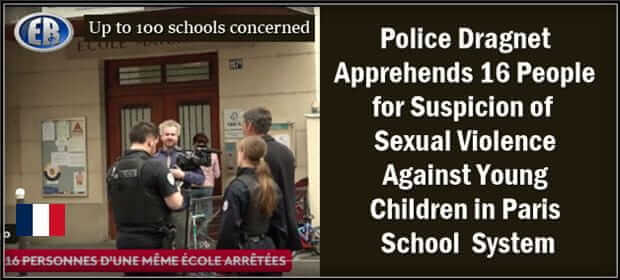
Translation: 16 people aged 18 to 68 are still in custody this morning following around thirty complaints of sexual assaults, indecent exposures, and rapes against children from the Saint-Dominique school in Paris Support for the parents

Translation: Little by little, we’re discovering that the Parisian after-school care is a nest of mentally ill people, sexual deviants, and child predators. A hundred schools. All the districts. Tell @Anne_Hidalgoand@egregoire Who was the scum in charge of recruitment?…

Translation: A former Parisian after-school program host to be tried on May 26 for assaults on nine minors. The mother of one young victim delivers chilling testimony. While Paris struts around as an “inclusive city,” our children are handed over to predators in public facilities. #Insécurité #Périscolaire #JusticeFrançaise

This criticism of the left, for whom a cabbage could stand for election in Paris and succeed, probably has some merit —

Translation: « This person took off my pants… » Children sexually assaulted in the Parisian after-school program: 16 arrests. Thanks to the left’s omertà and its migrant influx. Our kids are paying the price for their laxity. Wake up!

********

Sexual Scandal: Wave of Arrests in Parisian Schools

The new mayor is forced to act under the pressure of the public and the media.

HELENE de LAUZUN for EUROPEAN CONSERVATIVE

Within a matter of months, the Paris after-school care scandal has emerged as one of the most serious scandals to hit the French capital’s state schools in decades.

Behind this term lie dozens of reports of physical violence, sexual assault and, in some cases, rape involving staff hired for after-school activities organised by the City of Paris. The case took on major political significance in the run-up to the 2026 local elections, calling into question city hall’s oversight mechanisms, the slowness of legal proceedings and the relative silence that surrounded certain reports for several years.

Within a few months, cases scattered across several arrondissements piled up. In some instances, the incidents date back to 2019. Yet for a long time, these cases were handled separately, without any real overarching narrative. It is precisely this that now fuels the accusations of a ‘code of silence’ levelled by parents’ groups.

The scandal truly exploded into the public eye during the Paris municipal election campaign. A series of revelations emerged between January and April 2026: a surge in complaints, revelations about reports that had not been acted upon promptly, staff members transferred from one institution to another despite previous warnings, and administrative investigations that remained confidential. Many families felt that the systemic gravity of the problem had been downplayed both by the outgoing city council and by sections of the national press, which for a long time treated the cases as mere local news items. The contrast is all the more striking given that the figures revealed since then are considerable.

The scale of the phenomenon now appears difficult to dispute. According to data provided by the Paris public prosecutor’s office, investigations concern more than a hundred establishments: 84 nursery schools, around 20 primary schools and a dozen crèches. All arrondissements are reportedly affected. Since the start of 2026, 78 childcare workers have been suspended by the city of Paris, 31 of them on suspicion of sexual abuse. In 2025 alone, 46 suspensions had already been imposed, 20 of which were for sexual offences.

The complaints lodged by families also illustrate the depth of the trauma. In some establishments, dozens of children have been interviewed by investigators. At the Paul-Dubois nursery school in the 3rd arrondissement, 15 complaints were filed against a youth worker and 19 children were interviewed as part of the proceedings. Other cases involve repeated assaults on children aged between three and ten. The young age of the victims adds to the horror of the abuse suffered. Parents’ groups have formed, such as SOS Périscolaire, denouncing not so much an isolated recruitment issue as a chain of institutional failures: failure to escalate reports, managerial inaction, the transfer of problematic staff, and a lack of transparency towards families.

Given the scale of the scandal and the lack of a commensurate response from Anne Hidalgo’s team, one might have hoped that the Socialist teams vying to succeed her would be censured by the voters. This was not the case—due, in particular, to the timid press coverage of the events. Faced with the crisis, the new mayor of Paris, Emmanuel Grégoire, eventually adopted a firm stance. He spoke of a “systemic” phenomenon, promised a zero-tolerance policy, and announced an action plan worth around 20 million euros. Among the measures put forward are a simplification of reporting procedures, a strengthening of administrative controls and, above all, the organisation of a citizens’ convention on after-school care and children’s free time.

But these responses are considered largely insufficient by the families. The participatory convention has all the hallmarks of a false technocratic response to extremely serious incidents. Whilst discussions are taking place, no fundamental reforms to recruitment, disciplinary oversight, or background checks are being implemented. For exasperated parents, it is clear that the council waited until it was under media and electoral pressure to acknowledge the scale of the problem—and still doesn’t draw the appropriate conclusions.

The disconnect between the severity of the reported offences and the initial judicial responses is also fuelling anger. The first landmark trial in the scandal, held behind closed doors in early May 2026, concerned a youth worker prosecuted for sexual harassment and sexual assault against several young girls. The prosecution sought an 18-month suspended prison sentenceThis relative leniency shocked many parents, who see it as a sign that the justice system remains hesitant when it comes to sexual violence against minors in a school setting.

At the same time, some after-school activity leaders feel they have become the scapegoats of the crisis. A broad inter-union coalition called for a strike in May 2026 to denounce “unjustified suspensions” and a climate of widespread suspicion. Some unions accuse the city hall of issuing more suspensions to project an image of firmness to the public.

This situation has created a striking contrast: on the one hand, staff denouncing a policy deemed too repressive; on the other, families describing lasting trauma in children who are sometimes very young. The city council is simultaneously attempting to reassure parents and demonstrate that it is acting swiftly, whilst avoiding a complete breakdown in relations with a professional workforce that is essential to the running of Parisian schools.

The latest twist came on Wednesday, May 20th, with a wave of arrests in several cases linked to Parisian after-school clubs. Investigators carried out a wide-ranging crackdown targeting, in particular, activity leaders suspected of sexual abuse of minors. This acceleration of legal proceedings comes as Paris public prosecutor Laure Beccuau has publicly acknowledged the existence of a “considerable” number of cases still awaiting processing.

The Paris after-school care scandal now goes beyond the mere issue of a few criminal individuals. The scale of the responsibilities should have called for an exemplary political sanction, but it is too late for Paris. The minister for national education, Édouard Geffray, has expressed support for the creation of a “blacklist” to exclude individuals who have exhibited “unacceptable behaviour” towards children but who have not been convicted of a criminal offence. That would still be better than nothing.

Hélène de Lauzun is the Paris correspondent for The European Conservative. She studied at the École Normale Supérieure de Paris. She taught French literature and civilization at Harvard and received a Ph.D. in History from the Sorbonne. She is the author of Histoire de l’Autriche (Perrin, 2021).
.
Featured image source: https://x.com/Gdams70/status/2057376546432700714
************

Published to The Liberty Beacon from EuropeReloaded.com

••••

The Liberty Beacon Project is now expanding at a near exponential rate, and for this we are grateful and excited! But we must also be practical. For 7 years we have not asked for any donations, and have built this project with our own funds as we grew. We are now experiencing ever increasing growing pains due to the large number of websites and projects we represent. So we have just installed donation buttons on our websites and ask that you consider this when you visit them. Nothing is too small. We thank you for all your support and your considerations … (TLB)

••••

Comment Policy: As a privately owned web site, we reserve the right to remove comments that contain spam, advertising, vulgarity, threats of violence, racism, or personal/abusive attacks on other users. This also applies to trolling, the use of more than one alias, or just intentional mischief. Enforcement of this policy is at the discretion of this websites administrators. Repeat offenders may be blocked or permanently banned without prior warning.

••••

Disclaimer: TLB websites contain copyrighted material the use of which has not always been specifically authorized by the copyright owner. We are making such material available to our readers under the provisions of “fair use” in an effort to advance a better understanding of political, health, economic and social issues. The material on this site is distributed without profit to those who have expressed a prior interest in receiving it for research and educational purposes. If you wish to use copyrighted material for purposes other than “fair use” you must request permission from the copyright owner.

••••

Disclaimer: The information and opinions shared are for informational purposes only including, but not limited to, text, graphics, images and other material are not intended as medical advice or instruction. Nothing mentioned is intended to be a substitute for professional medical advice, diagnosis or treatment.


Be the first to comment

Leave a Reply

Your email address will not be published.


*