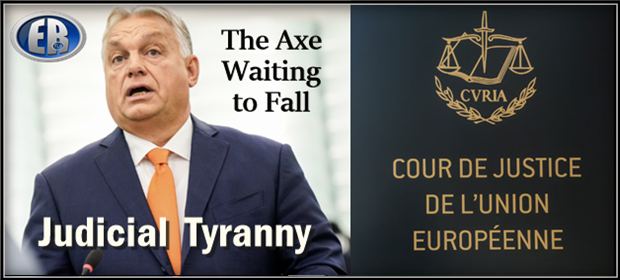
In the case concerning Hungary’s law protecting children from the negative influence of gender and transgender propaganda, challenged by the European Commission (Case C-769/22), the Advocate General issued an opinion nearly a year ago fully supporting the Commission’s claims. It is rare for the Court to depart significantly from such opinions, and it is an open secret that the final ruling will follow this line. At the same time, it is unusual for the Court to delay its judgement for so long—here, the Hungarian electoral calendar is clearly relevant. Announcing a CJEU ruling before the elections—one that strikes at the protection of children—would be a kiss of death for Péter Magyar’s Tisza. Backed by Brussels through every available means, it seeks to install a compliant puppet on the Danube, just as it did two years earlier on the Vistula.
Most Hungarians support protecting spaces accessible to minors—schools, educational materials, and media—from harmful content, including ideological manipulation related to transgender issues, indirect or direct encouragement of irreversible medical interventions, the sexualisation of children, and the aggressive promotion of non-normative sexual orientations.
Hungary has also given these regulations a clear constitutional foundation, explicitly stating that “the mother is a woman, the father is a man,” and that the state must protect a child’s identity in accordance with their sex at birth. It has reinforced the principle that parents have primary responsibility for raising their children, while the state must protect minors from content that may disrupt their development. In practice, restrictions on harmful LGBT content in education and media are not merely statutory provisions but stem directly from Hungary’s constitutional model of protecting family and children, forming part of its constitutional identity and sovereign axiological order.
For Brussels and Luxembourg, however, this is framed as discrimination, a violation of the internal market (sic!)—but also as a pretext for interference in matters beyond their competence. This message will likely be delivered only after the elections, so as not to expose the true agenda of Hungary’s globalist opposition during the campaign. Hypocrisy and manipulation are the standard operating methods of the European establishment—particularly the EPP and the socialists.
The Advocate General’s opinion clearly indicates that this ruling will mark a turning point in the process of centralisation—not only because it challenges constitutional-level Hungarian regulations, but because it introduces a far more dangerous element. It asserts that violations of Article 2 TEU values alone may serve as a direct legal basis for action against a member state. Previously, the CJEU treated Article 2 as an indirect reference point, linking its values to specific legal obligations in primary or secondary law. Now, it makes a fundamental leap, claiming that certain obligations arise directly from Article 2 TEU itself—despite the fact that, in practice, these values can be interpreted arbitrarily and often contrary to their original meaning.
The Advocate General explicitly calls on the Court to “take the opportunity” presented by the case to confirm this interpretation. In reality, such “interpretation” amounts to the appropriation of competences not granted by the Treaties. There is little doubt that left-liberal politicians in Luxembourg, dressed in judicial robes, will seize this opportunity to expand the power of the globalist establishment.
Kompetenz-Kompetenz of the CJEU in the Polish Constitutional Tribunal case
In the case concerning Hungary’s child protection law, the Court is thus preparing a substantive legal basis for potentially unlimited interference in the laws of member states. The formal and institutional foundation for this has already been laid in the judgement of 18 December 2025 concerning Poland’s Constitutional Tribunal (Case C-448/23).
In that case, acting beyond its competences, the CJEU held that Poland breached EU law through Constitutional Tribunal rulings that questioned the primacy of EU law and the jurisdiction of the CJEU over Poland’s constitution. What is crucial for the relations between a sovereign state and an international organisation was thus overturned. At the same time, the Court claimed that due to alleged irregularities in the appointment of three of the fifteen judges, the Polish Constitutional Tribunal does not meet the standard of an independent and impartial court under EU law.
Significantly, the judgement rests on a false narrative about irregularities in the appointment of those judges. In reality, in 2015, the outgoing liberal majority adopted provisions allowing it to appoint judges “in advance” to secure control over the Tribunal after losing power. The procedure was not completed because the president—due to constitutional doubts and a referral to the Tribunal—did not administer the oath, which is a constitutive condition for assuming office. As a result, the process had to be restarted by the newly elected Sejm under the principle of discontinuity. The new majority lawfully elected judges to vacant positions, and they were sworn in by the president.
The Constitutional Tribunal’s judgement, delivered after the new judges had already been sworn in, upheld the constitutionality of the statute insofar as it allowed the liberals to appoint three judges, and found it unconstitutional with respect to the appointment of two. The Polish Constitutional Tribunal adjudicates exclusively on legal norms, not on individual acts. It therefore assessed the statute that formed the basis for the appointments, not the validity of the Sejm’s resolutions appointing specific judges. Crucially, the Tribunal examined only the provisions of the statute underpinning the “advance” appointments made by the liberals, not the Rules of Procedure of the Sejm, which constituted the legal basis for the election of judges by the new Sejm with a conservative majority.
Accordingly, the Tribunal did not assess either the acts appointing the new judges or even the normative basis for those appointments. Most importantly, the judgement no longer had any practical effect, as—due to the principle of discontinuity—the Sejm conducted a new appointment process, completed by the swearing-in of the judges. Consequently, there are no legal grounds to question the validity of the appointments made in December 2015, and claims of an “improper composition” of the Polish Constitutional Tribunal are a political narrative and Tusk’s founding lie—one that also became the basis for the CJEU’s judgement in Case C-448/23.
This judgement goes far beyond Poland. The CJEU not only reaffirmed the absolute primacy of EU law over national law—including national constitutions—but also arrogated to itself the exclusive power to determine the scope of competences conferred on the EU, rejecting any such role for national constitutional courts. It effectively declared itself the master of the Treaties and the ultimate arbiter, claiming Kompetenz-Kompetenz.
Thus, 27 politicians in judicial robes, selected by governments through non-transparent procedures, have in effect proclaimed themselves sovereign over 450 million citizens of the EU member states.
This marks a fundamental formal and competence-based step toward the centralisation of the Union—one built, it must be emphasised, on entirely false allegations. It can therefore be argued that Case C-448/23 constitutes the founding lie of a centralised EU.
The forthcoming ruling on Hungary’s child protection law will complement this development by adding a substantive legal foundation—Article 2 TEU—to the formal Kompetenz-Kompetenz already asserted. Together, these rulings will enable deeper, unchecked interference in the legislation and constitutions of member states, unconstrained by meaningful limits. Concepts such as ‘tolerance,’ ‘non-discrimination,’ or ‘rule of law,’ in the hands of ideological actors, become tools for arbitrary interpretation.
These judicial mechanisms will reinforce broader non-judicial instruments used to centralise power in Brussels, despite growing resistance among European nations. It is no coincidence that both rulings target Poland and Hungary—two nations which, by defending their sovereignty, identity, security, and prosperity, pose a challenge to the EU’s centralisation agenda. Poland was misled and manipulated by false promises, and in 2023, Brussels installed a compliant puppet government. Hungarians, despite intense pressure from globalist forces, have not succumbed so easily. And as early as next year, Warsaw may have the chance to return to the camp defending freedom and sovereignty.







Leave a Reply