

The Larak Corridor: Iran’s Rial Gate With No US, No Israel and No Way Around
Freddie Ponton | via 21WIRE
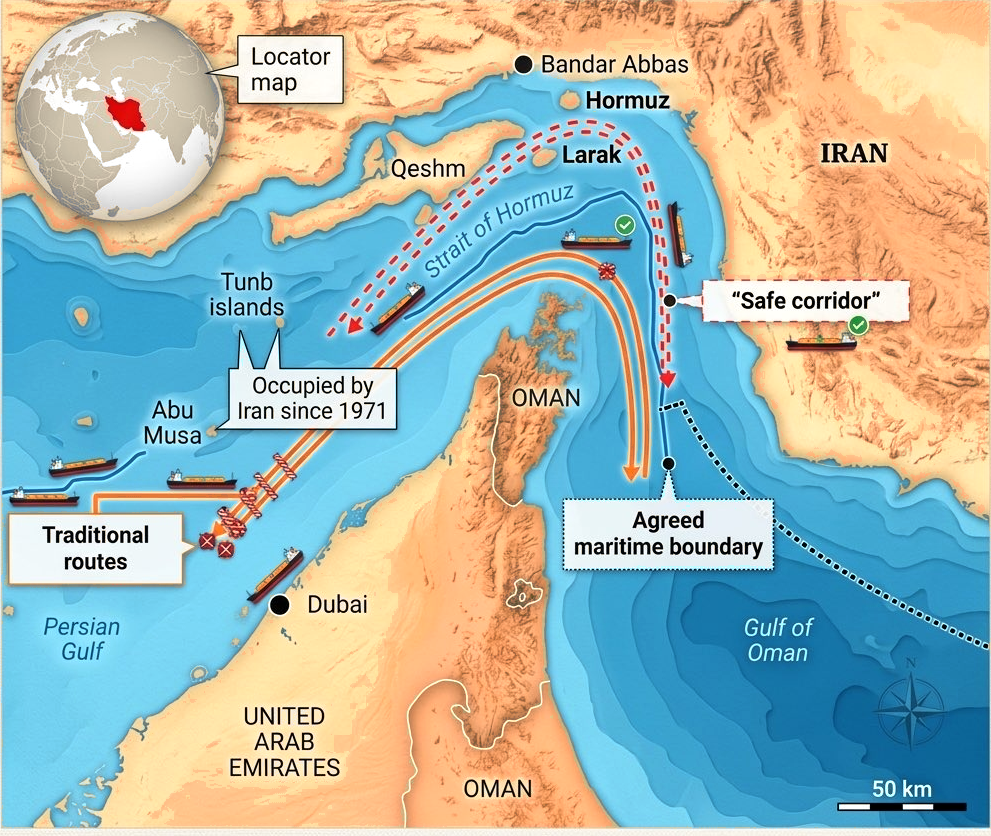
While MOW Secretary Pete Hegseth was telling other nations to “step up” in the Strait of Hormuz, Donald Trump was already backing away, insisting its security was “not for us.” In between those contradictions, Washington dumped a fog of conflicting slogans on the public—slogans that never looked like strategy so much as panicked improvisation. That confusion is not a sideshow to the war, but the political static masking a brutal reality. While the White House and its zionist neocon war camp lurch between bluff and retreat, Iran has been moving with cold discipline, quietly building what Iranian reporting calls the Larak Corridor and what maritime trackers have identified as a tightly managed lane through the Qeshm-Larak gap inside Iranian waters.
Around Larak, Tehran is no longer just reacting to an illegal war launched against it. It is turning battlefield pressure into procedure, selective access, and proposed law, using a controlled corridor and a wider Hormuz management plan to show that the old fantasy of automatic Western command over this chokepoint is breaking down in real time. The truth of the war is not found in the bombast coming out of Washington; instead you will find it in the places where power is actually shifting, and right now, one of those places is a narrow strip of water off Larak, where Iran looks calmer, more deliberate, and more in command of events than the people who thought they could bomb it into submission.
The Day Hormuz Moved on Iran’s Terms
The Strait of Hormuz has not been shut, and that is exactly why what Iran has done matters more. What has emerged around Larak is not a crude blockade but a controlled passage system, a wartime checkpoint laid across one of the most important arteries of the world economy. Iranian reporting most often calls it the Larak Corridor. At the same time, the broader phrase Larak-Qeshm Corridor is best understood as a geographic description of the lane running through the narrow gap between those two islands inside Iranian waters.
Names are not cosmetic here. Western and trade coverage tend to speak of a route between Qeshm and Larak. Iranian coverage roots it in Larak itself, in Iranian-managed waters, under Iranian rules. That is the quiet shift the war has produced. For decades, the story of Hormuz was told from the deck of a U.S. carrier. Today, one of its key arteries is being renamed and reorganised from a small island most Western audiences have never been asked to think about.
Iran appears to be building a differentiated transit regime, not a universal shutdown. That means the market consequence is not simply “less supply,” but a more political energy map in which some buyers and shippers face privileged access while others face delay, denial, or sharply higher costs.
That is the part of the story that cuts through the propaganda. A total closure would have been easy to denounce and easy to rally against. A selective corridor is harder to attack because it allows Tehran to say that passage has not ended, only the assumption that ships can move through Iranian waters during an illegal war on Iran without submitting to Iranian conditions.
This is why Larak matters. It is where Iran stopped merely threatening the map and started administering it.
The lane at Larak
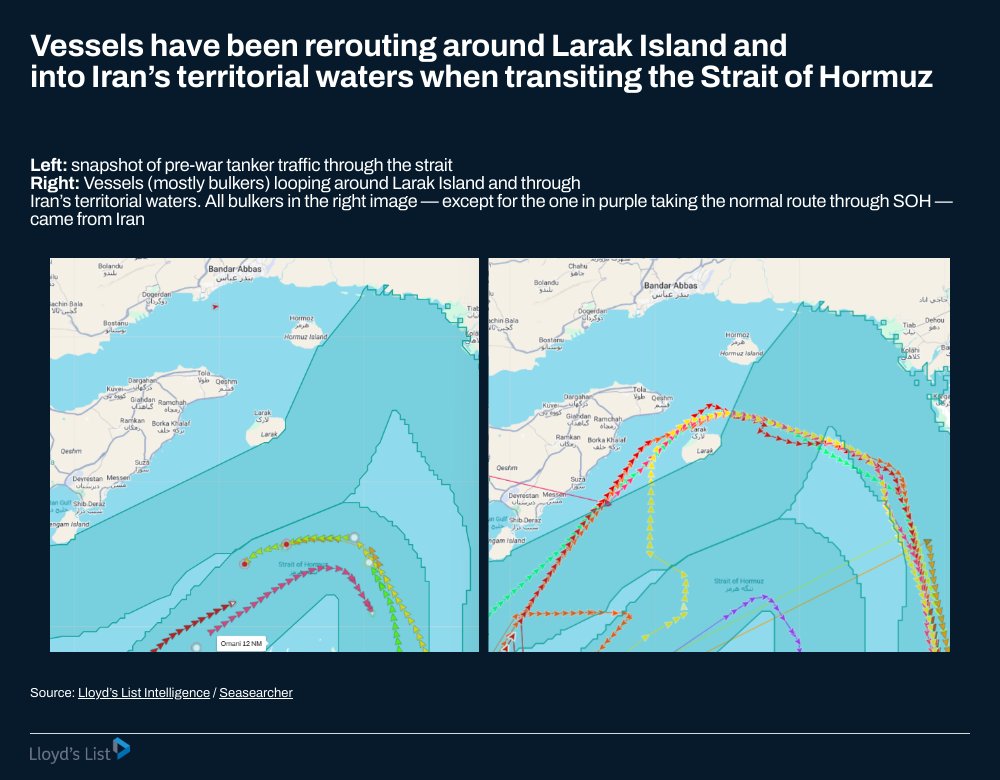
The outlines of the new lane are now visible. The Larak Corridor is not a return to normal traffic. It is a filtered, low-volume, politically segmented route for approved movement. Trade and maritime analysis has traced authorised vessels through the five-mile gap between Qeshm and Larak, close to the Iranian coast and under a web of Iranian surveillance and intervention capacity. Iranian and Arabic reporting has described a safe corridor around or between Larak and Qeshm, never a full reopening of the strait, even though yesterday the Wall Street Journal reported that the Bahman pier on the eastern side of Qeshm Island was attacked, according to a statement from Hormozgan governor’s office relayed by Iranian state-affiliated media ISNA. Qeshm overlooks the Clarence Strait in the Strait of Hormuz and is referred to by the locals as “Kuran”, Iran’s main launchpad for its asymmetric naval warfare. In early March, the Israeli/US war machine had targeted a desalination plant on Qeshm Island, leaving 30 villages without water.
VIDEO: Larak Island’s Hidden Arsenal: How Iran Turned a “Barren” Rock into a High‑Threat Kill Zone for the US Navy (Source: Alma Research & Education Center)
Iranian threats facing US Navy vessels near the strait of Hormuz –
At first glance, Larak appears to be a barren desert island with little to no military infrastructure. A closer look reveals that Iran has been deploying multiple military assets to Larak. A Russian-made and… pic.twitter.com/b2VQIvruCo
— Israel-Alma (@Israel_Alma_org) February 23, 2026
That low-volume point changes everything. The lane exists in deliberate contrast to prewar patterns. UN-linked reporting put pre-crisis traffic through Hormuz at roughly 130 ships a day. Against that baseline, the authorised trickle through Larak is not evidence of restored normality but a clear indication that normality has been replaced by a rationed flow that Iran alone can modulate.
The lane also stratifies states. Some governments have secured negotiated passage, some ships have moved after prior coordination and documentation, and others have been turned back or discouraged from approaching in the first place. The result is not an open sea but a tiered system in which diplomatic posture, sanctions alignment, and wartime behaviour shape access to one of the world’s central energy routes.
Calling this a blockade is comfortable for Western officials, but it is wrong. A blockade denies passage to provoke a fight. The Larak Corridor functions more like a wartime border crossing, granting passage conditionally, keeping discretionary power in Iranian hands, and making political hierarchy visible on the water.
Force became law
The story becomes more serious once you see that Tehran is not leaving this system in the realm of ad hoc force, but instead the Islamic Republic of Iran is building a legal scaffold around it.
Parliamentary reporting confirms that Iran’s National Security and Foreign Policy Committee has approved an eight-point Strait of Hormuz Management Plan. The plan is built around eight clear pillars: securing the strait, ensuring ship safety, addressing environmental risks, establishing financial arrangements with a rial-based toll system, banning American and Israeli vessels from passage, asserting Iran’s sovereign authority and that of its armed forces, cooperating with Oman on the legal framework, and prohibiting entry to any state that participates in unilateral sanctions against Iran.
 IMAGE: Iran’s Strait of Hormuz Eight Pillars Management Plan
A parallel description from Xinhuanet states that the measure gathered more than 250 signatures and outlines four immediate objectives: ensuring shipping security, charging environmental polluters, collecting fees for guidance services, and establishing a regional development fund funded by the toll regime. Those details matter as they show that Tehran is not marketing this as a simple wartime levy, but as sovereign administration over safety, environmental protection, navigational management, revenue, and regional development.
It is crucial to be precise. The plan is not yet fully enacted into law. Committee approval is significant because it codifies the logic of the corridor and signals an intention to turn military practice into statute, but Iranian reporting makes clear that key elements are still in the phase of initial measures and continued drafting. That does not weaken the argument. It actually strengthens it. The turning point is not when the last procedural stamp is applied, but when a state under attack openly decides to legislate the war’s new realities into its domestic legal order.
The Oman clause is one of the plan’s sharpest edges. Iranian reporting says Oman must be present in the legal regime and coordination structure because the southern side of the strait is Omani. At the same time, a parliamentary voice emphasised that in matters of toll collection “the essence of the matter is in Iran’s hands,” and that Iran is the party positioned to collect fees, while Oman’s place is in cooperation and coordination, not revenue capture.
In other words, Tehran is regionalising the legal façade without diluting operational control. Omani decrees from 2025 ratifying broader cooperation and legal-judicial accords with Iran give this move a pre-existing legal context, making the Hormuz framework look less like a unilateral edict and more like a hard extension of bilateral agreements into wartime management.
This is what it means for force to become law. Iran is not simply blocking ships. It is regulating them, invoicing them, and giving itself the legal language to defend that behaviour once the guns fall quiet.
Islands’ sovereignty and the human layer
Strip Larak from its geography and you miss half the story. Hormuz cannot be seen as just another free-floating blue line on an analyst’s map. It is a dense, lived space of islands, coastlines, fishing ports, naval outposts, and communities that have grown up under the shadow of foreign fleets and sanctions.
VIDEO: How Iran Revolutionary Guards (IRGC) use their islands in the Gulf to control navigation at the Strait of Hormuz (Furkan Gözükara | X account)
;
Imagine sailing a massive cargo ship and suddenly being surrounded by heavily armed speedboats and drones with zero time to react. Iran has turned Larak Island into a heavily fortified choke point enforcer. Absolute dominance over global shipping lanes. pic.twitter.com/bEgIYnzKPl
— Furkan Gözükara (@FurkanGozukara) March 19, 2026
For half a century, the world has been taught to treat the islands of Abu Musa and the Tunbs as footnotes, little “disputed” specks on the map. In reality, they, along with Qeshm and Larak, sit inside a network of surveillance and reach that allows Iran to watch, shape, and, when necessary, squeeze movement at the mouth of the Gulf. The Larak Corridor is not a freakish one-off. It grows out of a sovereignty geography that has been quietly undermining the fiction of an “American lake” in Hormuz for decades.
READ MORE: IRAN- The Three Islands Unmaking American Unipolar Sea Power in the Persian Gulf
There is a human layer that rarely makes it into Western press. Iran’s maritime posture is not only the work of admirals in Tehran, but it also rests on coastal communities, port workers, pilots, and the broader ecosystem that includes the Naval Basij, the volunteer maritime defence network you researched earlier. That network, with its small craft, its local knowledge, and its political symbolism, has always been part of how Iran thinks about defending the strait, not simply by hardware but by socialised resistance.
READ MORE: Iran’s Naval Basij Turned Hormuz into a Graveyard for US-Israeli Arrogance
For people living on those coasts, the corridor is not a theoretical legal innovation. It is one of the few visible signs, in the middle of bombardment and assassination, that their state can still impose some order at the place where global power once promised them none. Seen from there, the Larak Corridor looks less like opportunism and more like a resilient country insisting that sovereignty is not an abstract word but something that can be exercised in a specific channel of water under fire.
The Gulf pays for the war
The political brilliance of the Larak move is in who gets billed for it: not Washington first, not Tel Aviv first, but the Gulf order that enabled this war and is now trapped in its consequences.
Gulf governments were not properly warned, their objections were ignored, and Europe was largely marginalised from the decision-making that triggered the regional blowback they are now paying for.
That one sentence punctures the comforting story that the old security architecture still works. Some Gulf capitals had urged Washington not to attack Iran. Some tried to keep a distance from the opening salvo. Europe itself was treated less like a partner than a spectator told to brace for impact.
The cost has not been theoretical. Freight risk exploded. Insurance premiums climbed. Cargo timetables turned into contingency plans. The “guarantee” on offer from Washington turns out to be a package in which Gulf states host bases, bankroll weapons, and then absorb the retaliation and economic shock once the trigger is pulled.
The evidence of fatigue is patchy but real. Saudi Arabia has intensified direct contacts with Iran. Regional diplomacy has tried to put some sort of brake on escalation. At the same time, influential Gulf voices still speak of the need to degrade Iranian capabilities, not simply to stop the war. That tension is important as it shows a region caught between fear of Iran and a growing recognition that the American-led order is no longer a stable shelter.
Larak turns that contradiction from an argument into a daily experience. Every tanker that has to negotiate with Tehran, every nervous call from an insurer, or every investor wondering whether to avoid Gulf exposure. All of it drives home the same lesson. A war on Iranian sovereignty will not remain confined to Iranian soil or to the screens of Western news shows. It will leak into ports, pipelines, desalination plants, stock exchanges, and households across the Gulf.
From a pro-peace, pro-sovereignty perspective, that is the real indictment. The architecture that claimed to keep the region safe has delivered a crisis that no one can turn off without Iran’s involvement.
Beyond the dollar and toward the Global South
Although it may sound like a speculative slogan about some future yuan world, it is a description of an experiment already underway. Iran’s proposed Hormuz management plan speaks in the language of rial-based tolls and financial arrangements. Broader analysis around the corridor connects that direction of travel to non-Western settlement channels and to the wider de-dollarisation agenda now running through BRICS and the Global South.
 IMAGE: Hormuz management plan and the Iranian rial-based tolls
The point is not that the petrodollar disappears tomorrow. It is that under bombardment, and with its conventional military apparatus under fire, Iran is still moving a slice of energy trade onto monetary rails where Washington’s sanctions power is weaker.
Hormuz is doubling as a testbed for de-dollarized energy payments.
China’s experiment with yuan-settled LNG from Qatar in 2023 showed that Gulf energy can clear outside dollar channels when states choose to build the infrastructure. Iran’s 2023 agreement with the UAE to use the dirham in bilateral trade, while imperfect because of the dirham’s peg, still represents a deliberate shift into regional banking circuits that cost Washington more to police. Meanwhile, BRICS has been advancing alternative payment mechanisms and settlement systems designed precisely to chip away at dollar centrality.
The Larak Corridor slots into this picture with unnerving ease. It rewards states willing to engage with Tehran rather than join the sanctions chorus. It opens space for deals denominated in rial, dirham, or yuan. It demonstrates that a Global South state under open attack can still exert leverage over the physical and financial pathways through which the world’s energy moves.
Tehran is not claiming a clean victory over the dollar. What it is doing is more subversive. It is using the war to erase the assumption that Washington can both close and reopen Hormuz at will, militarily and financially. Every transaction that clears outside Western rails, every ship that goes through a lane managed on Iranian terms, is another chip knocked out of a system that has long treated Gulf energy as an American instrument first and a regional lifeline second.
That is why the story of Larak is not simply a regional shipping story, but rather a frontline in the contest over who writes the rules of the global economy.
The old order is cracking
What has happened at Larak is not the final victory of a new world, but it is one of the clearest signs that the old one is cracking in real time.
For decades, the script ran on autopilot. The United States secured the sea lanes. The Gulf monarchies supplied the fuel. The dollar priced it. Everyone else adjusted. The war on Iran was supposed to be another scene in that familiar play. Instead, it exposed how much of it had become theatre.
Iran’s answer didn’t need to be polite, and it was never meant to be. It was disciplined, coercive, and grounded in the one thing Washington cannot replace with rhetoric, the geographic reality of where Hormuz actually lies. Tehran avoided the trap of a universal shutdown and built a mechanism that punishes enemies, rewards accommodation, and keeps the region inside a rolling uncertainty that no press conference in Washington can dispel.
That is why the phrase differentiated transit regime carries so much weight in this war. It captures the fact that what is happening off Larak is not chaos. It is governance under attack. It is a sovereign state, bombed and sanctioned, insisting that it still has the right to decide who crosses its doorstep and on what terms.
For people in the Gulf, it is about whether their ports can stay open, whether their desalination plants keep running, and whether their economies can withstand another cycle of manufactured crisis. For people in Iran, it is about whether anything in their immediate environment still belongs to them after decades of war, sanctions, and threats of regime change.
Seen from that angle, the Larak Corridor is not a provocation. It is a verdict. Peace will not come from pretending the old arrangement can simply be restored. It will come, if it comes at all, when the region and the wider world accept the reality written into the water off Larak. A Gulf built on assaults against Iranian sovereignty cannot remain prosperous, stable, or truly sovereign itself. Not now, and not in the long term.
Iran’s navy has been targeted. Its cities have been hit. Its leaders have been hunted. Yet at the most critical chokepoint on earth, the war machine that promised to reopen the map still cannot make Hormuz move on its own terms.
Sovereignty, once attacked, does not always retreat. Sometimes it answers by redrawing the map and forcing those who lit the fire to live with the new lines.
_________
Header featured image (edited) credit: Org. post content. Emphitis added by (TLB) editors
••••

••••
Stay tuned…

••••
The Liberty Beacon Project is now expanding at a near exponential rate, and for this we are grateful and excited! But we must also be practical. For 7 years we have not asked for any donations, and have built this project with our own funds as we grew. We are now experiencing ever increasing growing pains due to the large number of websites and projects we represent. So we have just installed donation buttons on our websites and ask that you consider this when you visit them. Nothing is too small. We thank you for all your support and your considerations … (TLB)
••••
Comment Policy: As a privately owned web site, we reserve the right to remove comments that contain spam, advertising, vulgarity, threats of violence, racism, or personal/abusive attacks on other users. This also applies to trolling, the use of more than one alias, or just intentional mischief. Enforcement of this policy is at the discretion of this websites administrators. Repeat offenders may be blocked or permanently banned without prior warning.
••••
Disclaimer: TLB websites contain copyrighted material the use of which has not always been specifically authorized by the copyright owner. We are making such material available to our readers under the provisions of “fair use” in an effort to advance a better understanding of political, health, economic and social issues. The material on this site is distributed without profit to those who have expressed a prior interest in receiving it for research and educational purposes. If you wish to use copyrighted material for purposes other than “fair use” you must request permission from the copyright owner.
••••
Disclaimer: The information and opinions shared are for informational purposes only including, but not limited to, text, graphics, images and other material are not intended as medical advice or instruction. Nothing mentioned is intended to be a substitute for professional medical advice, diagnosis or treatment.



Leave a Reply