

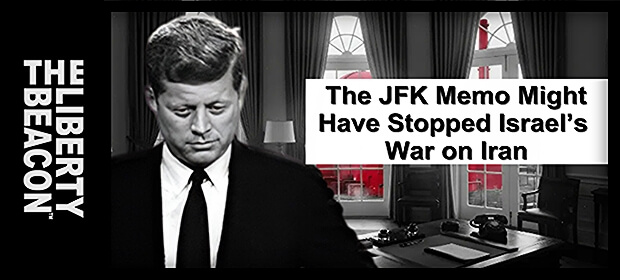
The Memo That Might Have Stopped Israel’s War on Iran
The JFK Memo
“My God, we wouldn’t continue our guarantee of West Germany if they started manufacturing nuclear weapons, which is really of vital importance to us compared to our position in Israel.”
President John F Kennedy, on Israeli nuclear ambitions, 1963
(Source: National Security Archive – “Battle of the Letters, 1963” and discussion of Kennedy’s private warnings in Wm. Bundy memo excerpt | Video below from Monika Wiesak | X)
My God, we wouldn’t continue our guarantee of Germany if they started manufacturing nuclear weapons, which is really of vital importance to us, why should we guarantee Israel if they’re doing it? – JFK pic.twitter.com/dpRWJvYZG7
— Monika Wiesak (@MonikaWiesak) January 23, 2026
On 21 November 1963, two days before John F Kennedy was shot in Dallas, one of his closest advisers sat through a tense lunch with an Israeli minister and quietly wrote down what Washington dared not say in public. That memorandum, drafted by National Security Council advisor Robert Komer (“Blowtorch Bob”), reads today like a warning note from a different era, a moment when a US president still tried to keep some distance from a small client state that demanded everything and offered secrecy in return.
Komer describes an Israel already furious that the United States would not simply sabotage a United Nations debate on Palestinian refugees to its liking. The Israeli side accuses American diplomats of “lying” and “active lobbying” against an Israeli resolution, as though Washington’s task at the UN were not to balance conflicting claims in a decolonising region but to function as Israel’s parliamentary whip. In response, Komer sketches a picture that has become brutally familiar in 2026. He sees a government whose “consistent policy” is to push the United States into an openly pro-Israeli position, regardless of the consequences with Arab societies, regardless of the opportunity it hands to rival powers, regardless of the long-term cost in blood and legitimacy. All of these phrases and characterisations such as “lying,” “active lobbying,” the description of Israel’s “consistent policy” since 1948 and US concern over its impact on Arab relations and Soviet influence, are drawn directly from and faithfully summarised in Komer’s November 21, 1963 memo. (full memo).[2001-2009.state]
In the memo, the United States is already Israel’s “guarantor, banker, and strongest friend,” expected to subsidise the state, shield it diplomatically, and fight its wars if necessary. Yet even at this early stage, Washington is kept in the dark about the most dangerous files.
VIDEO: JFK Hints at Secret Nuclear Clash with Israel in 1963 Press Conference (Source: Monika Wiesak| X)
Though JFK’s battle with Israel over nukes was largely unknown to the public at the time, he did reference it in an April 1963 press conference when asked if he would give military aid to Israel. pic.twitter.com/wX0IwqyVqq
— Monika Wiesak (@MonikaWiesak) March 29, 2025
Komer writes with unconcealed frustration about Dimona (Israel’s nuclear site) and about Israeli missile purchases from France. The Americans are footing the bill and will one day be asked to intervene militarily, but they are denied basic clarity on whether their protégé is quietly assembling a nuclear delivery system in defiance of non-proliferation principles that Washington claims to uphold everywhere else.
VIDEO: In 1963, Kennedy threatens to expose Israel’s Dimona stonewalling (Source: Monika Wiesak| X)
In 1963, JFK threatened to leak Israel’s refusal of Dimona inspections to the press: “We ought to leak it out that there’s suspicion & they won’t permit inspections.” JFK would be very appreciative that at least one person in the press is bringing attention to this issue. https://t.co/H0UuIKmcRl pic.twitter.com/vE9iTOK5C3
— Monika Wiesak (@MonikaWiesak) January 16, 2026
All of this is grounded in the memo’s passages where Komer calls the US Israel’s “guarantor, banker, and strongest friend,” complains that Israel is “consistently coy” about defence plans, explicitly cites the way Israel handled the Dimona reactor as creating “real suspicion” of a nuclear weapons intent, and notes Rabin’s refusal to say whether Israel is acquiring missiles from France. The broader context of the Kennedy–Dimona 1961-1962 clashes can be found in Avner Cohen and William Burr’s report available on the Wilson Center Website – “Kennedy, Dimona and the Nuclear Proliferation Problem”.
Six decades later, US warplanes and missiles are striking Iran while an undeclared Israeli nuclear arsenal sits outside any treaty framework and outside any meaningful inspection regime. Iran, a signatory to the Non-Proliferation Treaty and subject to some of the most intrusive inspections ever imposed on a state, is presented as the existential nuclear threat. Israel, which stonewalls on Dimona to this day, is wrapped in euphemism and strategic silence. The inversion is not an accident. It is the logical outcome of a relationship Komer already recognised as structurally lopsided, with Washington dragged step by step from uneasy sponsor to unconditional accomplice.
The facts underpinning these events include Iran’s Non-Proliferation Treaty (NPT) status in 1968 and inspection history, as well as USIP “Timeline of Iran’s Nuclear Activities”, Arms Control Association NPT timeline, and Israel’s undeclared but widely documented nuclear arsenal outside the NPT, rooted in Dimona.
The same pattern repeats with refugees and borders. In 1963, the argument was over a UN paragraph that might strengthen the principle of return for Palestinians expelled in 1948. In 2026, the argument has been replaced by brute force. Gaza is shattered. The West Bank is strangled by settlements. Millions of Palestinians live and die under siege or military rule. When Israel and its allies extend this violence outward into Lebanon, Syria and now Iran, they do so from a position painstakingly constructed over decades of US protection, weapons flows and diplomatic impunity. Komer warned that an all-out embrace of Israel would push the Arab world toward Moscow and lock the United States into a regional confrontation that served neither its people nor basic international law. In the end, it was Iran that the US helped push toward Moscow and ultimately China.
The 1963 refugee and UN‑paragraph dispute, and Komer’s warning about US credibility with Arabs and Soviet penetration, come from the memo text itself. The long‑term pattern of massive US military, financial and diplomatic support to Israel, including arms flows and political cover over settlement expansion, wars in Lebanon and Gaza, and current operations, is well documented in official and scholarly summaries such as “History and Overview of U.S. Foreign Aid to Israel” and recent analyses of US support in the Gaza war and beyond. (See: “United States support for Israel in the Gaza war”, JFK Library and FRUS collections on security guarantees).
What Komer’s memo captures with chilling clarity is that this drift was not an inevitable fate. It was argued over, and also resisted from within, however weakly. It was also enabled step by step, and to read it now, under the shadow of US-Israeli attacks on Iran and with the memory of Dimona still officially unspeakable, allows us to see how early Washington understood the dangers of arming and shielding a state that refused to define its borders, refused to resolve the refugee question, and refused to subject its nuclear ambitions to any honest scrutiny.
The tragedy is not that no one saw this coming. It is that they did, they wrote it down, and the warnings were buried.
In conclusion, the claim that Kennedy and his advisers understood and debated these dangers is very much supported by the Komer memo itself and by the broader documentary record of 1961‑63 Kennedy–Ben‑Gurion/Eshkol correspondence over Israel’s security guarantees and nuclear program, where inspection of Dimona and the risk of nuclear proliferation sit at the centre of US concerns.
 IMAGE: US President John F. Kennedy with National Security Council official Robert Komer (Source: Created by Author)
.
John F. Kennedy Administration: Memorandum on Palestinian Refugee Item in UN, Relations with Arabs (Source: Jewish Virtual Library – November 21, 1963)
This is a memorandum for the record covering R.W. Komer’s meeting with Gazit on the Palestinian refugee item in the United Nations, the relationship between the U.S. and Israel and the UAR military capabilities.
At luncheon with Israeli Minister Gazit, we had a rather brisk exchange. He began by complaining bitterly about the way we had “lied” to them about the Arab refugee matter in the UN. Cleveland and Sisco had misled Harman and him by not revealing we had changed our strategy to include para. 11. We had never told them the real facts of our position. He also accused us of “active lobbying” to get some of the co-sponsors to withdraw. Israel took the direct negotiations resolution very seriously. There had been a full Cabinet meeting on it the week before, which decided to go ahead, and our role in the debacle was going to create real complications in US-Israeli relations. All in all, he was most unhappy about the future course of these relations.
While I was not familiar with all the ins and outs of the refugee debate this year, I simply couldn’t accept this accusation. We had clued the Israelis in on our new position as soon as it became apparent we could no longer get away with blurring para. 11. We had told them that otherwise both of us would end up with the worst of all possible outcomes–an Arab resolution passed by 2/3 majority–if we didn’t shift. We’d sought to exchange information on vote counts, but they’d refused. I even recalled some difference in view as to whether they had in fact promised us they would not even bring the DN matter to a vote this year.
Turning to a larger frame, I felt this was another occasion on which Israel tried to press us for all the traffic would bear. Its consistent policy seemed to be to force us into an openly pro-Israeli stand despite our protests that this would undermine us with the Arabs and give the Soviets a field day. Israel’s whole effort since 1948–in the UN, in the manoeuvres for a public security guarantee, in demands for more arms, joint planning, etc.–seemed aimed at forcing us off of an ostensibly middle position which permitted us to maintain reasonable relations with the Arabs and thereby combat Soviet penetration of the Middle East. Israel might think that a net outcome in which the US backed Israel all-out, while the Arabs turned to Moscow, was in its overall security interest, but we most emphatically did not. We saw our ME policy as being in Israel’s interest as much as ours. We had consistently tried to explain this to them, with little success.
I then mentioned (since the President had emphasised this the day before) how the Gruening amendment had so limited our freedom of action with the Arabs as to make it very difficult for us to be as forthcoming with Israel in the refugee or other issues as we would otherwise like. Gazit, of course, insisted that Israel had had nothing to do with the standard pro-Zionist reactions of Farbstein, Gruening, Keating, and Javits. He recounted how Javits had come to the area and wanted to write a report on the Arab refugees. Israel had tried to convince him not to issue such a report, but he had gone ahead anyway. I told Gazit that even if Israel had done nothing positive to encourage the Gruening amendment, it would have been in Israel’s interest to discourage such limits on the President’s flexibility in foreign policy. How could one define “aggression”, much less “preparing for” aggression? It was even possible that Israel could be called to account under this amendment as a result of a reprisal raid.
Gazit deplored the “arms-length” relationship between the US and Israel, which made it so difficult to achieve our joint purposes. For example, they had laid out all of their intelligence in the Rabin exchange, but we had kept “mum”. I retorted that we had given the Israelis more of our intelligence estimates on the UAR than at any previous time. We certainly didn’t give the Arabs any such intelligence on Israel. The Rabin exercise had been a good one, and we hoped the Israelis appreciated this. Moreover, if one were going to talk about lack of candour, it was strange to me that Israel was so consistently coy about describing its own defense plans and programs to its guarantor, banker, and strongest friend in the world. If trouble developed in the Near East, it was not the French or Germans but the US which had to come to Israel’s defense. We were expected to subsidise Israel, both privately and publicly, to support her to the hilt on every issue, to meet all of her security requirements, and to defend her if attacked. In return, we did not even know what she intended to do in such critical fields as missiles and nuclear weapons. I referred to the way in which Israel had handled the Dimona question as creating real suspicion on our part that such evasiveness must mask an intent to acquire nuclear capability. Now in response to direct questions on two occasions, Rabin had refused to say whether Israel was acquiring missiles from France. What kind of a relationship was this?
Gazit said he regretted the way his Government had chosen to handle Dimona, but returned to the theme that the US/Israeli relationship was entering a state of crisis. As reasons, he cited not only the new UN resolution but also indications that the US was raising objections to Israel’s security relations with third parties. When I asked what he meant, he said that they had heard we were objecting to certain things they were getting from European sources. I told him I did not propose to discuss this matter in specifics, but that I believed I knew what he was talking about. It was by no means the situation he described. On those occasions when Israel and another country made arrangements with respect to items on which we had a lien, we jolly well expected that both parties–as friends of ours–would at least consult us in advance. Second, as Israel’s chief guarantors and financial backers, weren’t we, in general, entitled to have a better idea than they seemed to think about what they were doing? After all, if Israel acquired weapons which set off a new round of arms escalation in the Middle East and otherwise seriously disturbed the existing deterrent balance, or if Israel took action (e.g., vis-à-vis Jordan or reprisal raids) which could lead to a war into which we would inevitably be drawn, we emphatically felt entitled to have our say in advance.
Gazit then described the special security problems of Israel and the importance of its having adequate deterrent power. He indicated, without saying it in so many words, that his Government had decided to acquire a missile capability; this was dictated by its security interests. I told him that I personally felt this was not a decision which Israel should take without consulting us. Given our role vis-à-vis Israel, why were we not entitled to be consulted on as major a new departure in the Israeli military program as buying several hundred dollars’ worth of SSMs? It looked to me as though Israel was planning to use its own substantial foreign exchange reserves to buy from France a very expensive missile capability, while coming to us for several hundred tanks. As those who provided far more financial aid to Israel than anyone else over the years, why couldn’t we legitimately suggest that Israel take the money we thought it would waste on a missile capability and purchase tanks in Europe instead? We argued extensively with our other allies about such misuse of their resources. Why was Israel a special case?
I stressed our great concern over the possible repercussions of Israeli acquisition of SSMs. I thought we had convinced them that the primitive UAR missile force, even if built up to the 1000 they alleged by 1968, would not represent a threat to military targets, probably would not even give the UAR much disruptive capability against Israel’s mobilisation, and was only of psychological value. If Nasser wanted to waste his money this way (and we doubted that he would go for any 1000 missiles), why should Israel follow suit? Gazit said that even if we could convince the most knowledgeable people in Israel, such arguments could not override the deep concern of the Israeli people over UAR missiles, which the political level must heed. I responded that one way of meeting this problem was to conduct an educational campaign to explain to the Israeli population how little a threat the primitive UAR missiles actually were.
Moreover, was the psychological deterrent gained through Israel’s acquiring superior missiles worth either the cost or the risks? I wanted to stress these risks again. First was the risk that the UAR would be stimulated to get good SSMs from the USSR, which would give them a better capability even with conventional warheads. But even more important, such missiles were not militarily effective without nuclear warheads. Therefore, Israel’s acquisition of SSMs inevitably raised questions in our mind as to whether it was not indeed going for a nuclear capability as well. Even if Israel did not intend to do so at this point its possession of an operating reactor plus a missile delivery system would bring it much closer to a nuclear deterrent if it chose to go this route. The US was fundamentally opposed to such nuclear proliferation. This was not a policy directed at Israel. It was a cause of great strain in our relations with France. Yet we were determined to undergo this strain. Why should we put Israel in a different category from France?
As we left, I suggested to Gazit that since he had frequently suggested how the President should answer their letters, I would presume to suggest how Eshkol or BG might answer ours. Couldn’t the Israeli Government acknowledge just once that the US had a defensible position in attempting to maintain good relations with the Arab states? Instead, take Eshkol’s latest letter; he simply dusted off the President’s statesmanlike exposition of our reasoning on a security guarantee by saying that he would come back at us again, and then proceeded to make a whole series of new requests. It was not always a question of the US failing to take Israel’s security interests into account, but of at least comparable failure on their part to give any recognition to the possible validity of our policy. We were ships passing each other in the night.
R. W. Komer
__________
About the Author:
Freddie Ponton is an independent researcher and journalist based in France, with a keen interest in European politics, geopolitics, NATO strategy, and international criminal investigations, as well as corporate and government intelligence. Over the decades, Freddie has lived and worked on multiple continents, witnessing global events, and thus brings a unique perspective to his work in informing and educating readers, whilst constantly pursuing the truth, wherever it leads. Follow him on X.com
___________
Header featured image (edited) credit: Org. post content. Emphasis added by (TLB) editors
••••

••••
Stay tuned…

••••
The Liberty Beacon Project is now expanding at a near exponential rate, and for this we are grateful and excited! But we must also be practical. For 7 years we have not asked for any donations, and have built this project with our own funds as we grew. We are now experiencing ever increasing growing pains due to the large number of websites and projects we represent. So we have just installed donation buttons on our websites and ask that you consider this when you visit them. Nothing is too small. We thank you for all your support and your considerations … (TLB)
••••
Comment Policy: As a privately owned web site, we reserve the right to remove comments that contain spam, advertising, vulgarity, threats of violence, racism, or personal/abusive attacks on other users. This also applies to trolling, the use of more than one alias, or just intentional mischief. Enforcement of this policy is at the discretion of this websites administrators. Repeat offenders may be blocked or permanently banned without prior warning.
••••
Disclaimer: TLB websites contain copyrighted material the use of which has not always been specifically authorized by the copyright owner. We are making such material available to our readers under the provisions of “fair use” in an effort to advance a better understanding of political, health, economic and social issues. The material on this site is distributed without profit to those who have expressed a prior interest in receiving it for research and educational purposes. If you wish to use copyrighted material for purposes other than “fair use” you must request permission from the copyright owner.
••••
Disclaimer: The information and opinions shared are for informational purposes only including, but not limited to, text, graphics, images and other material are not intended as medical advice or instruction. Nothing mentioned is intended to be a substitute for professional medical advice, diagnosis or treatment.


Leave a Reply