

The Optimism-Fatalism Historical Cycle
We are, above all else, predictable. ~Shakespeare
No fundamental form of human behavior, for better or worse, disappears forever.
Cycles of wealth, fear, or frustration force changes, and they bear an uncanny similarity to Shakespeare’s “Seven Ages of Man.” We are, above all else, predictable.
The present decline, distortion, or much-heralded “end of democracy” is overstated. Still, it is difficult to disagree that the present cycle of democracy—beginning in the 18th century—has run its course. It is a human concept of behavior and, as with all things human, has its lifespan before it becomes feeble and sclerotic, corrupt and cynical, and ultimately a parody of what was intended in the flush of innocent youth.
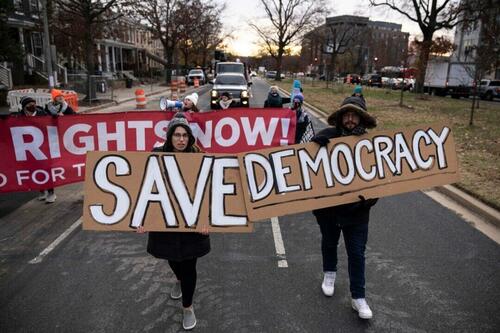
Throughout the world, “democracies” now see themselves beset by the internal competition for office by career politicians whose goal, before all else, is to attain and retain power. The compromises of dignity, nobility of purpose, and service to the electorate are the hallmarks of the age. These compromises have led to the thing aspiring politicians once saw as the bane of human existence: autocracies or, worse, rampant and totalitarian tyrannies. But autocracies cloak themselves with the language of democracy.
Just as Africa, freed now from the coercion of major external powers, has resorted to removing governments by force, we see politicians in power using their office to suppress, deter, or remove their challengers for office.
The Communist Party of China (CCP) introduced the concept of “lawfare” to outmaneuver its domestic and international opponents: using legal mechanisms to constrain an adversary. This concept has been adopted vigorously by “democratically elected politicians” worldwide, so there are now few societies where “lawfare” is not used to eliminate legitimate opponents and constrain and channel society at large.
The spirit of democracy is nowhere to be seen.
Waste no time on mourning. Democracy has had its day and will return when the time is right.
But, equally, waste no time nurturing the self-delusion that moral or intellectual superiority lies in the pretense of democracy, the pretense that societies still embody what they once set out to represent. But we, most of us, insist on our certainty of the moral superiority of our own society because we have nowhere else to go. We cannot embrace our historical or geopolitical opponents’ rights to their own certainties.
But we do not know how best to reorganize our own society without the unthinkable collapse of that same democracy to force our actions.
The birth and death of states have been a preoccupation of scholars since humanity began to structure into durable communities. In 2006, I created—with the help of Greek Cypriot scholar Marios Evriviades—the words “cratocide” (the murder of nations) and “cratogenesis” (the birth of nations) for the book, “The Art of Victory.” Shortly afterward, we added the word “cratometamorphosis” to describe the total reorganization of societies.
Collapse is always the prerequisite to “cratometamorphosis.” Theoretically, this reorganization and revitalization of society should be feasible before total collapse creates a situation when no other option is available. But the very safeguards we have put in place over decades and centuries to protect our present structures also safeguard the corrupted wreckage they have become.
So if, as it appears, many societies—and by no means only those that thought of themselves as democratic—are waiting painfully for that total collapse so that they may be free to recreate themselves “closer to the heart’s desire,” then why is little thought given to that future society, that utopia?
During the years of difficulty that beset so many during the Industrial Revolutions, new concepts were conjured, speculatively, out of whole ideals. There were also years of uncertainty in societies in flux, during which new belief systems were devised.
These religions and ideologies all rippled down the ages and continue to inspire followers, often in the face of historical evidence that they failed here and there but were never revised to truly meet new requirements. Indeed, modern democracy itself—mirroring several iterations in the Hellenic states and earlier in the Indus Valley civilizations over the past 10,000 years—was just such a “revivalist creed,” and its new advocates failed to understand (or even question) why, in its earlier iterations, it had ultimately collapsed.
Is it possible that at our present impasse, there is some belief that technology—artificial intelligence, quantum computing, and so on—will define or create a new social framework? Have we, in so embracing “technology,” outsourced responsibility for devising ways in which humans can best work together? Certainly, technology has enabled the implementation of mass guidance of vast numbers of the human population, like the “murmuration of starlings,” the uncanny, but now understood, mass coordination of flocks of starlings in flight.
This “mass guidance” of humans is the mass psychosis tendency, a fundamental self-protection mechanism in human behavior designed to create herd protection.
That mass psychosis, of course, is what we saw during the COVID-19 crisis. However, it presupposes that human societies can be made to walk willingly and fatalistically toward the scenario outlined in the book, “1984,” by George Orwell. It may be man’s good fortune that economic dislocations—now being evidenced in the tremblors that shake the values of currencies and the viability of major economies—will gradually erode the pace of technological progress, enabling human society to regroup on more elemental or human lines.
To “start again” with new concepts for societal organization—governance—will inevitably involve considering concepts that, whether we realize it or not, have probably been played out before. However, it would be ideal to recognize that the framework begins with the sovereignty of each individual and the requirement for each individual to respect each other individually to achieve progress and human reproduction.
At least that optimistic framework can reemerge for a while until we see politics once more fatalistically reach the point where all respect is once again lost, and the desire for power outweighs the desire for societal wellbeing.
*********
(TLB) published this article by Gregory Copley as posted at The Epoch Times and ZH
Header featured image (edited) credit: Demonstration/org. ZH article insert
Emphasis added by (TLB)
••••

••••
Stay tuned to …

••••
The Liberty Beacon Project is now expanding at a near exponential rate, and for this we are grateful and excited! But we must also be practical. For 7 years we have not asked for any donations, and have built this project with our own funds as we grew. We are now experiencing ever increasing growing pains due to the large number of websites and projects we represent. So we have just installed donation buttons on our websites and ask that you consider this when you visit them. Nothing is too small. We thank you for all your support and your considerations … (TLB)
••••
Comment Policy: As a privately owned web site, we reserve the right to remove comments that contain spam, advertising, vulgarity, threats of violence, racism, or personal/abusive attacks on other users. This also applies to trolling, the use of more than one alias, or just intentional mischief. Enforcement of this policy is at the discretion of this websites administrators. Repeat offenders may be blocked or permanently banned without prior warning.
••••
Disclaimer: TLB websites contain copyrighted material the use of which has not always been specifically authorized by the copyright owner. We are making such material available to our readers under the provisions of “fair use” in an effort to advance a better understanding of political, health, economic and social issues. The material on this site is distributed without profit to those who have expressed a prior interest in receiving it for research and educational purposes. If you wish to use copyrighted material for purposes other than “fair use” you must request permission from the copyright owner.
••••
Disclaimer: The information and opinions shared are for informational purposes only including, but not limited to, text, graphics, images and other material are not intended as medical advice or instruction. Nothing mentioned is intended to be a substitute for professional medical advice, diagnosis or treatment.



I keep thinking of how many years China has never been able to gain democracy. And with today’s tech, Artificial Life and Intelligence, they have the upper hand. Imagine if Hitler had this technology, we’d all be speaking German. AI will split us from our own humanity. I do hope the pendulum will swing the other way, but I’m not optimistic. They’ve had their plans and people in position for a very long time and China, Trilateral commission and the WEF are front and center. No one is coming to save us. And we’re always playing ‘catch up’ to their orchestrated plans.