

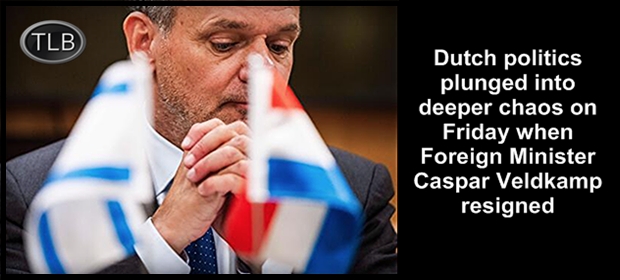
Dutch Foreign Minister Veldkamp Resigns Over Israel’s Genocide in Gaza
Veldkamp, a former Ambassador to Israel, recently called for stronger actions against Israel due to its military actions in Gaza and West Bank settlements. After a Dutch cabinet meeting failed to reach a consensus on further measures, he chose to resign,

Dutch politics plunged into deeper chaos on Friday when Foreign Minister Caspar Veldkamp resigned, expressing his frustration over the failure to implement new sanctions against Israel. His departure, which came after a heated cabinet meeting, led his party, the New Social Contract (NSC), to exit the governing coalition, exacerbating the nation’s political crisis.
Veldkamp, a former Ambassador to Israel, recently called for stronger actions against Israel due to its military actions in Gaza and West Bank settlements. On Thursday, he advocated for more sanctions, criticising Israel’s actions as ‘iron-fisted’ and against international law, but after a cabinet meeting failed to reach a consensus on further measures, he chose to resign, stating that he “felt limited in pursuing the direction he believes is essential as foreign minister.” In the Netherlands, public protests have surged, with The Hague seeing its largest demonstrations in two decades, demanding sanctions against Israel and humanitarian access for Gaza. The urgency intensified after the UN (IPC) declared a famine in the region, blaming Israel for obstructing aid deliveries.
DOCUMENT: IPC FAMINE REVIEW COMMITTEE: GAZA STRIP, AUGUST 2025 – Conclusions and Recommendations CLICK HERE FOR DOC VIEW>>> (Source: IPC)
The resignation of Dutch Foreign Minister Veldkamp comes amid growing domestic and international pressure on Western governments to address Israel’s military actions in Gaza. Last month, The Hague declared far-right Israeli ministers Itamar Ben-Gvir and Bezalel Smotrich as persona non grata for inciting violence, promoting illegal settlements, and endorsing ethnic cleansing rhetoric. Last week, the Netherlands joined 20 nations in condemning Israel’s new West Bank settlement project as “unacceptable and against international law.” Veldkamp argued that further actions were needed. Proposed EU measures include suspending Israel from a €900 million science initiative, imposing trade restrictions, and banning visas for certain Israeli officials. However, the EU has struggled to reach a consensus, with some member states opposing sanctions.
Veldkamp’s resignation is sending a strong message to Prime Minister Dick Schoof’s already fragile government, weakened by the June exit of Geert Wilders’ far-right Freedom Party (PVV). With another coalition partner gone, Schoof faces diminished parliamentary support, nearly a month away from the October 29 national election.
It’s refreshing to witness that there are still politicians in Europe who possess a moral compass and integrity, refusing to link their names and political affiliations to Israel’s actions in Gaza, which many International human rights organisations have characterised as genocide…
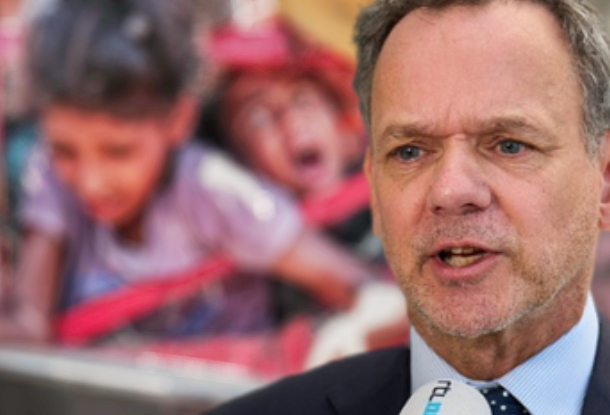
Siphiwe Dlamini reports for Cape Flats…
Dutch Government Fractures as Ministers Resign Over Israel Sanctions Refusal
A rift in the Dutch caretaker government has escalated into a full-blown political crisis following the dramatic resignation of two senior ministers over the coalition’s refusal to take punitive action against Israel’s military operations in Gaza.
Dutch Foreign Minister Caspar Veldkamp, alongside Minister for Foreign Trade Hanneke Boerma, has exited the caretaker coalition, a move that has left the governing bloc with just 32 of the 150 seats in the Dutch House of Representatives. The departure of both ministers, members of the Social Contract Party (NSC), underscores deep divisions within the government over the country’s stance on Israel’s ongoing campaign in Gaza.
The NSC made its position public in a statement issued on Friday, citing Israel’s intensifying bombardment of Gaza as the tipping point.
“Additional measures” were sought against Israel in light of the “increasingly deteriorating humanitarian situation in Gaza,” the statement read.
While the NSC pushed for decisive steps—including a proposed import ban on goods produced in Israeli settlements located in occupied Palestinian territories—its coalition partners refused to endorse such sanctions. This disagreement led the NSC to formally withdraw from the governing coalition, as confirmed by the Dutch foreign ministry on Saturday.
“After a meeting of the cabinet on the situation in Gaza,” the ministry noted, “the Social Contract (NSC) party, of which both officials are members, decided to withdraw from the caretaker coalition government.”
The resignation of Veldkamp is particularly striking given his diplomatic background. As a former ambassador to Israel, his views carry weight in shaping the Netherlands’ foreign policy towards the region. His advocacy for economic measures, including the banning of imports from Israeli settlements, was seen as an attempt to align the Netherlands with growing international concern about Israel’s conduct in Gaza.
“After weighing the moral, legal, and humanitarian consequences, I could no longer justify remaining part of a government that refuses to act”
Veldkamp reportedly told aides prior to his resignation, according to insiders familiar with the cabinet deliberations. While that quote was not officially published, his party’s website makes clear that the decision was not made lightly.
The international backdrop to this political fallout is increasingly volatile. The Israel Defense Forces announced earlier this week that it had launched an operation to assert full control over Gaza City, signalling an escalation of its military campaign. The military conflict was triggered by a Hamas attack on southern Israel on 7 October 2023, in which approximately 1,200 people were killed and 250 taken hostage.
In response, Israeli forces have conducted widespread air and ground operations across Gaza. According to the Hamas-run health authorities in Gaza, over 62,000 people—most of them civilians—have been killed since the Israeli offensive began. These figures have drawn widespread international condemnation and renewed calls for diplomatic and economic measures against Israel.
The Netherlands had already taken some steps before the ministers’ resignations. In July, Amsterdam declared two hardline Israeli ministers persona non grata, signalling disapproval of Israel’s settlement policies. More recently, the Netherlands joined 20 other countries in signing a declaration denouncing Israel’s plans to build new settlements in the occupied West Bank.
Meanwhile, the global diplomatic climate continues to shift. European Union member states, traditionally aligned with Israel, are beginning to reconsider their policies. Spain’s Foreign Minister, Jose Manuel Albares, called in June for the European Union to “immediately suspend” the EU–Israel association agreement and impose a ban on arms sales to Israel. Such calls have grown louder as the humanitarian toll in Gaza rises.
The United Kingdom and France, among other Western powers, have also begun signalling a potential shift. Increasingly, these nations are expressing openness to formally recognising Palestinian statehood—an idea that had long been considered politically sensitive in Western capitals.
Against this turbulent backdrop, the resignations from the Dutch cabinet take on deeper significance. They reflect not just a domestic political rupture, but a wider reassessment among Western governments of their historic alliances and diplomatic priorities in the Middle East.
Though the Dutch government now finds itself weakened and facing the challenge of maintaining even a symbolic governing presence, the message from the resigning ministers is clear: silence and inaction are no longer acceptable responses to a humanitarian crisis of this scale.
__________
(TLB) PUBLISHED THIS REPORT FROM 21WIRE
SUPPORT INDEPENDENT MEDIA – BECOME A MEMBER @21WIRE.TV &VISIT OUR TELEGRAM CHANNEL
Header featured image (edited) credit: Org. post content. Emphasis & editing added by (TLB)
••••

••••
Stay tuned…

••••
The Liberty Beacon Project is now expanding at a near exponential rate, and for this we are grateful and excited! But we must also be practical. For 7 years we have not asked for any donations, and have built this project with our own funds as we grew. We are now experiencing ever increasing growing pains due to the large number of websites and projects we represent. So we have just installed donation buttons on our websites and ask that you consider this when you visit them. Nothing is too small. We thank you for all your support and your considerations … (TLB)
••••
Comment Policy: As a privately owned web site, we reserve the right to remove comments that contain spam, advertising, vulgarity, threats of violence, racism, or personal/abusive attacks on other users. This also applies to trolling, the use of more than one alias, or just intentional mischief. Enforcement of this policy is at the discretion of this websites administrators. Repeat offenders may be blocked or permanently banned without prior warning.
••••
Disclaimer: TLB websites contain copyrighted material the use of which has not always been specifically authorized by the copyright owner. We are making such material available to our readers under the provisions of “fair use” in an effort to advance a better understanding of political, health, economic and social issues. The material on this site is distributed without profit to those who have expressed a prior interest in receiving it for research and educational purposes. If you wish to use copyrighted material for purposes other than “fair use” you must request permission from the copyright owner.
••••
Disclaimer: The information and opinions shared are for informational purposes only including, but not limited to, text, graphics, images and other material are not intended as medical advice or instruction. Nothing mentioned is intended to be a substitute for professional medical advice, diagnosis or treatment.



Leave a Reply