

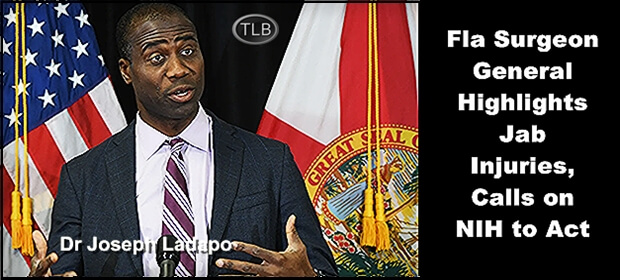
Florida Surgeon General Highlights Vaccine Injuries, Calls on NIH to Act
I had the opportunity to participate first-hand. That’s how we know legacy media outlets bury the lead. ~James Lyons-Weiler, PhD
July 17, 2025, Tampa Florida
At a press conference at Florida State University in Tampa Florida, Florida Surgeon General Dr Joseph Ladapo made an urgent call for the NIH program funding to help Americans injured by COVID-19 vaccines and expressed support for the May federal changes in the HHS’s restrictive COVID-19 vaccine recommendations.

James Lyons-Weiler, PhD reports on Substack
On the Ground in Tampa: What Ladapo Really Said
I attended as invited to Florida Surgeon General Dr. Joseph Ladapo’s press conference in Tampa on July 17, 2025. In contrast to how some mainstream outlets later portrayed it, the event centered on a call to recognize and research COVID-19 vaccine injuries, rather than a mere anti-vaccine screed. Dr. Ladapo – a physician and Florida’s top health official since 2021 – emphasized the urgent need to support those suffering adverse effects from mRNA COVID-19 shots. He praised recent federal moves to scale back mRNA vaccine recommendations for certain groups, but went further by asserting that these products “should not be used in any human beings” given their safety profile. From my front-row perspective, Ladapo’s tone was measured yet resolute. He recounted how unusual it is, in his experience, to encounter so many post-vaccination issues. “When was the last time that you had a vaccine that literally almost every single person knows someone who had a bad reaction from it?” Ladapo asked pointedly.
Before the COVID era, he noted, he never personally knew a patient who was clearly vaccine-injured. “Now,” he continued, “there are very few people that I run into who either themselves have not had a bad reaction from these mRNA COVID-19 vaccines, or who don’t know someone who’s had a bad reaction”.
This was a striking report that hung in the air – one supported anecdotally by nods from some attendees sharing their own stories. Ladapo stressed that adverse reactions have become distressingly commonplace, and he even bluntly called the COVID shots “terrible vaccines” as a result
Ladapo’s Call to Action: Fund Research & Care for the Vaccine-Injured
Rather than simply condemning the vaccines, Dr. Ladapo dedicated much of his speech to advocating for the victims of vaccine injury. He applauded Health Secretary Robert F. Kennedy Jr.’s May announcement removing mRNA COVID-19 shots from recommended use in healthy kids and pregnant women – a policy Florida itself adopted earlier.
But crucially, Ladapo said this must be followed by concrete support for those already harmed. He called on federal agencies, especially the National Institutes of Health (NIH), to expand their research into vaccine injuries and long-term post-vaccine complications. “Today, I want to call on the federal government, [on] NIH, to expand the work that they are doing in long COVID to genuinely and wholly include vaccine-injured people – specifically, people who have been injured by mRNA COVID-19 vaccines,” Ladapo urged. In his view, resources devoted to “long COVID” should equally address post-vaccine syndromes, which many believe share overlapping symptoms and mechanisms. Ladapo outlined areas where federal leadership is needed: funding clinical care for vaccine injury patients, and scientific studies to understand and mitigate these conditions.
“We need to study this better,” he insisted, “We need to fund physicians who are caring for these patients clinically and who are doing scientific work in this area”
The Surgeon General’s message was clear: people suffering adverse effects – whether myocarditis, neurological issues, autoimmune reactions, or other chronic post-vaccine syndromes – deserve acknowledgment and a commitment of research dollars toward treatment and recovery. Florida’s stance, as presented by Ladapo, is that public health authorities have a responsibility to those individuals, just as much as to those affected by COVID-19 itself. It’s worth noting that Dr. Ladapo’s own background as a physician informed his plea. He remarked that since receiving his M.D. in 2008 and treating countless patients, he had never encountered the volume of serious vaccine-related injuries that he sees now.
Real-world observation aligns with reports from other doctors now specializing in COVID vaccine injury. This formed the basis of his argument that federal health agencies must take action: the scale of the issue appears unprecedented and thus demands urgent attention. Key points from Ladapo’s address:
mRNA Vaccine Guidance: He praised the revised federal guidance (announced by RFK Jr. at HHS) that no longer recommends mRNA COVID-19 vaccines for healthy children and pregnant women, noting Florida led on this policy years prior
Ladapo expressed hope that this would lead to even broader caution. “These products… should not be going into human beings,” he said bluntly.
Widespread Adverse Reactions: Ladapo reported that adverse reactions from the COVID shots are far more common than any previous vaccine, to the point that “almost everyone” knows someone who suffered a bad reaction.
He cited his own clinical experience to illustrate an alarming frequency of vaccine injuries ranging from cardiac events to autoimmune conditions.
NIH’s Role: A major call to action was directed at the NIH and federal research programs. Ladapo urged that ongoing Long COVID studies be expanded to fully include COVID vaccine injury cases – integrating those patients into research cohorts and data collection.
This would help determine mechanisms and potential remedies for post-vaccination syndromes.
Support for Patients and Doctors: Ladapo emphasized the need to fund physicians and clinics caring for vaccine-injured patients, as well as basic research. In practice, this could mean grant programs for studying treatments (for example, therapies to mitigate spike protein-related pathology) and establishing specialized centers of excellence for post-vaccine injury care
Such support is currently lacking at the federal level.
Media Spin vs. What Was Actually Said
Despite the substance of Dr. Ladapo’s remarks focusing on research and patient welfare, coverage in many mainstream media outlets largely framed the press conference as Florida doubling down on an “anti-vaccine” stance. Initial headlines highlighted Ladapo “reiterating” his opposition to COVID vaccination and praising RFK Jr., which is true, but they often omitted the nuanced context and his appeals on behalf of injured patients. For instance, local news reports noted Ladapo’s quote that “[t]hese products should not be used in any human beings” and that he claimed mRNA shots have caused “bad reactions and adverse health conditions for many people.
However, some outlets swiftly countered his statements with commentary from other experts and cast them as dubious. In an NPR-affiliated report, a representative of the American Academy of Pediatrics condemned Ladapo’s message, saying “we are not going to just throw out decades of science and research… just because of one person or a group of people… spreading conspiracy theories about the danger [of vaccines]”
This kind of response, featured prominently in mainstream coverage, suggests that Ladapo’s concerns were portrayed as fringe or unfounded, rather than as legitimate calls for investigation. Such pieces tended to focus on the controversy of a Surgeon General questioning vaccine safety, while downplaying the specifics of his NIH research request. The press conference’s primary purpose – urging federal support for the vaccine-injured – was often lost in translation in MSM coverage.
It is important to clarify that Dr. Ladapo did not merely tell Floridians “don’t get vaccinated” and walk off. In fact, much of his briefing was forward-looking: he wants the federal government to acknowledge injuries and help devise solutions. By glossing over that aspect, some media coverage misrepresented the thrust of Ladapo’s message. Instead of grappling with his assertion that large numbers of people are suffering real medical issues post-vaccination – an assertion that could be either validated or refuted with data – headlines largely reinforced a pre-existing narrative of Ladapo as a vaccine skeptic. To be sure, Ladapo’s claims are denied in the broader medical community.
Many experts try to dispute Ladapo’s implications that the vaccinated are at higher risk of illness; Ladapo cited data showing that the most heavily boosted individuals may be at highest risk for COVID complications.
The debate over vaccine risk/benefit thus looms in the background. But regardless of where one stands on that issue, the Surgeon General’s appeal for research funding to study those who have been injured is a concrete policy ask – one that, notably, does not undermine vaccination campaigns, but rather seeks to help a minority of patients in need. This distinction was largely muddied by the way mainstream reports filtered his remarks.
Echoes from Dr. Pierre Kory and Frontline Physicians
Dr. Ladapo is not alone in raising these concerns. Other physicians known for treating COVID vaccine injuries have been making similar appeals for recognition and resources. One prominent voice is Dr. Pierre Kory, a critical care specialist.. Dr. Kory was at the Tampa press conference, and his work directly intersects with Ladapo’s points. After early advocacy for COVID treatments, Kory in recent years has focused on patients suffering lingering complications after vaccination. He co-founded a practice in early 2022 dedicated to evaluating and treating vaccine injury syndrome and long COVID
The volume of patients they’ve seen underscores the prevalence Ladapo alluded to. “Scott [Marsland] and I have now seen well over 900 patients who are chronically ill after receiving the Covid-19 mRNA injections or suffering with Long Haul Covid,” Kory reported in late 2023, noting roughly 70% of their cases are post-vaccine injury (“Long Vax”) versus 30% Long COVID.
This ratio, he says, has grown in favor of vaccine-injury cases over time as more people seek help. Such figures suggest that thousands of Americans may be experiencing serious post-vaccination health issues, even if exact incidence rates are still unknown. Dr. Kory has publicly echoed Ladapo’s sentiment that these patients are being overlooked. He has been outspoken about the lack of support from mainstream medical institutions. In one commentary, Kory shared a chilling report: a neurologist at a respected hospital privately admitted to a vaccine-injured patient that “our whole practice is full of vaccine injuries but we are not allowed to talk about it”
This underscores a climate in which many doctors observe the phenomenon yet feel constrained from speaking out or coding these cases as vaccine-related. Kory and others in the medical community who do not deny vaccine injury argue that this culture of silence further harms patients, who are often dismissed or misdiagnosed (frequently written off with “functional” disorders) rather than given proper care. Indeed, Kory describes many of his patients being gaslighted by physicians before finding his clinic
In the wake of HHS Secretary RFK Jr.’s policy changes and Dr. Ladapo’s statements, Dr. Kory has applauded efforts to bring vaccine injuries to light. On social media, Kory recently praised Robert F. Kennedy Jr. for “killing Big Pharma’s grift” piece by piece – implying that exposing vaccine safety problems and adjusting policy accordingly is a blow to pharmaceutical interests.
While a strongly worded take, it aligns with Ladapo’s implication that there has been a systematic downplaying of vaccine harms. Both Ladapo and Kory assert that acknowledging injuries is not only a matter of scientific honesty but also a step toward remedies. Kory has called the suffering of vaccine-injured patients “one of the most dispiriting aspects” of the pandemic era for clinicians, noting that many were previously healthy, high-functioning individuals now left disabled.
The resonance between Ladapo’s and Kory’s messages is significant. One, a state public health official, and the other, a private physician and COVID treatment pioneer, are both shining a light on the human toll of adverse vaccine reactions. They converge on a key point: officialdom must not ignore these medical conditions. Whether one views their stance as controversial or prescient, their calls raise questions about how health authorities like NIH allocate attention and funds. Notably, in the same press conference Ladapo mentioned, “long COVID” research has received substantial federal funding, and he argues vaccine injuries should be studied under a similar framework
Dr. Kory and colleagues, for their part, have been compiling case series and publishing treatment guidance for post-vaccine syndrome, but much of this work is happening outside of mainstream research channels
Greater NIH involvement could lend resources and credibility to understanding these phenomena.
The NIH’s Responsibility and Path Forward
A summary-level takeaway from the Tampa event is a pointed question: What is the responsibility of agencies like the NIH when it comes to vaccine injuries? Dr. Ladapo explicitly placed the onus on the federal health establishment to “genuinely and wholly include” the vaccine-injured in its research programs
This is a call for inclusion – treating those patients as worthy of study, care, and compassion. For NIH, this could mean funding dedicated studies on post-vaccination myocarditis, neurological complications, autoimmune reactions, and recovery strategies. It could mean creating registries for those with suspected vaccine injury and following their outcomes, just as long COVID cohorts are tracked. Essentially, Ladapo is urging NIH not to leave this subset of patients behind, especially as the federal government has invested billions in vaccine deployment; a fraction of that investment, he argues, should now go toward mitigation and treatment of any unintended effects. From a medical ethics standpoint, many would agree that if even a small minority of people are hurt by a public health intervention, there is an ethical duty to understand and address that. Vaccine injuries may be statistically rare (exact rates are debated), but they are no less real for those afflicted. Ladapo’s appeal, backed by voices like Kory’s, is that public health authorities must actively care for those individuals, not marginalize them. This doesn’t require abandoning vaccination programs for the majority; it requires a parallel effort to make whole those who drew the short straw on the risk curve. In practical terms, that could involve specialized treatment clinics, research into therapies (from immunosuppressants to novel drugs that might neutralize lingering spike protein, for example), and proper acknowledgement of vaccine injury syndromes in medical literature and education. As of this writing, it remains to be seen how the NIH and federal government will respond. Will they expand long-COVID studies to explicitly incorporate vaccine-adverse events, as Florida’s Surgeon General demands? Early signs are mixed. The Health and Human Services leadership under RFK Jr. has already signaled a more skeptical stance on mRNA vaccines for low-risk groups, suggesting some openness to evaluating safety signals anew.
However, institutional inertia and fear of fueling vaccine hesitancy have made agencies cautious about prominently investigating harms.
In Tampa, Dr. Joseph Ladapo delivered a message that the mainstream narratives largely sidelined: that caring for the vaccine-injured is now an urgent public health priority. Those of us who were present heard not just criticism of vaccines, but a compassionate plea to help people who “did the right thing” per societal guidance yet ended up with lasting health issues. “We need to fund physicians… and do scientific work in this area,” he reported, effectively asking the country’s medical establishment to step up.
Time will tell if that call is heeded. For now, Ladapo’s stance – controversial as it may be – shines a spotlight on patients who often suffer in the shadows. And as Dr. Pierre Kory and others affirm, shining that spotlight is the first step toward bringing those patients the understanding, treatments, and hopefully recovery that they desperately need.
_________
Header featured image (edited) credit: (PAUL HENNESSY/SOPA IMAGES/LIGHTROCKET VIA GETTY IMAGES). Emphasis added by (TLB)
••••

••••
Stay tuned…

••••
The Liberty Beacon Project is now expanding at a near exponential rate, and for this we are grateful and excited! But we must also be practical. For 7 years we have not asked for any donations, and have built this project with our own funds as we grew. We are now experiencing ever increasing growing pains due to the large number of websites and projects we represent. So we have just installed donation buttons on our websites and ask that you consider this when you visit them. Nothing is too small. We thank you for all your support and your considerations … (TLB)
••••
Comment Policy: As a privately owned web site, we reserve the right to remove comments that contain spam, advertising, vulgarity, threats of violence, racism, or personal/abusive attacks on other users. This also applies to trolling, the use of more than one alias, or just intentional mischief. Enforcement of this policy is at the discretion of this websites administrators. Repeat offenders may be blocked or permanently banned without prior warning.
••••
Disclaimer: TLB websites contain copyrighted material the use of which has not always been specifically authorized by the copyright owner. We are making such material available to our readers under the provisions of “fair use” in an effort to advance a better understanding of political, health, economic and social issues. The material on this site is distributed without profit to those who have expressed a prior interest in receiving it for research and educational purposes. If you wish to use copyrighted material for purposes other than “fair use” you must request permission from the copyright owner.
••••
Disclaimer: The information and opinions shared are for informational purposes only including, but not limited to, text, graphics, images and other material are not intended as medical advice or instruction. Nothing mentioned is intended to be a substitute for professional medical advice, diagnosis or treatment.



Leave a Reply