
Silicon Valley, a Proxy State Orchestrating Regime Change in Iran
The Tech-Colony Complex
Freddie Ponton
21st Century Wire
In Tehran, the streets are tense, the internet is down in many places. In a bid to try and stem a foreign-backed destabilisation operation, Iranian government has imposed a nationwide blackout, cutting citizens off from information, communication, and the outside world. Yet while state authorities scramble to maintain control, Silicon Valley quietly undermines sovereignty. Smuggled Starlink terminals from SpaceX beam uncensored internet into homes and streets, letting protesters livestream events, coordinate actions, and access unblocked platforms, a lifeline aligned with U.S. and Israel strategic objectives. This is not philanthropy. It is corporate-enabled geopolitical intervention.
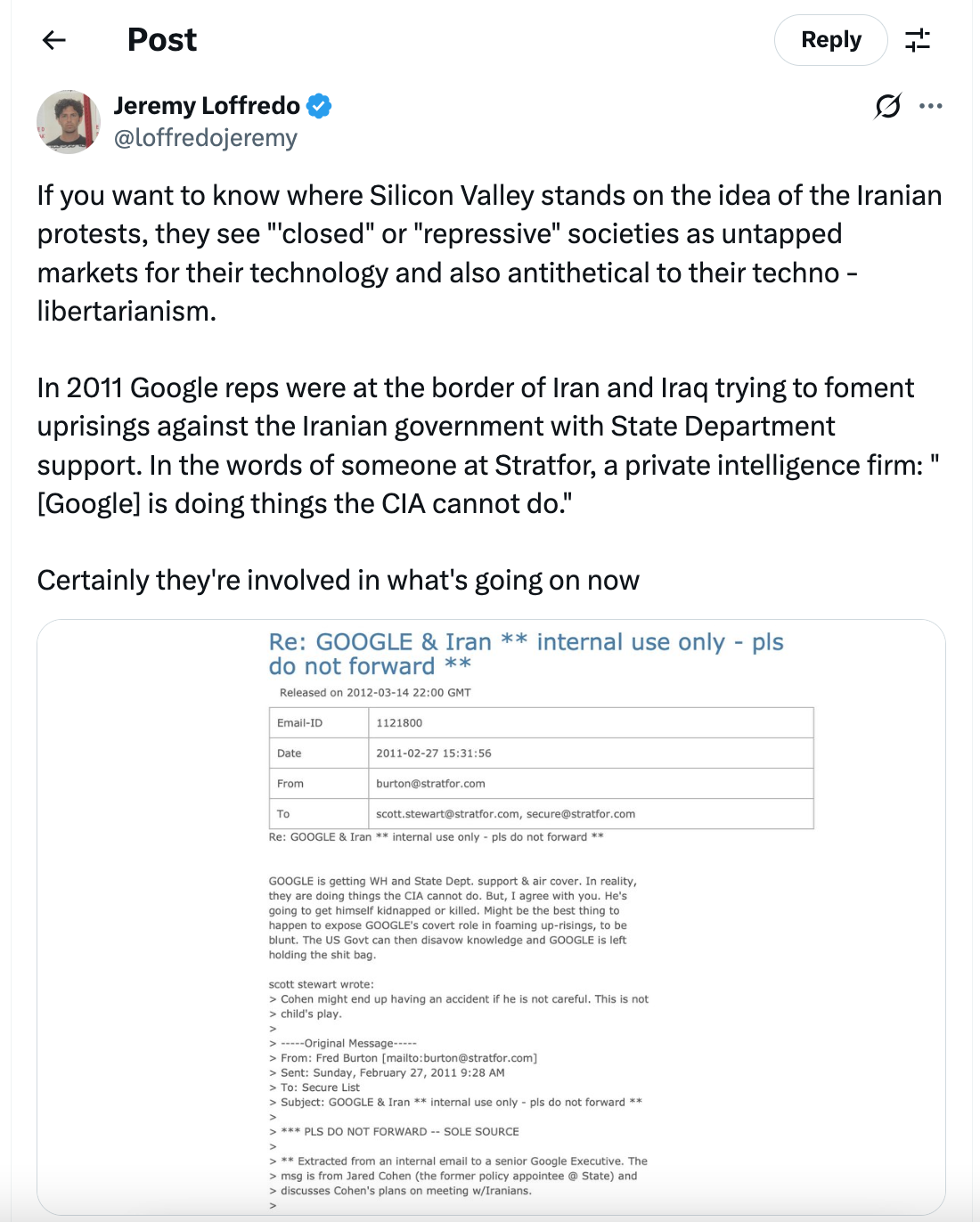
A 2011 Stratfor email, disclosed by journalist Jeremy Loffredo on X, reveals that in 2011, Google, under Jared Cohen’s Google Ideas (Google’s “civic tech” incubator), explored how social media fuels modern “color revolutions” (protests/uprisings) by amplifying US-funded ‘citizen journalism’, which became Jigsaw in 2016, was operating at the Iran–Iraq border doing “what the CIA cannot do,” allegedly with tacit support from the White House and State Department. Jigsaw was and still is dedicated to applying technological solutions, which can be used in operations aimed at countering extremism, online censorship, and cyber-attacks to protect (or control) access to information.
“The Internet Is The Oxygen, Of The Free Iran Movement” said Yasmin Green, CEO Jigsaw at Google, Advisor to Iranian Diaspora Collective on Connectivity (Source Iranian Diaspora Collective)
In other words, where intelligence agencies are constrained by law, corporate actors move with impunity, using advanced technologies, social media, activist networks, and encrypted communications to shape the political fate of a sovereign nation. (Note that the post on Jeremy Loffredo’s X account (@loffredojeremy) that included the Stratfor email has since been taken down, though we captured it via screenshot.)
Long before today’s unrest, Cohen and Google Ideas were theorising and operationalising a model in which connectivity and digital tools could be weaponised to accelerate political upheaval under the guise of democracy. Every viral hashtag, encrypted message, and trending narrative can become part of a covertly orchestrated architecture of influence, tilting power, mobilising dissent, and reshaping the political landscape.
Even beyond Iran, major tech companies, including Google, Microsoft, Amazon, and Meta, have faced allegations that their infrastructure and AI services have been co-opted into Israeli military and surveillance operations in Gaza, enabling targeting and control of civilian populations. This underscores that Big Tech does not exist in a vacuum; its platforms are instruments of geopolitical strategy.
The Machinery of Influence: Movements.org and Israel
One striking example illustrates how thin the line is between activism and state power. David Keyes, an Israeli-American public relations representative who led the so-called human-rights platform Movements.org (Alliance for Youth Movements), worked closely with and received support from Google Ideas under Jared Cohen. Movements.org presented itself as a neutral hub for activists, offering training, networking, and amplification through Western tech infrastructure, but in practice, it became a pipeline for influence.
Keyes later became foreign media advisor to Israeli Prime Minister Benjamin Netanyahu, overseeing Israel’s international communications strategy. In that role, he ran direct messaging campaigns targeting Iranian audiences, including Farsi-language outreach framed as solidarity with Iranian protesters.
This trajectory reveals a crucial truth: digital activism, tech philanthropy, and state communications are overlapping networks, not separate spheres. Tools, networks, and narratives incubated under the banner of human rights can be repurposed seamlessly into state-level influence operations, weaponising civil society for foreign agendas.
The point is not that Google Ideas “worked for Israel.” The point is that the ecosystem it built, platforms, activist networks, and strategic communications, can be leveraged by actors with clear geopolitical objectives, Israel among them. Once these infrastructures exist, foreign influence operations become plausible, effective, and deniable, and that is precisely what is currently at play in Iran.
Empowerment or Destabilisation? The Human Cost
It would be easy to frame this as a technical debate, but the stakes are human. Iranian youth, facing economic collapse, hyperinflation, and political repression, now organise through encrypted apps, VPNs, and social media. These tools offer voice, visibility, and agency, yet they also reshape power in ways that escalate tension, accelerate confrontation, and expose citizens to new risks.
The platforms themselves are not neutral. By enabling viral mobilisation and bypassing state censorship, they tilt the playing field, favouring rapid, decentralised dissent over measured negotiation. From Silicon Valley’s perspective, this is empowerment. From Tehran’s perspective, it is destabilisation. From an international perspective, it is a foreign intervention without oversight or accountability.
Beyond software, SpaceX’s Starlink satellites actively bypass Iranian blackouts, giving protesters access to uncensored internet across 31 provinces. Terminals are smuggled, access is reportedly free for limited periods, and connectivity persists despite government jamming. Starlink is not neutral; it is a technological lifeline for dissent aligned with U.S. and Israeli policies promoting “internet freedom,” effectively undermining Iranian control.
Similarly, the U.S. government has urged tech giants, including Google, to support Iranians in circumventing censorship via VPNs, bandwidth, and technical measures—another form of direct interference in Iran’s domestic affairs. Together, these interventions show how technology can be weaponised to advance foreign geopolitical objectives, with ordinary citizens caught in the middle.
Power Without Oversight
The Stratfor email makes one fact unmistakably clear: technology companies now operate in a gray zone of global power, influencing governments, shaping revolutions, and acting with little to no legal or democratic oversight. Intelligence agencies are constrained by law and diplomacy; tech firms are bound only by corporate policy and the occasional PR backlash.
This is regime change without fingerprints. Foreign policy without Congress. Power without consequence. Whether Google, SpaceX, Jigsaw or other tech actors intended to reshape Iran’s political landscape is largely irrelevant; the tools they build, the networks they support, and the philosophy they propagate, embodied in Jared Cohen’s vision of “harnessing social media for revolution“, make them de facto geopolitical actors.
In an article authored by Louise Lee, published on the Graduate School of Stanford Business website, you can read:
“Like most people, Google’s Jared Cohen once thought of Bluetooth as a tool to ‘let you talk and drive at the same time.” But in 2004, as he walked the streets of Shiraz, Iran, he saw its revolutionary potential: Young adults were connecting with one another using the wireless protocol that allows devices within short distances to communicate. When protests broke out over the presidential election five years later, and the government closed down cellular networks, many Iranians used Bluetooth connections to organize and get in touch. As Cohen learned, citizens of countries with restrictions on civil liberties can get very creative. “All of a sudden you start reading the instruction manual,” he told Stanford GSB students January 30. “You start learning how to use every single aspect of a device.”
VIDEO: Jared Cohen: The Changing Nature of Political Transitions (Source: Stanford Graduate School of Business)
The urgent question is no longer theoretical: if private corporations can mobilise populations, shape narratives, and influence sovereign governments, who monitors them? Who bears the cost when their interventions fail or escalate violence? Until this is addressed, Silicon Valley will continue exercising power that rivals states, all under the guise of a “better internet.
The complexity of Mainstream media reporting on these crises is not benign. Western mainstream outlets claim to cover Iran’s unrest, but they filter the story through a Western lens, endlessly quoting U.S. and European officials while ignoring the impact of sanctions, foreign meddling, and digital information warfare. This isn’t just selective reporting; it is a media ecosystem that amplifies U.S. and Israel agendas, flattens the complexity of Iran’s crisis, and turns global news outlets into unwitting, or complicit, tools of geopolitical influence.
_________
(TLB) published this article from 21WIRE
SUPPORT INDEPENDENT MEDIA – BECOME A MEMBER @21WIRE.TV & VISIT OUR TELEGRAM CHANNEL
Header featured image (edited) credit: Org. post content. Emphasis added by (TLB)
••••

••••
Stay tuned…

••••
The Liberty Beacon Project is now expanding at a near exponential rate, and for this we are grateful and excited! But we must also be practical. For 7 years we have not asked for any donations, and have built this project with our own funds as we grew. We are now experiencing ever increasing growing pains due to the large number of websites and projects we represent. So we have just installed donation buttons on our websites and ask that you consider this when you visit them. Nothing is too small. We thank you for all your support and your considerations … (TLB)
••••
Comment Policy: As a privately owned web site, we reserve the right to remove comments that contain spam, advertising, vulgarity, threats of violence, racism, or personal/abusive attacks on other users. This also applies to trolling, the use of more than one alias, or just intentional mischief. Enforcement of this policy is at the discretion of this websites administrators. Repeat offenders may be blocked or permanently banned without prior warning.
••••
Disclaimer: TLB websites contain copyrighted material the use of which has not always been specifically authorized by the copyright owner. We are making such material available to our readers under the provisions of “fair use” in an effort to advance a better understanding of political, health, economic and social issues. The material on this site is distributed without profit to those who have expressed a prior interest in receiving it for research and educational purposes. If you wish to use copyrighted material for purposes other than “fair use” you must request permission from the copyright owner.
••••
Disclaimer: The information and opinions shared are for informational purposes only including, but not limited to, text, graphics, images and other material are not intended as medical advice or instruction. Nothing mentioned is intended to be a substitute for professional medical advice, diagnosis or treatment.



Leave a Reply