


By: William Levin
With Trump’s electrifying victory, Elon Musk’s promise to cut $2 trillion in federal spending takes center stage. To date, the target has not been viewed seriously. With federal discretionary spending, excluding military, at less than a trillion dollars, we are assured that the effort is unrealistic or achievable only by a suicidal attack on Social Security, Medicare, Medicaid, and income protection programs — collectively, entitlements.
That is a mistake. Elon Musk does not speak idly.
President Trump has charged Musk and Vivek Ramaswamy to cut waste and fraud via a newly created Department of Government Efficiency (DOGE). Musk promises that the effort will “send shockwaves through the system.” But that understates what these two generational minds can achieve.
By June 2026, the team will identify billions in misspent money and, more importantly, reimagine the delivery of government services for a generation to come, long after DOGE sunsets. This is the “revolution” deliverable by Musk and Ramaswamy. No effort is more important, or difficult to achieve. Every American — Democrat, Republican and Independent — would personally benefit by earning more, in real dollars, and keeping more of what he earns.
The return to permanent fiscal sanity must be jump-started by DOGE, then continuously implemented by President Trump’s two-term successor. Significant spending cuts are achievable without breaking the promise to Americans on entitlements. To be clear, because the Democrat counter will be savage, 100% of all entitlement programs (Social Security, Medicare, Medicaid, Income Security) in the plan below are preserved and enhanced, increasing at more the twice the rate of inflation. Democrats promise higher entitlement spending, but it is illusory, as the money will be consumed by inflation. (Disclaimer: All forecasts are solely those of the author, not the Trump administration. There are always multiple paths to an objective, and trust fund insolvencies in the 2030s must be addressed separately.)
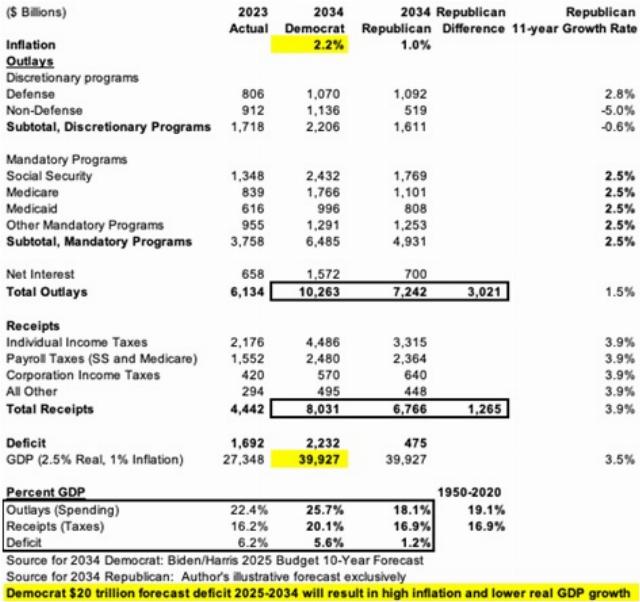
To address feasibility, it is best to start with the most difficult subject: mandatory programs. In budget language, mandatory does not mean fixed, permanent, or unchangeable. It simply means that the spending is required by law. There is no principled difference between discretionary programs, which must be proposed by the president and enacted into law, and mandatory programs, which have been enacted but can be and have been changed by law. In a democratic republic, all spending is a choice among competing alternatives, duly enacted into law.
The real issue is inflation. As American have come to realize, the government’s measure of inflation does not accurately reflect increases in living costs. Take Social Security as the example. One hundred eighty-four million Americans pay from every wage check to support their future retirement, disability, and dependent survivors in a program that currently pays 68 million beneficiaries. With long-term inflation, the wage-earner suffers a decline in living standard during working years, at which point he gets a fixed benefit, indexed to the CPI, which erodes in real value afterward in retirement. Everyone loses, and massively so. Democrats pretend otherwise, but inflation over time equals misery.
America’s road back to health rests on eliminating the monetary pressure that causes inflation. There is no secret here. Reduce federal spending by 1% from historical norms, or from 19.1% of GDP to 18.1% by 2034, while taxes remain at the historical 16.9% GDP limit. Real GDP growth at ultra-low inflation is the only true and sustainable guarantor of entitlement spending. In this economy, entitlement spending can increase every year, at a 2.5% compounded rate, such that real benefits increase faster than inflation (2.5% growth versus 1.0% inflation). Misery is replaced with reward.
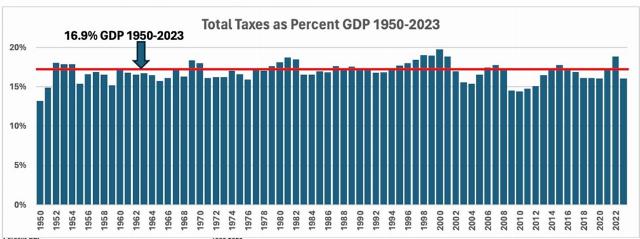
Source: FRED (Federal Reserve Bank of St. Louis)
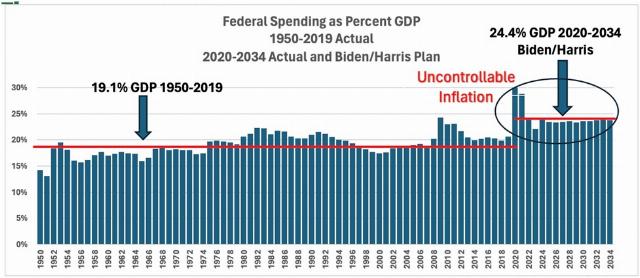
Source: 1950-2023 Fred (Federal Reserve Bank of St. Louis); 2024-2034 Biden/Harris 2025 Budget
In the process, the deficit shrinks dramatically but nonetheless persists, owing entirely to the interest burden of prior overspending. It is the inescapable after-party hangover we all suffer for running interest expense to $1 trillion and rising. The good news is that the deficit increases more slowly than GDP (1.2% versus 3.5%), which over time will lower the federal debt burden.
Priorities require choice. To ensure funding for entitlements, federal discretionary spending must be slashed, matched by an end to over-regulation. As Musk reminds us, there are some 420 federal agencies, a mind-boggling concept, and among the reasons he says cuts will be easy. With respect to the military, the metric is a 21st-century fighting force, not the status quo. Think Tesla efficiency and SpaceX innovation. Post-DOGE, we need far fewer government employees, re-assigned and redirected.
Agencies for decades have assumed, correctly, that they will get more money every year, every budget cycle, and every administration, without regard to purpose, technology, and private-sector alternatives.
The answer is not necessarily to abolish entire departments — even the deserving Department of Education. Change requires diffusion of targets and time rather than concentrated attention on a single target. DOGE will provide the initial shock-and-awe windfall. Beyond that, every federal department, excluding the Department of Defense, needs to manage against a minimum 5% annual drop in budgetary authorization, over a ten-year time horizon. Americans will experience no noticeable impact, as critical programs will be maintained, technology implemented, new approaches realized, and resources shifted to the private sector. The benefit in the aggregate is available funding for entitlements and low inflation, which benefits everyone.
Department spending is target-rich. Much of government spending has quite simply been a failure and needs to stop. Does anyone believe that the $82-billion Department of Education serves “states, school districts and institutions of higher education”? Is the mission of the Agriculture Department to address “housing insecurity,” “environmental justice, “international food security,” and “jobs in clean energy”? Or Health and Human Services spending for “promise to refugees,” “gun violence,” and “evidence-based community violence initiatives”?
Technology and management permit radically improved service with fewer employees, in a government conceptually running on DOS. The Social Security Administration takes 36 minutes to answer a call and a mind-numbing 450 days to process the average disability claim. Agriculture today is a high-tech industry, serving domestic and global demand at low cost, yet the $29-billion Agriculture Department is run like a Depression-era dustbowl spending machine. Western states desperately want and need local control of land use and water rights, but the land is owned by the federal government and grossly mismanaged by the Department of Interior. Above all, spending can be redirected to useful activities and outcome. As one example, education spending on school choice can do more to restore America’s health than billions plowed into corrosive curriculum mandates.
Returning the federal government to historic norms is neither impossible nor radical. All can be achieved with consistent real growth, a strong defense, 5% annual declines in discretionary spending, and 1% long-term inflation due to total spending and taxation within our historical means.
The fight, the challenge, the issue that stands above all is spending, spending, spending.
President Trump, led by Elon Musk and Vivek Ramaswamy, can set America on an amazing journey. In tandem with deregulation, and heading to Mars, of course, optimism will spread far and wide.
But extreme caution is warranted.
The full process takes years to implement, meaning the war is never won. It will require a two-term Republican successor to have permanent impact. Agencies will try to cut the most emotional, headline-grabbing programs rather than reform. Every federal employee fired, every job reassigned, every dollar decline in spending from $6.9 trillion will be shrieked as the end of the world, conveniently forgetting that five years ago, we did just fine spending $4.4 trillion.
Federal spending is the ultimate death struggle for Democrats. The fight will be vicious and unrelenting.

Image via Pixabay.
Also by this Author:
Federal Reserve Taking Us into Uncharted & Deadly Waters
••••
The above article (The Trump-Musk Road to Prosperity) is republished here under “Fair Use” (see disclaimer below article) with attribution to the original articles author William Levin as well as the publishing website americanthinker.com.
TLB Project recommends that you visit the American Thinker website for more great articles and information.
William Levin is the founder and managing director of a NY investment banking firm.
Read more articles and blog-posts by William Levin.
Image Credit: Graphics in Featured Image (top) via Pixabay License.
••••
Checkout TLBTalk.com:
Click Here to Visit the TLBTalk.com Site
••••
Welcome to TLB Project Neighborhood

TLBTalk – ShakeAndWake Radio – TLB Network – The Butcher Shop
••••

••••
Stay tuned to …

••••
The Liberty Beacon Project is now expanding at a near exponential rate, and for this we are grateful and excited! But we must also be practical. For 7 years we have not asked for any donations, and have built this project with our own funds as we grew. We are now experiencing ever increasing growing pains due to the large number of websites and projects we represent. So we have just installed donation buttons on our websites and ask that you consider this when you visit them. Nothing is too small. We thank you for all your support and your considerations … (TLB)
••••
Comment Policy: As a privately owned web site, we reserve the right to remove comments that contain spam, advertising, vulgarity, threats of violence, racism, or personal/abusive attacks on other users. This also applies to trolling, the use of more than one alias, or just intentional mischief. Enforcement of this policy is at the discretion of this websites administrators. Repeat offenders may be blocked or permanently banned without prior warning.
••••
Disclaimer: TLB websites contain copyrighted material the use of which has not always been specifically authorized by the copyright owner. We are making such material available to our readers under the provisions of “fair use” in an effort to advance a better understanding of political, health, economic and social issues. The material on this site is distributed without profit to those who have expressed a prior interest in receiving it for research and educational purposes. If you wish to use copyrighted material for purposes other than “fair use” you must request permission from the copyright owner.
••••
Disclaimer: The information and opinions shared are for informational purposes only including, but not limited to, text, graphics, images and other material are not intended as medical advice or instruction. Nothing mentioned is intended to be a substitute for professional medical advice, diagnosis or treatment.



OBVIOUSLY, the #DeepState SwampRats will be RESISTING again every step. So, can they cut $2 Trillion. THEY MUST AT LEAST TRY! We all know there has to be at least 1/2 Trillion easy and low-hanging fruit (most Grants, a Welfare Reform Bill (even exactly just repass the Gingrich Congress Bill that Clinton FINALLY signed after being shamed after Veto twice, WORKfare), and so many things in WE THE PEOPLE DEMAND LIST (my quasi Contract With America) that I created and have floating around out there and will be Reporting on in 2 parts in Dec. here on TLB. It doesn’t matter if it costs 2 dollars, 2 thousand dollars, 2 hundred thousand dollars, 2 million, 2 hundred million, if it is UNLAWFUL/UNCONSTITUTIONAL it should all be cut and SOONER OR LATER will add up to likely more than $2T in the Budget… And that is a whole other thing in WTPDList —- BUDGETS! No more Continuing Resolution manure!!!