
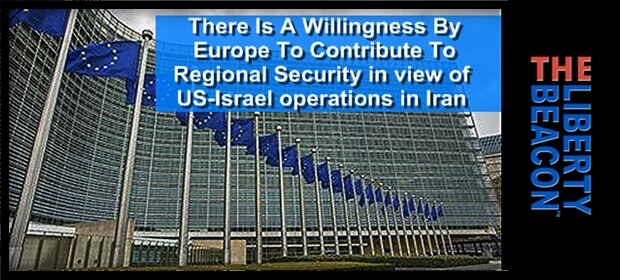
There Is A Growing Willingness By Europe To Contribute To Regional Security
Both Israel and the United States have signalled that their Iran operations will continue for several more weeks…
By Elwin de Groot, head of macro strategy at Rabobank
Losing One’s Innocence
A degree of calm seemed to return to energy and financial markets yesterday, helped by tentative signs – reinforced by US and Israeli statements – that intensified military operations against Iranian targets are degrading Iran’s air defense, missile, and drone capabilities. A US submarine sank an Iranian naval vessel off the coast of Sri Lanka, and, as noted in yesterday’s Global Daily, Kurdish forces appear to have already made limited incursions into Iranian territory.
⭕️This is a crucial indicator of Iran’s remaining and degraded capabilities. There has been a consistent and steep daily decline in the number of launches from Iran. pic.twitter.com/GuDmjsSYAs
— Raylan Givens (@JewishWarrior13) March 3, 2026
Still, there is no clear evidence that the regime is nearing collapse. Both Israel and the United States have signalled that their operations will continue for several more weeks. Given the “fog of war,” any firm conclusions would be premature. Indeed, the closure of the Strait of Hormuz – even if it appears to be a narrow maritime problem – could trigger a cascading, system‑wide global crisis because modern civilization is built on deep, fragile interdependencies. What begins as an energy supply disruption can rapidly spread through petrochemicals, fertilizers, food production, metals, electricity grids, semiconductors, and ultimately state finances and even public order.
Oil prices are stabilizing in a range of $80–85 per barrel, while the European gas benchmark fell below €50/MWh after touching €65 on Tuesday. These moves are not easily tied to specific events, though Trump’s announcement earlier this week – that the US would insure and secure shipping through the Strait of Hormuz – may have supported sentiment. European equities recovered about 1.5%, and government bond yields nudged lower yesterday, where UST’s saw yields rise by 3–4 basis points across the curve. The decline in European yields was more than reversed in early trading today, after reports of new strikes on Iran dampened sentiment again.
Following the attack on a Cypriot airfield earlier this week, NATO intercepted an Iranian ballistic missile launched toward Turkish airspace yesterday. Its apparent trajectory toward the strategic port of Ceyhan – home to a major oil terminal, highlights the widening risk. As the conflict drags on, the number of “innocent bystanders” is likely to shrink.
Indeed, another noteworthy development is the growing willingness of European countries to contribute to regional security. EU foreign policy chief Kaja Kallas already said on Sunday that the EU would reinforce its Gulf naval mission, Aspides, to protect shipping. The list of countries announcing deployments – especially to Cyprus – is expanding and now includes France (taking a lead role), the UK, Germany, and Greece. Italy is coordinating but has not confirmed deployment, while Dutch media report that the Netherlands is also sending a naval vessel.
And, as European leaders try to find the right posture given the developments in the Gulf region, the EU is also trying to make further advancements in other parts of its strategic autonomy agenda.
First, the EU indicated it does not expect the US to raise its universal tariff on EU exports from 10% to 15% this week, despite Treasury Secretary Scott Bessent signalling the increase was imminent. According to Bloomberg, citing individuals familiar with the matter, the EU has received assurances that the US will maintain the 10% rate for the bloc. EU lawmakers have therefore kept the ratification process on hold pending further clarity from Washington and plan to reconvene on 17 March.
A central question, however, is whether the US can legally offer preferential tariff treatment to any specific country or bloc. The current framework is being applied uniformly, and existing exemptions cover only narrow categories of goods. While legal interpretation is ultimately for experts, the statutory language behind Section 122 tariffs supports temporary, non‑discriminatory surcharges – not country‑specific relief. Any deviation could expose the administration to legal challenges, and if courts adhere to the original intent of Section 122 (addressing balance‑of‑payments risks), preferential exemptions may trigger broader complications.
Given this backdrop, the EU’s optimism should be treated cautiously. US “assurances” may simply suggest that alternative tariff mechanisms are being prepared. In the same CNBC interview, Bessent said he believes tariff rates will revert to their previous levels within five months, pointing to potential replacements under Sections 301 and 232.
We published an impact assessment on the new tariff environment for the Eurozone last week –likely overshadowed by Middle East developments – and see no reason to revise our view that a 15% tariff could ultimately apply to EU exports as well.
A second major development was the European Commission’s adoption of the Industrial Accelerator Act, designed to rebuild Europe’s industrial base, accelerate decarbonisation in strategic sectors, reduce external technological dependencies, and strengthen economic security and supply‑chain resilience. Recent volatility in fossil‑fuel markets reinforces the logic behind this push. The Act effectively serves as Europe’s answer to the US Inflation Reduction Act, China’s expanding industrial dominance, and the increasing weaponisation of economic dependencies seen last year.
Strategic sectors initially targeted include steel, cement, aluminium, automotive, and net‑zero technology manufacturing, with the possibility of expanding to additional industries. The goal is to accelerate modernisation, boost clean‑tech adoption, and ensure sufficient EU‑based production capacity to reduce vulnerabilities. The Commission proposes three main channels to achieve this:
- “Made in EU” and low‑carbon requirements in public procurement to stimulate demand for EU‑produced clean industrial goods;
- Simplified and faster permitting to reduce bureaucratic delays;
- Stricter screening of foreign investments, particularly in sensitive sectors.
For investments above €100 million where a single non‑EU country controls more than 40% of global capacity in the relevant sector, the Act introduces additional obligations, including mandatory technology transfer, local‑content requirements, creation of high‑quality jobs, and ensuring at least 50% EU workforce participation. These measures are likely aimed at China.
The Regulation now moves to negotiations between the European Parliament and the Council and may be amended. Politico warns that with numerous last‑minute changes – including dropping certain industries – the legislation risks substantial revision before final adoption. Once in force, however, it could have significant implications for the affected sectors. That the EU is losing its economic innocence does not seem a far-fetched conclusion, we would argue.
___________
Header featured image (edited) crfedit: Open public image. Emphasis added by (TLB)
••••

••••
Stay tuned…

••••
The Liberty Beacon Project is now expanding at a near exponential rate, and for this we are grateful and excited! But we must also be practical. For 7 years we have not asked for any donations, and have built this project with our own funds as we grew. We are now experiencing ever increasing growing pains due to the large number of websites and projects we represent. So we have just installed donation buttons on our websites and ask that you consider this when you visit them. Nothing is too small. We thank you for all your support and your considerations … (TLB)
••••
Comment Policy: As a privately owned web site, we reserve the right to remove comments that contain spam, advertising, vulgarity, threats of violence, racism, or personal/abusive attacks on other users. This also applies to trolling, the use of more than one alias, or just intentional mischief. Enforcement of this policy is at the discretion of this websites administrators. Repeat offenders may be blocked or permanently banned without prior warning.
••••
Disclaimer: TLB websites contain copyrighted material the use of which has not always been specifically authorized by the copyright owner. We are making such material available to our readers under the provisions of “fair use” in an effort to advance a better understanding of political, health, economic and social issues. The material on this site is distributed without profit to those who have expressed a prior interest in receiving it for research and educational purposes. If you wish to use copyrighted material for purposes other than “fair use” you must request permission from the copyright owner.
••••
Disclaimer: The information and opinions shared are for informational purposes only including, but not limited to, text, graphics, images and other material are not intended as medical advice or instruction. Nothing mentioned is intended to be a substitute for professional medical advice, diagnosis or treatment.

Leave a Reply