
[Essay] What to Do As the World Falls Apart: A Framework for Action
NATE HEGANS
This essay is adapted from the Frankly episode posted on March 20th, 2026 titled, “What to Do As the World Falls Apart: A Framework for Action.”
What follows is as much a personal rite of passage as it is a Frankly essay. It will be long, but if you’ve followed the evolution of my work, I ask that you find the time to read it, as it will be a springboard for much of this platform’s future content.
I’ve now spent over twenty years trying to articulate what I’ve come to call the “more-than-human predicament.” The core pillars of this story are known to most of you and yet still mostly unknown to broader society.
The central theme is this: We are near the peak of a one-time Carbon Pulse. An army of 500 billion human-worker-equivalents that cost us pennies, which – when combined with machines – do the vast majority of physical work in our societies. On top of that, we’re burning them over a million times faster than they were created, meaning we’re also drawing down the main bank account supporting our lifestyles.
As we burn this planetary endowment, the waste heat itself is not only trapped, but is accompanied by heat-trapping molecules in the atmosphere. The result will be a spike in global heating that will likely take centuries to fully unfold – and will be anywhere from civilization disrupting to civilization ending in its impacts.
Related but separate from this are the seven of nine Planetary Boundaries that have now been crossed due to the impacts of human industrial activity: plastics, nitrogen and phosphorus cycles, ocean acidification, freshwater depletion, biodiversity loss, ecosystem destruction, and all the interconnected impacts on the web of non-human – and human – life.
We have an economic system that continues to grow, but the gains are more concentrated and increasingly fueled by accelerating financial claims on reality – effectively transmuting wealth into income. We’re increasingly trapped in cycles of addiction, and I mean the institutional kind, not just the personal kind. Supernormal stimuli hijacks our attention and polarizes our politics, and ingroup bias has been amplified to a civilizational scale. And now AI is suddenly on the scene adding a big wild card and all kinds of additional destabilizing risks – and perhaps some opportunities.
I could spend the rest of my life going deeper on any one of these issues. And many people are doing exactly that. This work continues to be important as our culture remains energy blind and systems blind.
But the events of the last few months have changed where I find myself today.

We are in week ten of a war that has reduced the flow of hydrocarbons from the Strait of Hormuz to the rest of the world – or more accurately to the U.S., Israel, and their allies. This is one chokepoint that has, until now, been a mostly peaceful spigot to the rest of the world for hydrocarbons, the benefits of which are indistinguishable from magic on human timescales.
Looking back at all twenty years of my research (some might label it an obsession), all those issues, all those interconnected systems, it all kind of condenses into one simple statement:
Our lifestyles, our institutions, our behaviors, our daily routines, and our expectations about the future are likely going to have to change. Not in the abstract ‘someday,’ but soon.
If you accept the general shape of what I just described as probably true, and I think an honest assessment of current events makes that increasingly hard to avoid, then continuing to primarily shout and point at novel events and ancillary risks becomes sort of a…category error.
The shouting and pointing and describing has its place. I’m not saying we shouldn’t keep doing the diagnostic work. The science and search for an understanding of our world will continue to march forward – and should.
But if we accept the diagnosis as broadly true, then the conversation that is actually proportional to our moment in history isn’t about news updates – it’s about what to do.
Not what we wish were happening, or what should have been done in 1990, or what we want the world to look like in twenty years. But what to do now given what we know about the world and the moment we’ve just entered.
A framework for action and response.
This moment calls for a way of organizing the meta question “what do we do?” so that different people – with different resources, in different places, working on different things, with different values – can locate themselves and their work inside a larger coherent frame.
The map that follows has been gestating for a decade. World events forced me to organize it in a few months. Please treat it accordingly: as an early public draft of something we’ll refine vertically and horizontally on The Great Simplification.
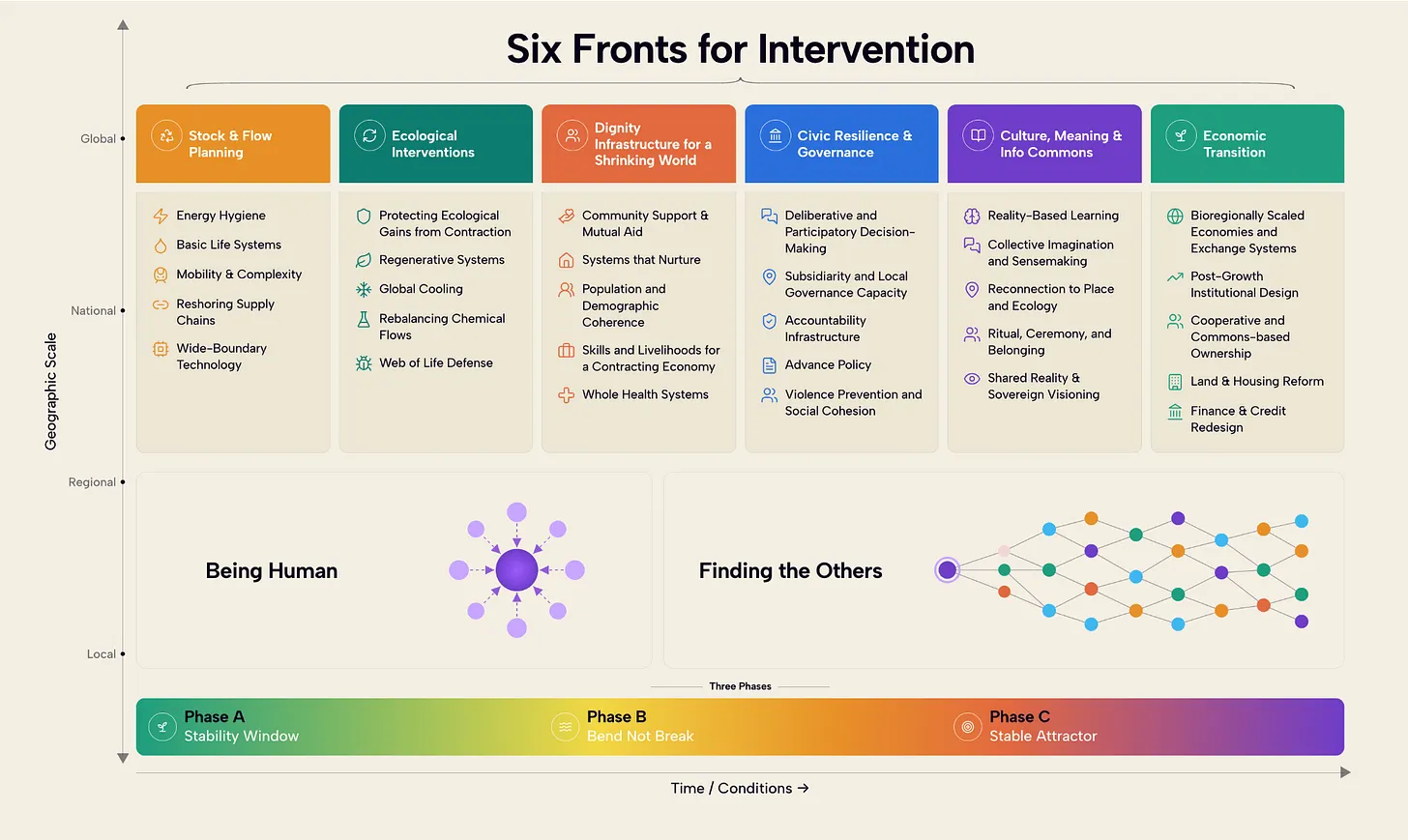
The map has four levels:
- A personal foundation
- A network and coordination layer
- Six broad fronts for interventions
- A timeline axis that runs across all of them
Here we go.
A Framework
The other day, I saw Ray Dalio had a piece out saying the Strait of Hormuz was “it,” and that our existing world order has broken down.
Someone on X asked Grok to summarize the post and it said,
“We’re in late stage: post-WWII order crumbling amid U.S.-China tensions, debt bubbles, populism. Risk of capital wars, devaluation, hot conflicts. Advice: Sell debt assets, buy gold to hedge inflation/monetary chaos.”
Even when standing at the edge of civilizational disruption, our cultural reflex is: how do I position my portfolio?
I do think Dalio is right. We have crossed the Rubicon now even if there is a TACO, or oil tankers have escorts, or the U.S./China summit is a proximate success.

What’s happening now is a different scale of problem than the Great Financial Crisis or Covid. Those were centered around financial leverage and a pandemic that highlighted financial leverage. This is about the international pipeline, distribution system, and recipients of fossil pixie dust, as well as who is on whose side in a dissolving world order. It’s like when you see a lightning strike and count how many seconds before the sound of thunder arrives. The storm might still be a ways off, but it is a storm…and a big one.
Level Zero: The Guide to Being Human Right Now
So, how do we prepare for this storm?
Before anything else – before strategy, before interventions, before picking a domain of concern and going to work – my work over the past two decades has led me to a conclusion I once would have thought was “woo.”

I’m going to call it a “Guide to Staying Human” for now. That framing might sound like self-help, that I’m about to tell you to meditate and drink water and everything will be fine. That is not what I’m suggesting.
What I’m saying is the inner work for us as individual humans – stabilizing our nervous systems, recapturing our sense of agency, stepping back from the addictions mediating our relationships to reality, and doing the grief work this moment actually requires – is all a precondition for effective action.
A nervous system constantly in sympathetic mode cannot hold complexity. A person in chronic fight-or-flight cannot build coalitions. A mind that is addicted to outrage, or to doom-scrolling, or to the dopamine cycle of social media engagement is not a mind that is available for the kind of patient, long-horizon work that this unfolding moment demands.
So know yourself and your actual situation. Not the situation you wish you were in or the situation you fear you’re in, but the real one – financially, physically, socially, geographically. Get your own house in order, both your actual living situation and your ‘inner house’.
Cultivate equanimity, rather than detachment or resignation. Equanimity is the capacity to hold difficulty without being destroyed by it; to act without needing certainty; to grieve without collapsing.
This “staying human” inner work is step one for everyone, including myself, and I will have an upcoming 8-10 part series on the stepping stones in this process. I’m not claiming domain expertise here. I’m naming what’s been foundational in my own experience.
This work is the foundation – the launchpad for everything else.
Level One: Find the Others

The next level, and this also foundational before the six fronts of intervention, is finding the others and building capacity.
None of what follows can be done alone, and very little of it can be done by people who don’t share a reasonably common language and framework. One of the most effective things you can do right now is to identify the people around you – locally and in your broader networks – who see the general shape of what’s happening and are trying to respond to it seriously, even if they don’t have specific plans. If there aren’t many around you, then perhaps start conversations in your community to bring more people into this group.
This level is about building trusted networks and mapping your constituency: Who are the people whose cooperation you actually need? It means developing shared mental models and a shared vocabulary, so that when something happens – a financial shock, supply disruption, or political crisis – you’re not trying to start the conversation from scratch and can jump into the response, instead of explaining the background and premises.
It means scenario planning and examining shortfall risks. Not predictions – nobody is predicting the future here – but thinking through the various branches of the probability tree. What if the financial system seizes up faster than expected? What if energy prices spike and don’t recede but stay there? What if the political situation in your country moves sharply in one direction or another? What are the shortfalls in food, energy, medical supplies, and social cohesion that you need to be prepared to navigate? Some of the “staying human” practices will help, but it will be exponentially better if these are shared with others.
Put into action, this is building response capacity, constituency, and trust infrastructure. It creates the space to transfer critical practical knowledge and skills.
This is the connective tissue. It is neither glamorous nor dramatic – actually quite the opposite. But it will make all the other things much more possible. I’m keeping this brief, but all this is important, foundational, and contributes to ideas like rocks in the river, islands of coherence, and seeding the cultural mitochondria that are at the core of this channel.
The Scenarios We’re Planning For

Before getting into intervention, a note on how to think about the future scenarios we’re preparing for. If you’ve been following my work, you might be familiar with the 4 scenarios I often use to describe the future: Green Growth, Mordor Economy, The Great Simplification, and Mad Max. They form a simple two-by-two grid. One axis represents whether the global economy keeps expanding or whether it begins to contract from today’s level of throughput. The other axis is whether that growth or contraction happens in a way that stays closer to ecological limits or stays in overshoot and remains fundamentally extractive as opposed to regenerative. I used this framing because it gives people an immediate sense of direction – it’s an oversimplification but helps us orient.
But those four scenarios are mostly using an economic lens for future pathways. Over time, I’ve recognized that I smuggled a lot of other things into these scenarios without naming them: politics, social cohesion, technology, geopolitics, and the state of the biosphere. All of these things are running in parallel, and they will shape what any “economic scenario” would actually feel like to live inside.
In a previous Frankly, I unpacked several other grids, in addition to the economic two-by-two, to help clarify the texture of possible futures.

One of these grids has to be governance. This represents whether institutions are broadly legitimate – meaning people still consent to the rules – and whether they have capacity – meaning they can execute and maintain basic functions. An economic contraction under high legitimacy and high capacity is a very different world than contraction under low legitimacy and failing capacity, even if the GDP chart looks similar.

Another grid is the political economy. Ownership refers to who has the legal claim on the productive base: land, energy, housing, finance, platforms, and infrastructure. Equality is about how those structures show up in lived outcomes: whether most people can afford stability, whether status anxiety is constant, and whether daily life feels dignified or precarious. This grid also acts as an indicator for how much autonomy an average individual has – or at least feels like they have – in shaping the rules, incentives, and outcomes for our human systems.

And then there’s the grid of the ecological backdrop itself. Climate stress and biosphere integrity each determine how forgiving the planet is. There’s an overlap, but each of these factors will shape how frequent environmental shocks arrive (like natural disasters and food shortages), how fast systems recover, and how difficult it becomes for us to rebuild when things break.
I bring up these grids ahead of the six fronts for intervention not to multiply possible scenarios for the sake of complexity, but to encourage us to avoid treating the future as a single storyline. Real futures will arrive as bundles. These scenarios are a way to name these bundles clearly enough that we can plan without pretending we can predict.
So we have a range of economic, institutional, political, and ecological scenarios that contain many overlapping possibilities. This matters because the six interventions I’m about to describe are not contingent on which flavors of these scenarios arrive. They don’t require us to bet on a single future. They are the things that are worth doing in Green Growth, worth doing in the Mordor Economy, and worth doing in The Great Simplification. The scenarios change the texture, timeline, and difficulty of the work, but they don’t change the nature of it.
Level Two: Six Fronts for Intervention

From that foundation – a stable self, trusted network, and a shared understanding of reality – we move into the actual domains of intervention. I’m organizing these into six large umbrella categories. Within each umbrella there are sub-domains that each deserve their own treatment, and we’ll return to those in depth on this platform.
Front One: Stock-and-Flow Planning
This is the most material and tangible domain. It’s about the physical systems that coordinate energy, food, water, and people – and what happens to those systems as the assumptions underlying their design become unreliable.
Most of our physical infrastructure was designed for a world of cheap, abundant, and globally-sourced energy and materials. That world is now ending, possibly rapidly. The response is to redesign or ‘MacGyver’ systems at scales that are affordable to use and maintain without ultra-cheap fossil pixie dust. This means making them more local, redundant, proximity-based, and resilient to disruption. Importantly, this has as much or more to do with reducing our throughput requirements than with swapping in alternative energy tech. Localization and re-regionalization here are more than slogans – they are design principles themselves.
I see at least five sub-domains within this front, each of which will get its own treatment on this channel:
- Energy Hygiene: How do communities fulfill basic energy needs when centralized grids become less reliable or less affordable? This starts with understanding how much energy you currently use, where that energy comes from, and what risks are posed to that system. Then, looking at how to build redundancy into your system through regeneration, storage, layered-distribution, and perhaps most critically, demand reduction. The specific technologies and systems will likely look different depending on where you’re located.
- Basic Life Systems: The basic infrastructure that keeps people safe and living their lives with minimal disruption – food, water, housing, and sanitation. For each of these, how can they be adapted to use local inputs and production, regional distribution, and working regeneratively with local ecosystems and their weather patterns – rather than against. On top of that, how can we retrofit our current built environment to better fit these criteria? We’d do well to consider all of this, while still attempting to maintain the minimum necessary access for community members.
- Mobility and Complexity: How food, goods, and people move within and between regions when fuel costs rise or become unstable. Currently each of these are primarily dependent on diesel or gasoline powered vehicles. For some goods and uses, that might remain the best choices – but how might trains, bikes, public transport, or other systems increase our options, reduce our energy and material use, and fit better for a more localized system?
- Reshoring Supply Chains: Many critical goods – such as modern medicine, industrial materials, and high-tech components – are dependent on globalized manufacturing. As the world becomes more disconnected and shipping becomes more costly or riskier, this vulnerability will become acute very quickly. How do we support the health, well-being, and basic needs of people on a local and regional scale?
- Wide-Boundary Technology: Innovation, application, and regulation of technologies that utilize that material from the region, with less energy, and higher efficiency – and that actually shift paradigms to benefit humanity and the biosphere. This category helps underwrite what is possible along the rest of these fronts – from communication and coordination systems, to energy production facilities, to materials that can assist with weatherization. What falls under this category includes everything from Goldilocks and Low-tech Innovations to thinking about how to practically regulate and use artificial intelligence to aid in the broader work.
Front Two: Ecological Interventions
I’ll say something here that I think is important and underappreciated – and that I expect will be controversial.
Most of the positive climate outcomes we are likely to see in the next twenty years will not come from technology, they will come from curtailed economic expansion driven by the very forces I described at the beginning of this essay: war, debt, and energy depletion. We already got a preview of this during the pandemic as economic activity halted. Industrial activity contracting is not a climate policy, but it is a climate outcome.
This doesn’t mean technology is irrelevant, it means we need to be honest about what technology can and cannot do and then allocate resources accordingly. Adaptation technology? Yes, urgently. Carbon drawdown and “global cooling?” Where it is genuinely viable at scale and based in ecological and energetic reality. But the fantasy that we will “tech” our way through global heating while maintaining current economic throughput is a psychological crutch, not a plan.

So what does ecological intervention actually look like in practice? I see five sub-domains here, and this is my personal North Star, so I’ll have a lot more to say on each of these in coming months:
- Protecting ecological gains from contraction: This may be the most important idea in this front. As economic activity contracts, there will be passive ecological benefits: forests regrowing, fisheries recovering, and emissions falling. The danger is that those gains get immediately erased by desperate hunger for more resource extraction amidst a shrinking substrate. Someone has to be deliberately protecting them if we want them – and us – to survive into the future.
- Regenerative Systems: local food systems that rebuild soil rather than deplete it, work with watershed flows to preserve the aquifers, and make efficient use of land to prevent converting more wild ecosystems into farmland. This is where food security, water access, and ecology converge, and it’s one of the most actionable things at a community scale. These three factors will increasingly define limits in the next several decades.
- Global Cooling: Slowing the warming molecules we’re emitting into the atmosphere and engaging in cooling ecological techniques and technologies. We’ll need these to both capture warming molecules previously emitted and lower localized temperatures through things like vegetation, higher albedo, and increased shade cover.
- Rebalancing Chemical Flows: The Earth is not only regulated by a balance of heat, but also has a delicate balance of all sorts of chemical flows. Nitrogen and phosphorus are important examples of these for agriculture – realignment of which will be important for food production in the future. Ocean acidification is a result of excess carbon chemically transforming and increasing pH – potentially resulting toxic noxious gases at extreme levels. And that’s not to mention our industrial chemical waste streams polluting our water, soil, and air – ultimately messing with the health of us and other wild animals. Rebalancing these flows is a critical component of maintaining biospheric integrity.
- Web of Life Defense: intensely defending what locally and globally remains, protecting rare untouched ecosystems, bolstering biodiversity, and connecting fragmented habitats so that species have a chance of adapting to what’s coming. This is a critical piece in preserving the connective natural relationships that have cradled humanity up until this point.
Front Three: Dignity Infrastructure for a Shrinking World
I decided to put this third, and here’s why: The people who have the luxury of thinking about frameworks, timelines, and six-domain maps are, by definition, not the people who are most at risk. Any framework that doesn’t center the people who already have very little now – and the people who will be dispossessed relatively soon – isn’t a real response to the more-than-human predicament. It’s a strategy for the comfortable.
This second front is about people who have materially close to nothing today, and people who will lose their means of livelihood in the relatively near future as financial systems contract, as jobs are automated or disrupted, and as global supply chains recede.
I’ll use the term “dignity infrastructure” deliberately here, because there is a massive difference between systems that keep people alive and systems that treat people with dignity and capacity.

Within this front I see five sub-domains. Local philanthropists, or just citizens, take heed – these are going to soon be sorely needed:
- Community Support and Mutual Aid: decentralized, community-led networks of support for basic needs like food, shelter, water, and medicine. This is fundamentally different from charity delivered from above, and it scales horizontally rather than vertically.
- Systems that Nurture: elder care, child care, disability support, and the recognition that this work is the backbone of every functioning community, with proportional support for the primary providers.
- Population/Demographic Coherence: Social infrastructure and planning for how to absorb the demographic changes built into the future – from climate and violence refugees to the declining and aging populations. How will we coordinate among our neighbors – new and old – to maintain the social fabric of our communities?
- Skills and Livelihoods for a Contracting Economy: practical, local, and adaptive capacities. We need to be equipping people for the economy that is actually arriving, not retraining them for one that is ending.
- Whole Health Systems: Taking care of our health is not only about addressing the physical systems underwriting our healthcare systems, it’s also about the social and value systems that coordinate and shape how we care for our health. From physical to mental wellness, this broad category includes not only access to care through things like affordability and geography, but also how we prioritize and educate on personal health in our jobs, relationships, and routines.
Front Four: Civic Resilience and Governance
This front is about the decision-making architecture of societies under stress.
The central challenge is this: the decisions we will have to make in the coming decades about energy, land, who bears the cost of contraction, and what gets maintained versus let go are decisions that require legitimate, adaptive, and participatory governance. We are heading into that period with governance institutions that are, in most places, deeply eroded and whose power has become concentrated.
Critically, woven throughout different subcategories of this front are geopolitical issues that determine the large-scale well-being – and survival – of the human species and large, complex life. These include things like mitigating the risk of nuclear war, stability of international trade, the preservation of sovereignty at lower levels of governance, and AI regulation.
Here are some sub-categories in this front:
- Deliberative and participatory decision-making: citizens’ assemblies, sortition-based processes, and the kind of structured public participation that Audrey Tang and the Taiwan project have demonstrated is actually possible (Check out TGS #169 Digital Democracy: Moving Beyond Big Tech to Save Open Societies for more on this). This has been practiced, it has worked, and it has produced better decisions for long-term well-being than election-driven alternatives.
- Subsidiarity and local governance capacity: decisions made at the lowest appropriate level, which in many cases is probably much more local than we currently assume. Communities need the ability to govern their own resource allocation when higher-level institutions can’t or won’t.
- Accountability infrastructure: mechanisms for accountability that survive crisis conditions and circumvent blame. This will matter even more during contraction, because the temptation to capture and loot during disruption will be large – and without systems in place, decision-making capacity will quickly erode.
- Advance policy: ombudsmen for the future, intergenerational governance bodies, and institutions designed to hold the long-view when political cycles shorten under stress. Such a governmental body would be isolated from the headline driven political cycles of today, holding the protection and well-being of future generations above all else.
- Violence prevention and social cohesion: When economic disruption moves fast and people have no narrative for why their lives are falling apart, the most dangerous thing that can happen is scapegoating – which can quickly dissolve into violence and the fracturing of society. This feels like one of the most important elements for preserving the integrity of our governance institutions – but also furthest from my expertise, so I’ll plan on bringing in some experts to shed some light on this in the future.
Front Five: Culture, Meaning & Info Commons
This front is the hardest to talk about in a framework because to label it as an intervention is against its own grain. We can’t build culture the way you build a water system, but we also can’t build a water system – or sustain any of the other five fronts – without a cultural substrate that makes collective effort feel meaningful rather than futile.
This gets back to Marvin Harris’ cultural materialism and “superstructure.” It’s the stories we tell about who we are, what a good life looks like, what we owe each other, and our relationships to the non-human world. Most of the stories currently running in our heads were written during a growth economy that needed us to be consumers first and citizens second. Those stories are now actively working against us.

I’ve come up with five sub-categories here:
- Reality-based learning: not just curriculum, but the fundamental question of what we’re preparing young people for. The current system is still training people for a growth economy that will not exist in the form they expect.
- Collective imagination and sensemaking: the role of arts and creative work in helping communities grieve, adapt, and imagine. This is not a luxury, it is how human groups have always metabolized disruption to continue working together.
- Reconnection to place and ecology: Understanding and embodying the difference between living somewhere and being from somewhere – and knowing a place’s ecology, seasons, vulnerabilities, and gifts. Communities that are rooted in place will navigate what’s coming very differently from communities that are not.
- Ritual, ceremony, and belonging: shared, connective experiences that market economies have systematically stripped away and that human beings cannot do without. When consumer substitutes for belonging fall away, communities will need real experiences of belonging.
- Shared reality and sovereign visioning: the capacity of communities to tell their own story and find their own vision for the future rather than have it told for them by algorithms, demagogues, or strangers with large followings. In a period of disruption, the communities that hold together will have a strong enough shared cultural narrative to metabolize hardship without breaking apart. This is not a soft category, it is essential and has the ability to bear weight.
Front Six: Economic Transition
The previous front is about the stories we live inside, while this one is about the structures those stories are embedded in, and which structures we need to build as the current ones fail or contract.
The economic transition front starts from a simple observation: that we aren’t going to grow our way out of overshoot. That means the institutions, incentives, and ownership structures that were designed to facilitate growth will increasingly become liabilities, rather than assets. The question is what replaces them – and whether we build the replacements deliberately or stumble into them under crisis conditions.
I offer five sub-domains within this front:
- Bioregionally scaled systems: local currencies, barter networks, community-level markets, and banks rooted to the regional scale. These are parts of resilience infrastructure for communities whose connection to global supply chains becomes unreliable and for when traditional job markets contract. These bioregionally based systems will also play a critical role in bringing physical infrastructure, supply chains, and logistics to a more local level.
- Cooperative and commons-based ownership: forms of ownership and governance that are neither state-run nor privately extractive and have a long track record of maintaining community assets across generations. These models already exist, but they need to be scaled and adapted.
- Post-growth institutional design: building institutions that can sustain human well-being without requiring expansion to function. This is more of a social engineering problem than a political preference.
- Land and housing reform: who owns the land, who has access to shelter, and on what terms. As financial systems contract, the ownership structures around land and housing are going to become some of the most politically charged questions in every society.
- Finance and credit redesign: how do communities manage debt, savings, and investment in a world where the current financial system is producing more claims than can be honored?
A word on sequencing here: many people in this space believe the types of transformations I just outlined are a precondition for everything else – that we can’t do ecology, governance, or infrastructure without first dismantling extractive ownership and growth-based capitalism. I understand the argument and the sentiment but I think ongoing events and the timeline are going to demand parallel construction. We build the new structures while the old ones are still standing, not after they’ve collapsed. Because waiting for the precondition would mean waiting forever.
And not to further complicate this map, but each of these six fronts can be approached at different scales: community/local, bioregional, national, and global. And yes – we’ll need people working at all the levels.
So here are the six fronts:
- Infrastructure and Physical Stack-and-Flow Planning
- Ecological Interventions
- Dignity Infrastructure for a Shrinking World
- Civic Resilience and Governance
- Culture, Meaning & Info Commons
- Economic Transition
These are not offered as a menu – you don’t pick one and ignore the rest. They are, as The Great Simplification community is undoubtedly aware, interdependent.
The Necessary Caveat
Before I turn to timelines, I need to say something directly. With sensitivity, because I hold a lot of sympathy for the people it’s aimed at, but also without softening it.
Many of the people who are most awake to the seriousness of what’s happening are people who are opposed to ecological destruction, capitalism, colonialism, patriarchy, and the like. These are people who want humans to reconnect to nature and respect the web of life. People who want justice – genuine, deep, structural justice – before anything else.
I hold many of these values. I believe there is much in those critiques that’s correct. With that said, these political ideologies should not be mistaken for a plan. Naming the system, even naming it correctly, without a viable intervention strategy is, at this scale and speed of overshoot, often a distraction – and sometimes even counterproductive.
I’m not arguing that people abandon their values, I’m arguing for us to move from critique to intervention. From naming what’s wrong to building what comes next, inside the constraints of what is actually possible and on the actual timeline we are in.
Level Three: The Timeline Phases
That brings us to the timelines and perhaps the most important orienting idea in this whole framework: We are not in one moment, we are in three overlapping moments simultaneously.

Here I’m calling them Phase A, B, and C. The interventions that are appropriate, possible, and necessary differ dramatically across them.
Phase A: The Stability Window (Right Now)
In many parts of the world, we are still in a period of relative stability. Systems are still connected. Surplus still exists. International coordination is still relatively possible. The institutions, however eroded, are still mostly functioning.
This window is finite, and many of us – especially in the last few weeks – are increasingly aware that it is closing. We just don’t know exactly how fast. But everything that can only be built in stability – institutional trust, physical infrastructure, knowledge transfer, and relationships – has to be built now, in this window, before conditions change.
Phase B: Bend Not Break
Phase B is already beginning in many places and will arrive with increasing clarity everywhere: financial shocks, supply disruptions, social fracture, geopolitical reorganization, and more people struggling to meet basic needs.
The work in Phase B is fundamentally different from the work in Phase A. In Phase A we’re building and preparing. In Phase B we’re largely triaging: maintaining critical functions, bridging communities through rupture, preventing cascades from becoming collapses, and holding deliberative space open when authoritarian shortcuts look appealing to a lot of people. This is the “Bend or Break” moment I’ve sometimes referenced on this channel.
The error of Phase B is either freezing – being unable to act because the situation is so far outside our previous experience – or capitulating to shortcuts and the abandonment of the long-view because the short-view becomes so overwhelming.
Phase C: The Stable Attractor
Phase C is not a place we arrive at by skipping A and B – I’m sorry to say that those phases can’t be skipped. Phase C is the destination that gives meaning and direction to the work of A and B.
What does it look like? Regenerative, resilient, human-scale, embedded in local ecology, equitable in a way that does not depend on infinite growth to fund redistribution, and rich in meaning, social connection, and all the things that actually make human life good.
This is the world where the values that animate the opposition to capitalism, ecological destruction, and patriarchy actually have a home – not because someone declared them into existence, but because the structures that produced the opposite have failed and been replaced by something better. Something new has been built, painstakingly, from inside the chaos of Phases A and B.
The long game is real. The stable attractor is real. But it is built from inside the disruption, not after it.
I put the timeline here, after the six fronts, for a reason. Each of those fronts has Phase A work, Phase B work, and Phase C work.
But the three phases are not independent of each other. What we build in Phase A sets the initial conditions for how Phase B might unfold, and how Phase B unfolds determines what Phase C could become. This is path dependence at a civilizational scale.
If we take this idea seriously, our starting point in Phase A means the current attractor in Phase C is a Mordor or Mad Max scenarios – continued resource depletion and everyone for themselves until something critical (likely ecological) breaks. For the Phase C to possibly become something akin to The Great Simplification, we have to plant the imaginal seeds of such a stable attractor today, increasing the odds of bending rather than breaking and increasing the odds of better possible futures. That work starts today, and is the focus of this channel.
The relationships we build now, the infrastructure we put in place now, the governance capacity, trust, and ecological protections we fight for now – while there is still surplus and coordination capacity – all shape the initial conditions for everything that follows. All of the big and small moves we make in Phase A add up and cumulate to broaden the potential futures in the next phases.
Geographic Scale
The other dimension through which each of us carries out this specific work will be whether we’re working at the local, regional, national, or international level – or some combination of these. This is not to say these different levels don’t all affect each other, but some projects and actions will inherently be focused at a specific scale of impact.
For example, if you’re attempting to get more involved in and build your community’s capacity for collective decision-making, then you’re acting at the local level of Front Four toward Civic Resilience. In contrast, if you’re trying to push forward nuclear non-proliferation and geopolitical stability policy, you’re acting at the international level of that same front.
Making this distinction isn’t to isolate these areas of action, but rather to help us orient ourselves toward the type of work we’d be most effective at – and most enjoy.
Concluding Thoughts
Phew – this was both long and way too short.
I’ve spent twenty years understanding and describing the problem. I’m not done with that work – the diagnosis, details, and nuances all still matter. Events in the Strait of Hormuz are just one signal among many others that we are at a moment where the most important thing I can contribute is not to get better at describing the problem – though to be honest that would be easiest and most comfortable for me. What’s needed now is for me – for all of us – to explore the unknown and start mapping out what to do.
Want to Learn More?
If you would like to see a broad overview of The Great Simplification in 30 minutes, watch our Animated Movie.
You can also find additional resources on our website.
Want to support The Great Simplification podcast?
The Great Simplification podcast is produced by The Institute for the Study of Energy and Our Future (ISEOF), a 501(c)(3) organization. We want to keep all content completely free to view globally and without ads. If you’d like to support ISEOF and its content via a tax-deductible donation, please use the link below.
Featured image: Nate Hagens

••••
The Liberty Beacon Project is now expanding at a near exponential rate, and for this we are grateful and excited! But we must also be practical. For 7 years we have not asked for any donations, and have built this project with our own funds as we grew. We are now experiencing ever increasing growing pains due to the large number of websites and projects we represent. So we have just installed donation buttons on our websites and ask that you consider this when you visit them. Nothing is too small. We thank you for all your support and your considerations … (TLB)
••••
Comment Policy: As a privately owned web site, we reserve the right to remove comments that contain spam, advertising, vulgarity, threats of violence, racism, or personal/abusive attacks on other users. This also applies to trolling, the use of more than one alias, or just intentional mischief. Enforcement of this policy is at the discretion of this websites administrators. Repeat offenders may be blocked or permanently banned without prior warning.
••••
Disclaimer: TLB websites contain copyrighted material the use of which has not always been specifically authorized by the copyright owner. We are making such material available to our readers under the provisions of “fair use” in an effort to advance a better understanding of political, health, economic and social issues. The material on this site is distributed without profit to those who have expressed a prior interest in receiving it for research and educational purposes. If you wish to use copyrighted material for purposes other than “fair use” you must request permission from the copyright owner.
••••
Disclaimer: The information and opinions shared are for informational purposes only including, but not limited to, text, graphics, images and other material are not intended as medical advice or instruction. Nothing mentioned is intended to be a substitute for professional medical advice, diagnosis or treatment.
Leave a Reply